


1 lats – Latvia
Add to wishlist
Non-circulating coins
Commemoration: Coin of Life
Latvia
Context
Material
Diameter: 38.61 mm
Weight: 31.47 g
Silver Weight:: 29.11 g
Shape: Round
Composition: 92.5% Silver
Standard: Silver ounce
Magnetic: No
Technique: Milled
Alignment: Medal alignment

flip
References
KM: #
Numista: #51704
Value
Exchange value: 1 LVL
Bullion value: $73.07
Inflation-adjusted value: 2.05 LVL
Obverse
Description:
The reverse shows a mother embracing a child in golden swaddling clothes, with LATVIJAS REPUBLIKA inscribed in a semicircle at the top right.
Inscription:
LATVIJAS REPUBLIKA
Translation:
Republic of Latvia
Script: Latin
Language: Latvian
Engraver: Ligita Franckeviča
Designer: Ilmārs Blumbergs
Reverse
Description:
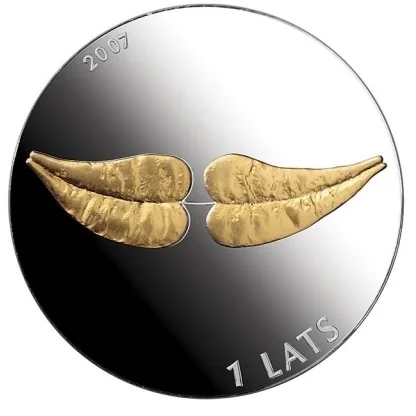
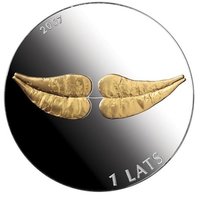
Centered are two golden heart-shaped leaves linked by a silver line. "2007" arcs at the top left, and "1 LATS" arcs at the bottom right.
Inscription:
2007
1 LATS
1 LATS
Script: Latin
Engraver: Ligita Franckeviča
Designer: Ilmārs Blumbergs
Edge
Plain
Mints
| Name | Mark |
|---|---|
| Monnaie de Paris | — |
Mintings
| Year | Mint Mark | Mintage | Quality | Collection |
|---|---|---|---|---|
| 2007 | — | 5,000 | Proof |
Historical background
In 2007, Latvia was in the final phase of its ambitious journey to adopt the euro, operating under a fixed exchange rate regime established in 2005. The national currency, the lats (LVL), was pegged to the euro within the European Exchange Rate Mechanism II (ERM II) at a central rate of 0.702804 lats to one euro, with a very narrow fluctuation band of ±1%. This peg was a cornerstone of macroeconomic policy, designed to ensure stability and signal the country's commitment to meeting the Maastricht convergence criteria for eurozone membership. The Bank of Latvia maintained this peg through active currency market interventions, building substantial foreign exchange reserves to defend the fixed rate.
However, this period of formal stability was overshadowed by growing internal economic imbalances. The Latvian economy was overheating, fueled by a massive credit boom and a surge in foreign capital, primarily from Scandinavian banks. This led to double-digit GDP growth but also caused rampant inflation, which peaked at over 14% by the end of 2007—the highest in the European Union. The inflation rate severely conflicted with the Maastricht criterion on price stability, creating a significant obstacle to the planned euro adoption timeline. The widening current account deficit, exceeding 20% of GDP, highlighted an economy consuming far more than it produced, raising concerns about long-term sustainability.
Consequently, while the currency peg itself remained firmly intact and unquestioned in the markets throughout 2007, economists and international institutions like the IMF began issuing strong warnings about the underlying vulnerabilities. The tension between the rigid exchange rate and the need to cool the overheating economy presented a major policy dilemma. Authorities prioritized maintaining the peg as a key anchor, betting that gradual fiscal tightening and administrative measures could control inflation without resorting to devaluation—a strategy that would be severely tested in the global financial crisis that erupted the following year.
However, this period of formal stability was overshadowed by growing internal economic imbalances. The Latvian economy was overheating, fueled by a massive credit boom and a surge in foreign capital, primarily from Scandinavian banks. This led to double-digit GDP growth but also caused rampant inflation, which peaked at over 14% by the end of 2007—the highest in the European Union. The inflation rate severely conflicted with the Maastricht criterion on price stability, creating a significant obstacle to the planned euro adoption timeline. The widening current account deficit, exceeding 20% of GDP, highlighted an economy consuming far more than it produced, raising concerns about long-term sustainability.
Consequently, while the currency peg itself remained firmly intact and unquestioned in the markets throughout 2007, economists and international institutions like the IMF began issuing strong warnings about the underlying vulnerabilities. The tension between the rigid exchange rate and the need to cool the overheating economy presented a major policy dilemma. Authorities prioritized maintaining the peg as a key anchor, betting that gradual fiscal tightening and administrative measures could control inflation without resorting to devaluation—a strategy that would be severely tested in the global financial crisis that erupted the following year.


✨ Legendary