

2 Jiao – Fukien Province
China
Context
Year: 1923
Country: China 
Issuer: Fukien Province
Period:
(1912—1949)
Currency:
(1896—1949)
Demonetized: Yes
Material
References
Y: #Click to copy to clipboard383
Numista: #51645
Value
Bullion value: $14.83
Obverse
Description:
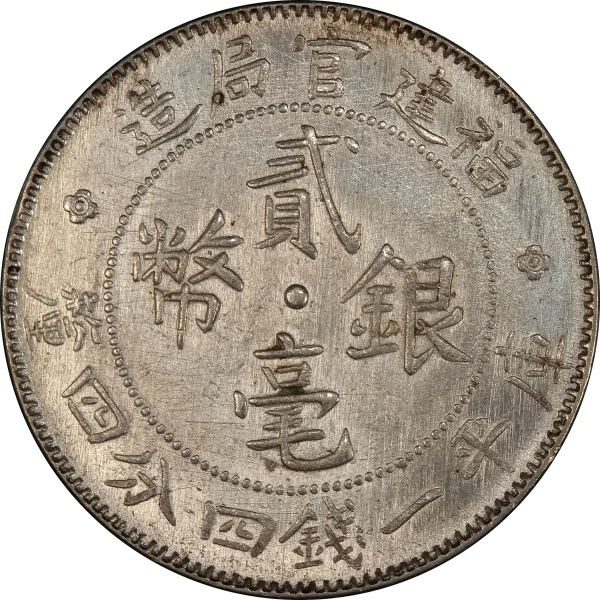
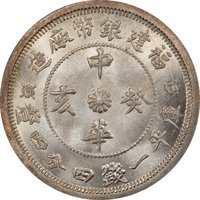
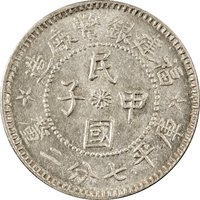
Four ideograms read vertically, right to left, encircled by more characters.
Inscription:
造局官建福
貳
幣銀
毫
釐四分四錢一平庫
貳
幣銀
毫
釐四分四錢一平庫
Translation:
Mint Official Jianfu
Two
Silver Coin
Mace
Candareen Four Candareens Four Mace One Tael Treasury Standard
Two
Silver Coin
Mace
Candareen Four Candareens Four Mace One Tael Treasury Standard
Language: Chinese
Reverse
Description:
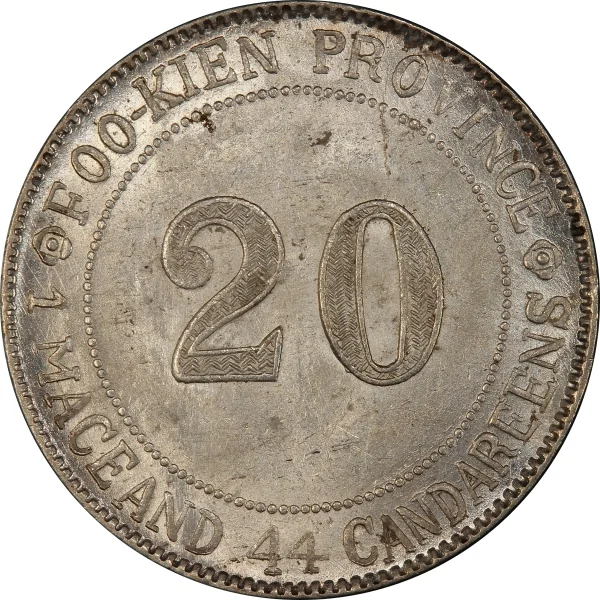
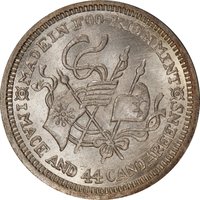
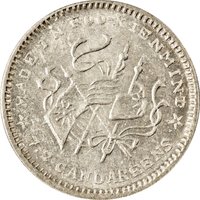
Value with English legend.
Inscription:
FOO-KIEN PROVINCE
20
1 MACE AND 4.4 CANDAREENS
20
1 MACE AND 4.4 CANDAREENS
Edge
Reeded.
Mintings
| Year | Mint Mark | Mintage | Quality | Collection |
|---|---|---|---|---|
| 1923 | — | — |
Historical background
In 1923, the currency situation in Fukien (Fujian) Province was one of profound complexity and instability, characteristic of the broader "warlord era" in China. The province was under the fractious control of military governor Li Houji, a member of the Anfu Clique, whose authority was contested by other local commanders and the southern revolutionary government. This political fragmentation was directly mirrored in the monetary system, which was a chaotic mix of competing instruments. No single authority had the power to issue a unified, trusted currency for the province.
The circulating medium comprised a confusing array of old imperial silver dragon dollars, foreign (particularly Mexican) silver dollars, and a flood of debased copper coins. Crucially, multiple entities issued paper money with little to no reserve backing. These included notes from the quasi-official Bank of China and Bank of Communications, but also from provincial banks, local commercial banks (qianzhuang), and even military commanders and merchant guilds to fund their operations. This led to severe regional disparities, where notes from one city might be heavily discounted or refused in another, crippling inter-regional trade.
The result was rampant inflation, frequent counterfeiting, and a deep loss of public confidence. Merchants and the populace increasingly relied on heavy silver coinage for any significant transaction, hoarding it and driving it out of daily circulation. This currency chaos stifled economic development, increased the cost of living for ordinary citizens, and served as a stark indicator of the breakdown of centralized governance. The situation would only begin to stabilize later in the decade after the Northern Expedition brought a degree of political reunification and monetary reform.
The circulating medium comprised a confusing array of old imperial silver dragon dollars, foreign (particularly Mexican) silver dollars, and a flood of debased copper coins. Crucially, multiple entities issued paper money with little to no reserve backing. These included notes from the quasi-official Bank of China and Bank of Communications, but also from provincial banks, local commercial banks (qianzhuang), and even military commanders and merchant guilds to fund their operations. This led to severe regional disparities, where notes from one city might be heavily discounted or refused in another, crippling inter-regional trade.
The result was rampant inflation, frequent counterfeiting, and a deep loss of public confidence. Merchants and the populace increasingly relied on heavy silver coinage for any significant transaction, hoarding it and driving it out of daily circulation. This currency chaos stifled economic development, increased the cost of living for ordinary citizens, and served as a stark indicator of the breakdown of centralized governance. The situation would only begin to stabilize later in the decade after the Northern Expedition brought a degree of political reunification and monetary reform.
💎 Very Rare