

12 xerafins – Portuguese India
Add to wishlist
India
Context
Years: 1817–1825
Country: India
Issuer: Portuguese India
Ruler: João VI
Currency:
(1706—1880)
Demonetized: Yes
Material
Diameter: 18 mm
Weight: 4.9 g
Gold Weight:: 4.90 g
Shape: Irregular round
Composition: Gold
Magnetic: No
Technique: Hammered
References
KM: #
Numista: #51442
Value
Bullion value: $762.86
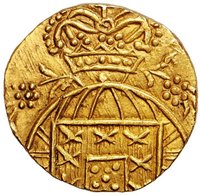
Obverse
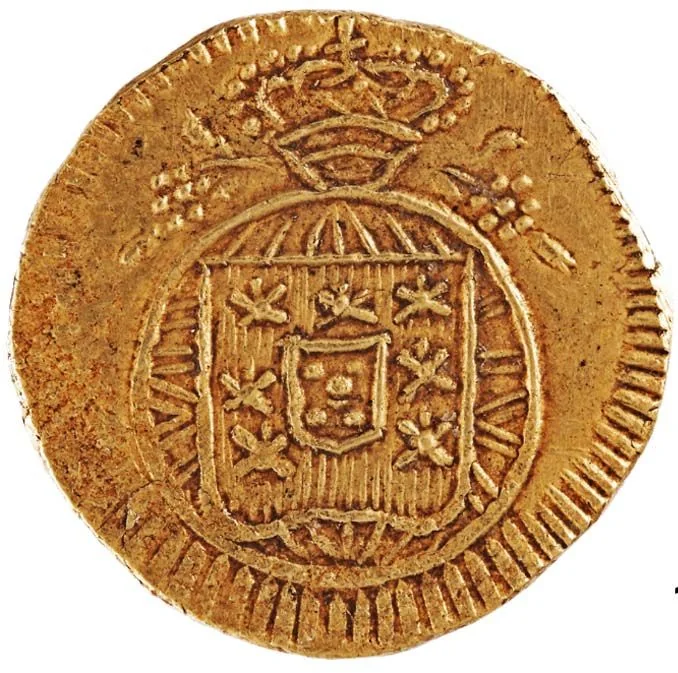
Description:
Miniature armillary sphere
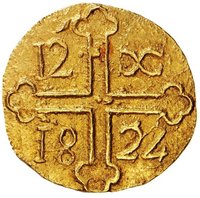
Reverse
Description:
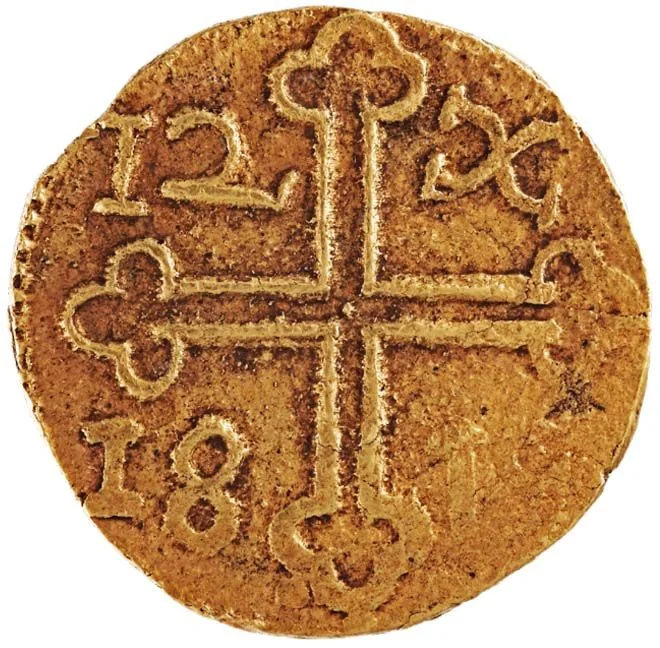
Cross of St. Thomas divides denomination and date.
Inscription:
12-X
18-20
18-20
Script: Latin
Edge
Mints
| Name | Mark |
|---|---|
| Goa | — |
Mintings
| Year | Mint Mark | Mintage | Quality | Collection |
|---|---|---|---|---|
| 1817 | — | — | ||
| 1819 | — | — | ||
| 1820 | — | — | ||
| 1822 | — | — | ||
| 1825 | — | — |
Historical background
In 1817, the currency situation in Portuguese India, centered on the territories of Goa, Daman, and Diu, was characterized by profound complexity and monetary instability. The official currency was the Portuguese Indian Rupia (or Rupia de Goa), but its circulation and value were overwhelmed by a chaotic mix of competing coins. The most dominant foreign currency in daily use was the British Indian Silver Rupee, particularly the Madras rupee, which circulated widely due to the region's extensive trade with British territories. Alongside these, older Portuguese-era gold mohurs and silver xerafins, as well as a plethora of coins from other European trading powers and regional Indian states, created a fragmented and inefficient monetary environment.
This multiplicity of currencies created severe practical problems. Exchange rates between the various coins fluctuated constantly, hindering commerce and tax collection. The Portuguese administration struggled to enforce its own currency as the standard, as public trust and practical convenience favored the more stable and widely accepted British rupees. Furthermore, a chronic shortage of specie (coined money) was exacerbated by the export of silver to settle trade imbalances, leading to frequent complaints from merchants and officials about the scarcity of reliable coin for transactions.
The underlying cause of this monetary disorder was the eroded economic and political power of Portuguese India within the wider Indian Ocean context. By 1817, Goa was no longer a major commercial hub, and its fiscal weakness prevented Lisbon from imposing monetary order. Attempts at reform, such as the introduction of new copper bazarucos for small change, failed to address the core issue. Consequently, the currency situation reflected the territory's diminished status: administratively Portuguese, but economically integrated into and dependent on the British Indian monetary sphere, awaiting a comprehensive reform that would only begin to materialize in the 1830s.
This multiplicity of currencies created severe practical problems. Exchange rates between the various coins fluctuated constantly, hindering commerce and tax collection. The Portuguese administration struggled to enforce its own currency as the standard, as public trust and practical convenience favored the more stable and widely accepted British rupees. Furthermore, a chronic shortage of specie (coined money) was exacerbated by the export of silver to settle trade imbalances, leading to frequent complaints from merchants and officials about the scarcity of reliable coin for transactions.
The underlying cause of this monetary disorder was the eroded economic and political power of Portuguese India within the wider Indian Ocean context. By 1817, Goa was no longer a major commercial hub, and its fiscal weakness prevented Lisbon from imposing monetary order. Attempts at reform, such as the introduction of new copper bazarucos for small change, failed to address the core issue. Consequently, the currency situation reflected the territory's diminished status: administratively Portuguese, but economically integrated into and dependent on the British Indian monetary sphere, awaiting a comprehensive reform that would only begin to materialize in the 1830s.
✨ Legendary