

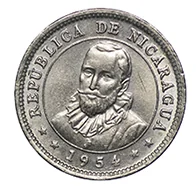
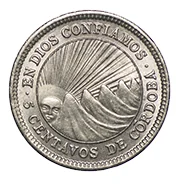
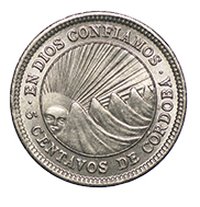
5 Centavos de Córdoba – Nicaragua
Nicaragua
Context
Years: 1946–1972
Issuer: Nicaragua 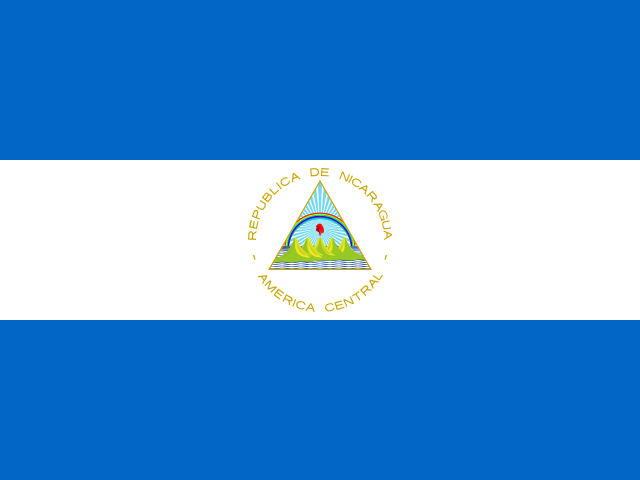
Issuing organization: National Bank of Nicaragua
Period:
(since 1854)
Currency:
(1912—1987)
Demonetization: 15 February 1988
Total mintage: 34,020,000
Material
References
KM: #Click to copy to clipboard24
Numista: #5141
Obverse
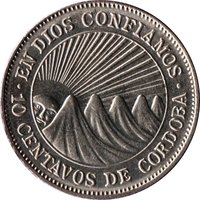
Reverse
Edge
Mints
| Name | Mark |
|---|---|
| Royal Mint (Tower Hill) | — |
Mintings
| Year | Mint Mark | Mintage | Quality | Collection |
|---|---|---|---|---|
| 1946 | — | 4,000,000 | ||
| 1946 | — | — | Proof | |
| 1950 | — | — | ||
| 1952 | — | 4,000,000 | ||
| 1952 | — | — | Proof | |
| 1954 | — | 4,000,000 | ||
| 1954 | — | — | Proof | |
| 1956 | — | — | Proof | |
| 1956 | — | 5,000,000 | ||
| 1962 | — | 3,000,000 | ||
| 1962 | — | — | Proof | |
| 1964 | — | 4,000,000 | ||
| 1965 | — | 10,000,000 | ||
| 1972 | — | 20,000 | Proof |
Historical background
In 1946, Nicaragua's currency situation was defined by the Córdoba, which had been the nation's official currency since 1912, replacing the peso. The system was relatively stable but operated under a managed exchange rate regime heavily influenced by the United States. This stability was largely artificial, propped up by Nicaragua's economic and political ties to the U.S., including the 1914 Bryan-Chamorro Treaty and the ongoing presence of U.S. financial advisors. The Córdoba was effectively pegged to the U.S. dollar, with its value maintained by the country's gold and foreign exchange reserves, primarily held in New York.
Economically, Nicaragua remained a single-export agrarian economy, heavily dependent on coffee and, to a lesser extent, bananas. This made the currency vulnerable to fluctuations in global commodity prices. While the immediate post-World War II period saw a brief boom for agricultural exporters, the underlying structure was fragile. The government of President Anastasio Somoza García, who consolidated power in the 1930s, exercised significant control over the financial system, using monetary policy and the state-owned National Bank of Nicaragua to support his regime's political and economic interests rather than pursuing broad-based development.
Looking ahead, the apparent stability of 1946 was precarious. The fixed exchange rate and dependence on a few agricultural exports created long-term vulnerabilities. These would eventually contribute to economic strain, leading to a significant devaluation of the Córdoba in 1947 and the introduction of a dual-exchange-rate system. Thus, 1946 represents the final year of a relatively stable but unsustainable monetary period before Nicaragua faced the pressures of currency adjustment and increasing inflationary trends in the late 1940s.
Economically, Nicaragua remained a single-export agrarian economy, heavily dependent on coffee and, to a lesser extent, bananas. This made the currency vulnerable to fluctuations in global commodity prices. While the immediate post-World War II period saw a brief boom for agricultural exporters, the underlying structure was fragile. The government of President Anastasio Somoza García, who consolidated power in the 1930s, exercised significant control over the financial system, using monetary policy and the state-owned National Bank of Nicaragua to support his regime's political and economic interests rather than pursuing broad-based development.
Looking ahead, the apparent stability of 1946 was precarious. The fixed exchange rate and dependence on a few agricultural exports created long-term vulnerabilities. These would eventually contribute to economic strain, leading to a significant devaluation of the Córdoba in 1947 and the introduction of a dual-exchange-rate system. Thus, 1946 represents the final year of a relatively stable but unsustainable monetary period before Nicaragua faced the pressures of currency adjustment and increasing inflationary trends in the late 1940s.
🌱 Common