

500 Schilling (Bregenz) – Austria
Non-circulating coins
Commemoration: 2000th Anniversary of Bregenz
Austria

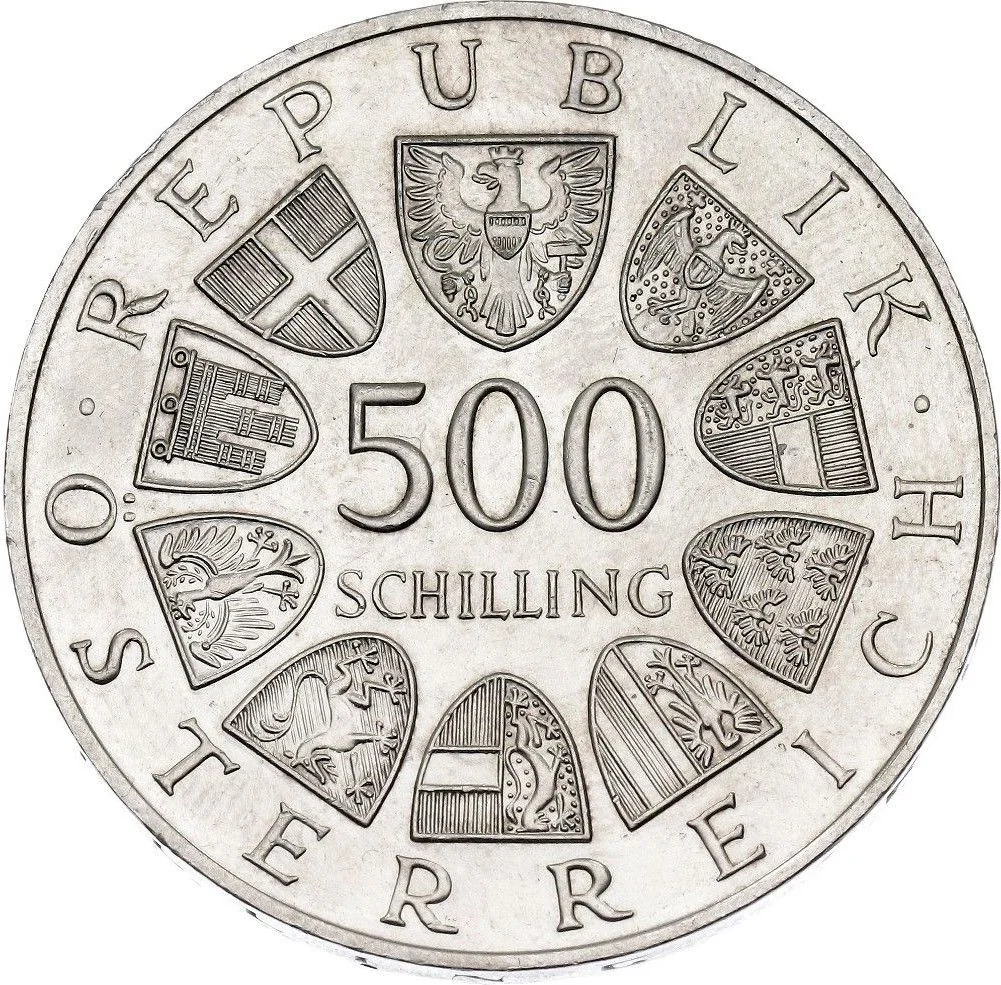
Obverse
Description:
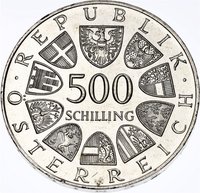
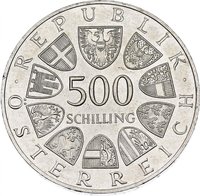
Shield-ringed value
Inscription:
REPUBLIK
ÖSTERREICH
500
SCHILLING
ÖSTERREICH
500
SCHILLING
Translation:
REPUBLIC
OF AUSTRIA
500
SCHILLING
OF AUSTRIA
500
SCHILLING
Script: Latin
Language: German
Engraver: Edwin Grienauer
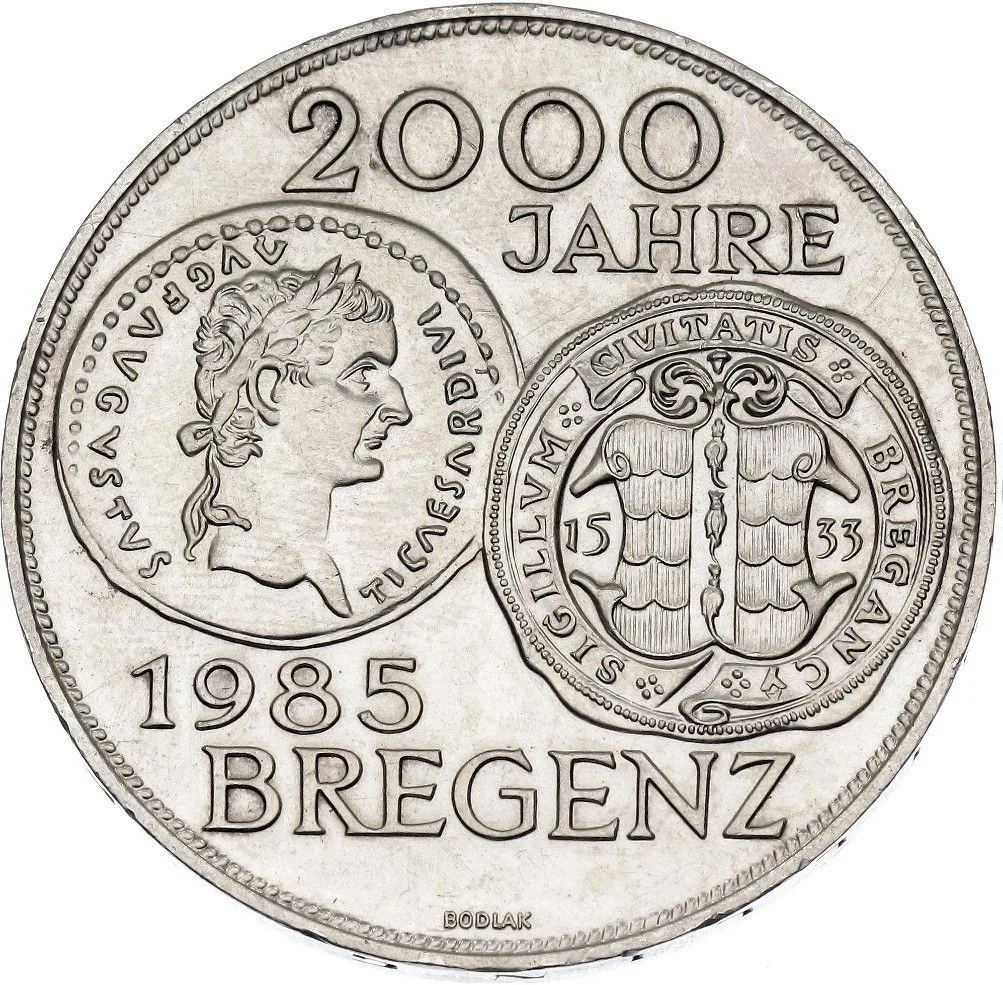
Reverse
Description:
Roman coin with laureate head right; right coin dated 1535 with shield of arms.
Inscription:
2000 JAHRE
1985
BREGENZ
1985
BREGENZ
Script: Latin
Engraver: Kurt Bodlak
Edge
Plain with inscription
Legend:
FUENFHUNDERT SCHILLING
Translation:
Five Hundred Schilling
Language: German
Categories
| Currency> Coin depiction |
| Symbols> Coat of Arms |
Mints
| Name | Mark |
|---|---|
| Münze Österreich | — |
Mintings
| Year | Mint Mark | Mintage | Quality | Collection |
|---|---|---|---|---|
| 1985 | — | 387,800 | ||
| 1985 | — | 112,200 | Proof |
Historical background
In 1985, Austria's currency situation was defined by stability and successful integration into the European monetary system, a notable achievement given the global economic turbulence of the previous decade. The Austrian schilling (ATS) was a strong and trusted currency, a status earned through a consistent and disciplined policy of "hard currency policy" (Hartwährungspolitik). This strategy, formally adopted in the 1970s, involved pegging the schilling closely to the Deutsche Mark (DM), the anchor currency of the European Monetary System (EMS). This linkage provided a crucial anti-inflationary discipline, as the Austrian National Bank (OeNB) committed to maintaining the exchange rate, thereby importing the monetary credibility of the German Bundesbank.
This policy framework delivered significant benefits. By shadowing the DM, Austria enjoyed low and stable inflation, which bolstered business confidence and facilitated long-term economic planning. The schilling's stability became a cornerstone of national economic identity, fostering a period of steady growth and high employment. While not a formal member of the EMS Exchange Rate Mechanism until 1995, Austria operated a de facto unilateral peg, which was widely accepted by financial markets and the public. This stability stood in contrast to the currency volatility experienced by some of its European neighbours during this period.
However, this stability came with a trade-off: the loss of autonomous monetary policy. To maintain the fixed exchange rate, Austria had to align its interest rates closely with those set in Frankfurt, regardless of domestic economic conditions. This meant that during the early 1980s, Austrian monetary policy was often tighter than it might have been if set independently, as it had to follow the Bundesbank's high-interest-rate stance aimed at combating inflation. Nevertheless, in 1985, the consensus within Austria was overwhelmingly in favour of this arrangement, viewing the schilling's strength and stability as a prerequisite for prosperity and a key step toward deeper European integration, which would culminate in the eventual adoption of the euro.
This policy framework delivered significant benefits. By shadowing the DM, Austria enjoyed low and stable inflation, which bolstered business confidence and facilitated long-term economic planning. The schilling's stability became a cornerstone of national economic identity, fostering a period of steady growth and high employment. While not a formal member of the EMS Exchange Rate Mechanism until 1995, Austria operated a de facto unilateral peg, which was widely accepted by financial markets and the public. This stability stood in contrast to the currency volatility experienced by some of its European neighbours during this period.
However, this stability came with a trade-off: the loss of autonomous monetary policy. To maintain the fixed exchange rate, Austria had to align its interest rates closely with those set in Frankfurt, regardless of domestic economic conditions. This meant that during the early 1980s, Austrian monetary policy was often tighter than it might have been if set independently, as it had to follow the Bundesbank's high-interest-rate stance aimed at combating inflation. Nevertheless, in 1985, the consensus within Austria was overwhelmingly in favour of this arrangement, viewing the schilling's strength and stability as a prerequisite for prosperity and a key step toward deeper European integration, which would culminate in the eventual adoption of the euro.
⭐ Rare