

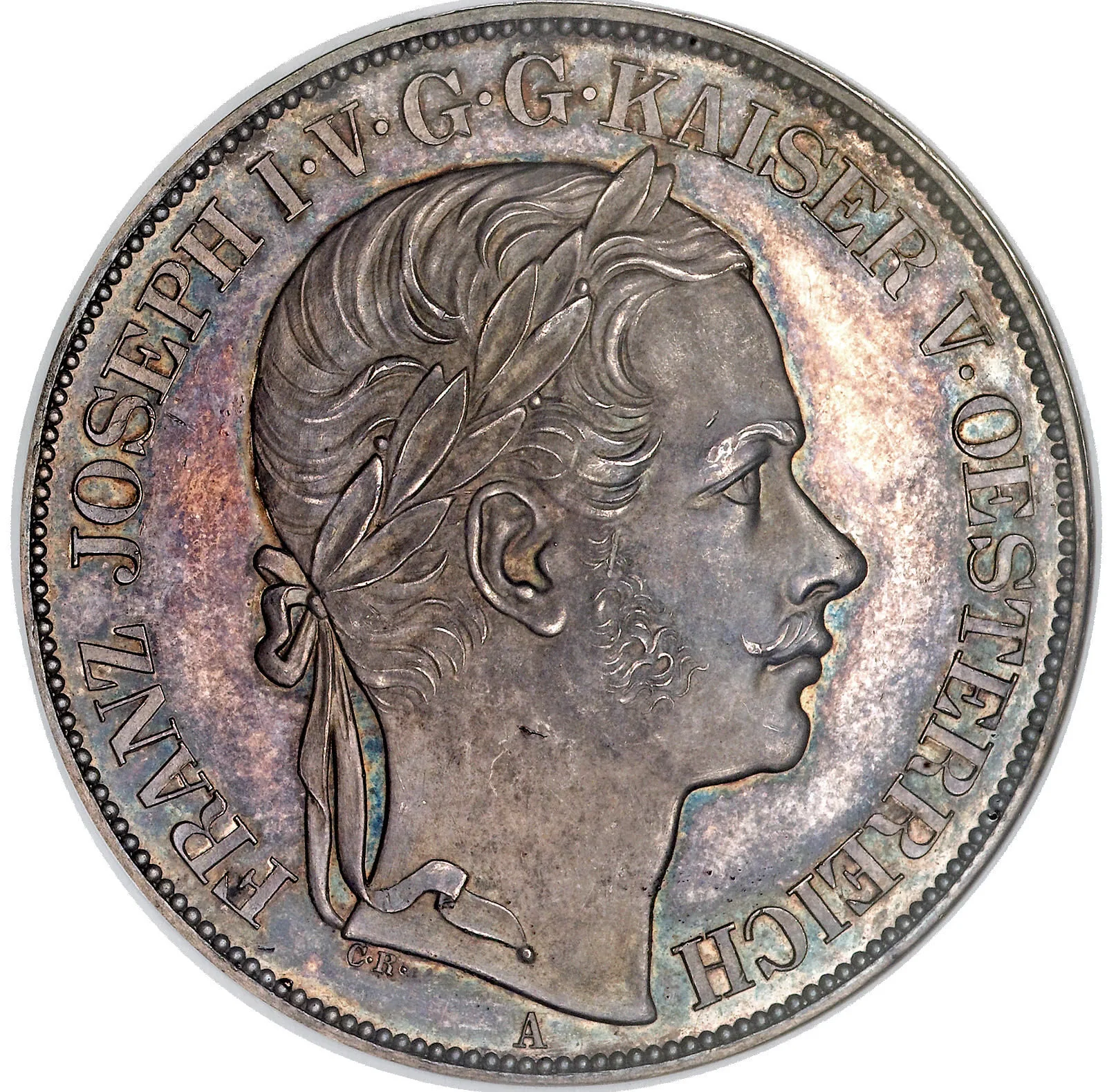
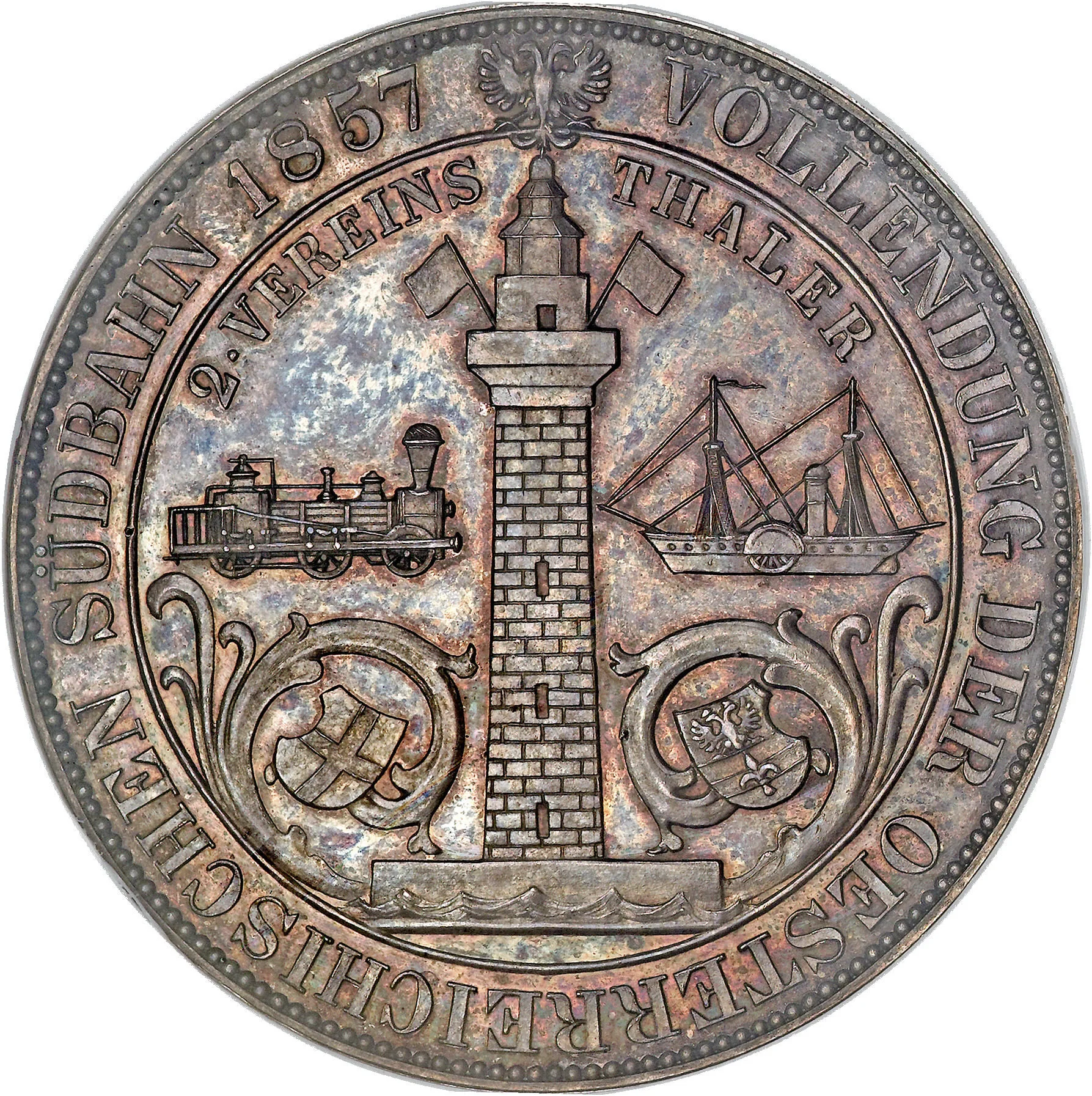
2 Vereinsthaler – Austrian Empire
Non-circulating coins
Commemoration: Completion of the South Austrian Railways
Austria
Context
Year: 1857
Country: Austria 
Issuer: Austrian Empire
Ruler: Francis Joseph I
Currency:
(1857—1892)
Demonetized: Yes
Material
References
Numista: #15153
Value
Bullion value: $92.41
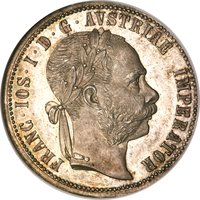
Obverse
Inscription:
FRANZ JOSEPH I·V·G·G·KAISER V·OESTERREICH
C·H·
A
C·H·
A
Translation:
FRANZ JOSEPH I, BY THE GRACE OF GOD EMPEROR OF AUSTRIA
APOSTOLIC KING OF HUNGARY
APOSTOLIC KING OF HUNGARY
Script: Latin
Engraver: Carl Radnitzky
Reverse
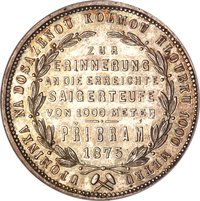
Inscription:
VOLLENDUNG DER OESTERREICHISCHEN SÜDBAHN 1857
2·VEREINSTHALER
2·VEREINSTHALER
Translation:
Completion of the Austrian Southern Railway 1857
2 Vereinsthaler
2 Vereinsthaler
Script: Latin
Language: German
Engraver: Carl Radnitzky
Edge
Plain
Categories
| Building> Lighthouse |
| Transportation> Watercraft |
| Transportation> Train |
Mintings
| Year | Mint Mark | Mintage | Quality | Collection |
|---|---|---|---|---|
| 1857 | A | — |
Historical background
In 1857, the Austrian Empire was grappling with a severe currency crisis that exposed the deep structural weaknesses of its monetary system. The empire operated on a complex and unstable dual system of paper and silver. The official currency was the silver Conventionsthaler, but the government, chronically short of funds due to military expenditures and debt, heavily relied on paper banknotes (Bancozettel) issued by the privileged Austrian National Bank. These notes were not fully convertible to silver, leading to frequent depreciation and a wide, fluctuating gap between their face value and their actual metallic worth. This created chronic uncertainty in both domestic commerce and international trade.
The immediate trigger for the 1857 crisis was the global financial panic that originated in the United States and spread rapidly across Europe. As international credit contracted, confidence in the already-suspect Austrian paper currency evaporated. A wave of withdrawals and a rush to convert paper into precious metal ensued, severely straining the reserves of the Austrian National Bank. The crisis was acutely felt in the empire's commercial centers, particularly Vienna, where numerous businesses and private banks faced insolvency, revealing the fragility of the financial sector.
The 1857 panic forced the Habsburg government to confront the unsustainable monetary situation directly. It culminated in the Imperial Patent of September 1858, which attempted a fundamental reform. This decree officially severed the link between paper money and silver, making the paper Gulden (the Vereinswährung) the sole legal tender for most domestic transactions, while mandating that international obligations be settled in silver (Valutawährung). This effectively created a forced paper currency and acknowledged the state's inability to guarantee convertibility, setting the stage for the more unified monetary reforms that would follow the 1867 Austro-Hungarian Compromise.
The immediate trigger for the 1857 crisis was the global financial panic that originated in the United States and spread rapidly across Europe. As international credit contracted, confidence in the already-suspect Austrian paper currency evaporated. A wave of withdrawals and a rush to convert paper into precious metal ensued, severely straining the reserves of the Austrian National Bank. The crisis was acutely felt in the empire's commercial centers, particularly Vienna, where numerous businesses and private banks faced insolvency, revealing the fragility of the financial sector.
The 1857 panic forced the Habsburg government to confront the unsustainable monetary situation directly. It culminated in the Imperial Patent of September 1858, which attempted a fundamental reform. This decree officially severed the link between paper money and silver, making the paper Gulden (the Vereinswährung) the sole legal tender for most domestic transactions, while mandating that international obligations be settled in silver (Valutawährung). This effectively created a forced paper currency and acknowledged the state's inability to guarantee convertibility, setting the stage for the more unified monetary reforms that would follow the 1867 Austro-Hungarian Compromise.
💎 Extremely Rare