

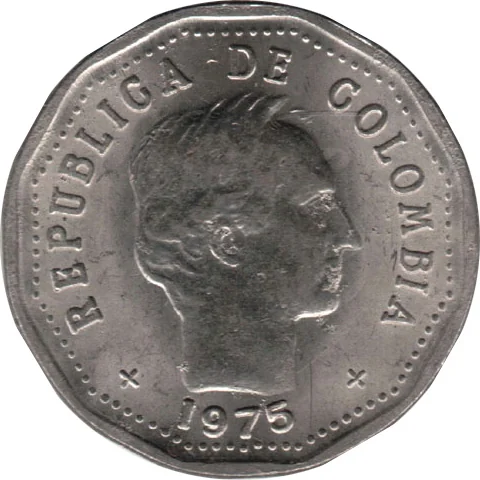
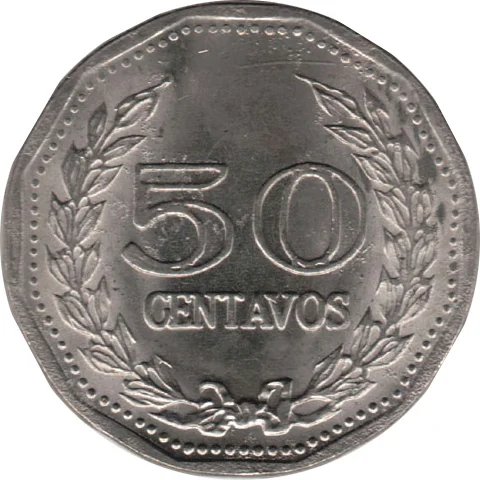
50 centavos – Colombia
Add to wishlist
Colombia
Context
Years: 1970–1980
Issuer: Colombia
Period:
(since 1886)
Currency:
(since 1847)
Total mintage: 204,226,000
Material
Diameter: 23.5 mm
Weight: 4.52 g
Thickness: 1.5 mm
Shape: Dodecagonal
Technique: Milled
Alignment: Coin alignment
flip
References
KM: #
Numista: #5098
Value
Exchange value: 0.50 COP
Inflation-adjusted value: 673.29 COP
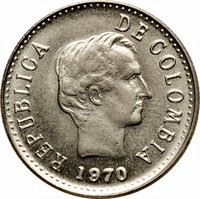
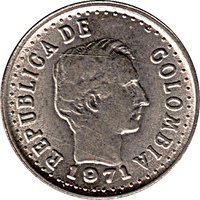
Obverse
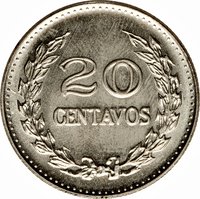
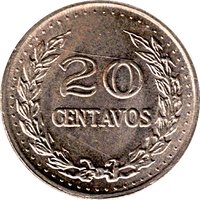
Reverse
Edge
Plain
Categories
| Person> Military leader |
| Person> Politician |
| Symbol> Wreath |
Mints
| Name | Mark |
|---|---|
| Bogota Mint | — |
Mintings
| Year | Mint Mark | Mintage | Quality | Collection |
|---|---|---|---|---|
| 1970 | — | 30,906,000 | ||
| 1971 | — | 32,650,000 | ||
| 1972 | — | 25,290,000 | ||
| 1973 | — | 8,060,000 | ||
| 1974 | — | 19,541,000 | ||
| 1975 | — | 4,325,000 | ||
| 1976 | — | 13,181,000 | ||
| 1977 | — | 10,413,000 | ||
| 1978 | — | 10,736,000 | ||
| 1979 | — | 22,584,000 | ||
| 1980 | — | 26,540,000 |
Historical background
In 1970, Colombia's currency situation was characterized by a managed exchange rate regime under the Bretton Woods system, with the Colombian peso pegged to the United States dollar. The official exchange rate was maintained at a fixed parity of 16.25 pesos per dollar, a rate established in 1967 following a significant devaluation. This devaluation, known as the "Crawling Peg" (minidevaluaciones), was a strategic shift from a rigid fixed rate to a system of small, frequent devaluations intended to boost exports by maintaining competitiveness, while controlling inflationary pressures and speculative capital flight that had plagued the previous decade.
The economic backdrop was one of moderate growth, but underlying pressures persisted. Colombia's economy remained heavily dependent on coffee exports, making it vulnerable to fluctuations in global commodity prices. While the crawling peg aimed to provide stability, it operated within a context of persistent, though moderate, inflation and ongoing concerns about the balance of payments. The government, under President Misael Pastrana Borrero (elected in 1970), maintained strict capital controls and exchange regulations to defend the parity and manage the limited foreign reserves, reflecting a cautious and interventionist monetary policy approach.
Overall, the currency framework in 1970 was in a period of cautious calibration. The system of gradual devaluation represented a pragmatic policy compromise, seeking to avoid the shocks of a sudden major devaluation while attempting to correct external imbalances. It laid a foundation for relative macroeconomic stability in the early 1970s, but the structure's dependence on careful government management left it exposed to future external shocks, most notably the coffee boom and bust cycles and the global economic upheavals that would follow later in the decade.
The economic backdrop was one of moderate growth, but underlying pressures persisted. Colombia's economy remained heavily dependent on coffee exports, making it vulnerable to fluctuations in global commodity prices. While the crawling peg aimed to provide stability, it operated within a context of persistent, though moderate, inflation and ongoing concerns about the balance of payments. The government, under President Misael Pastrana Borrero (elected in 1970), maintained strict capital controls and exchange regulations to defend the parity and manage the limited foreign reserves, reflecting a cautious and interventionist monetary policy approach.
Overall, the currency framework in 1970 was in a period of cautious calibration. The system of gradual devaluation represented a pragmatic policy compromise, seeking to avoid the shocks of a sudden major devaluation while attempting to correct external imbalances. It laid a foundation for relative macroeconomic stability in the early 1970s, but the structure's dependence on careful government management left it exposed to future external shocks, most notably the coffee boom and bust cycles and the global economic upheavals that would follow later in the decade.
🌱 Very Common