

1 Lats – Latvia
Non-circulating coins
Commemoration: Track Cycling
Latvia
Context

Material
References
KM: #Click to copy to clipboard44
Numista: #50912
Value
Exchange value: 1 LVL
Bullion value: $53.59
Inflation-adjusted value: 2.80 LVL
Obverse
Description:
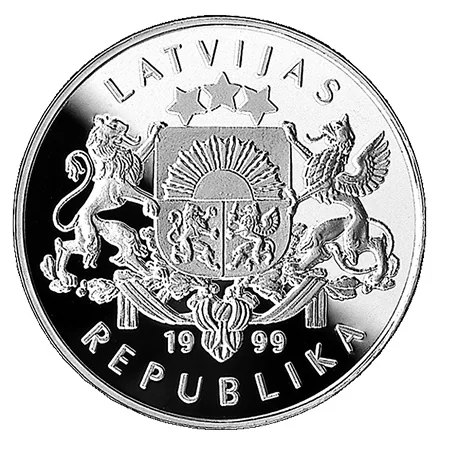
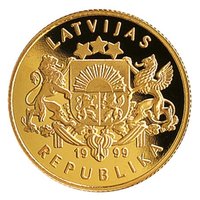
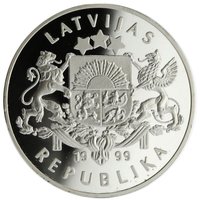
The Latvian coat of arms is centered, with "1999" below it. "LATVIJAS" and "REPUBLIKA" are arched above and beneath it, respectively.
Inscription:
LATVIJAS
1999
REPUBLIKA
1999
REPUBLIKA
Translation:
REPUBLIC OF LATVIA
1999
1999
Script: Latin
Language: Latvian
Engraver: Jānis Strupulis
Designer: Henrihs Vorkals
Reverse
Description:
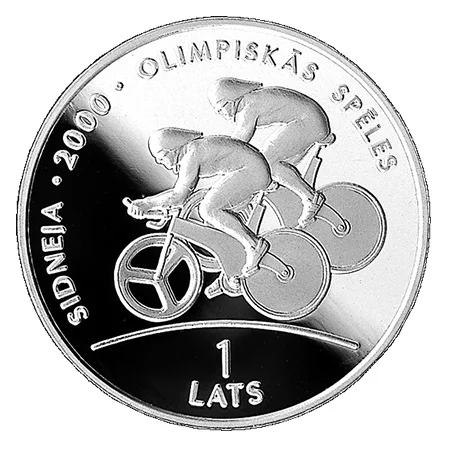
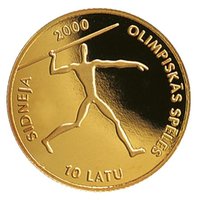
Two cyclists form the central motif, encircled by "SIDNEJA · 2000 · OLIMPISKAS SPELES." Below are the numeral 1 and "LATS."
Inscription:
SIDNEJA · 2000 · OLIMPISKAS SPELES
1
LATS
1
LATS
Script: Latin
Engraver: Jānis Strupulis
Designer: Henrihs Vorkals
Edge
Two inscriptions LATVIJAS BANKA (Bank of Latvia), separated by three stars.
Legend:
LATVIJAS BANKA ☆☆☆ LATVIJAS BANKA ☆☆☆
Categories
| Sport> Summer Olympic Games |
| Sport> Cycling |
Mints
| Name | Mark |
|---|---|
| Valcambi | — |
Mintings
| Year | Mint Mark | Mintage | Quality | Collection |
|---|---|---|---|---|
| 1999 | — | — | Proof |
Historical background
In 1999, Latvia was in a period of significant monetary stability and transition, operating under a currency board arrangement that had been established in 1994 to combat hyperinflation and restore confidence. This system strictly pegged the Latvian lats (LVL) first to the Special Drawing Right (SDR) and, from early 1999, exclusively to the euro's predecessor, the European Currency Unit (ECU), at a fixed rate of 1 EUR = 0.702804 LVL. The currency board mandated full foreign exchange backing for the lats in circulation, imposing strict discipline on monetary policy and effectively removing the central bank's ability to set independent interest rates or finance government deficits. This framework was widely credited with delivering low inflation and fostering economic recovery after the post-Soviet crisis.
The year was pivotal as Latvia, having weathered the 1998 Russian financial crisis better than some neighbors, formally set its strategic course toward European Union and NATO membership. The stable lats, underpinned by the currency board, was a cornerstone of this strategy, signaling macroeconomic responsibility to international institutions and investors. While the fixed exchange rate provided stability, it also required considerable fiscal austerity and structural reforms, as Latvia could not devalue its currency to regain competitiveness. The economy in 1999 was thus characterized by this trade-off: enjoying the credibility of a hard peg while adjusting to external shocks through internal wage and price adjustments rather than monetary tools.
Looking forward, the 1999 currency situation laid the essential groundwork for Latvia's future integration into the Eurozone. The unwavering commitment to the fixed peg, first to the ECU and then automatically to the euro upon its physical introduction in 2002, demonstrated a long-term political consensus. This trajectory was formalized when Latvia joined the EU in 2004 and entered the ERM II mechanism in 2005, a direct path from the currency board of 1999 to the eventual adoption of the euro in 2014. Thus, the year represented a period of consolidation, where the lats served as a stable bridge between post-crisis recovery and Latvia's anchored future within European economic and political structures.
The year was pivotal as Latvia, having weathered the 1998 Russian financial crisis better than some neighbors, formally set its strategic course toward European Union and NATO membership. The stable lats, underpinned by the currency board, was a cornerstone of this strategy, signaling macroeconomic responsibility to international institutions and investors. While the fixed exchange rate provided stability, it also required considerable fiscal austerity and structural reforms, as Latvia could not devalue its currency to regain competitiveness. The economy in 1999 was thus characterized by this trade-off: enjoying the credibility of a hard peg while adjusting to external shocks through internal wage and price adjustments rather than monetary tools.
Looking forward, the 1999 currency situation laid the essential groundwork for Latvia's future integration into the Eurozone. The unwavering commitment to the fixed peg, first to the ECU and then automatically to the euro upon its physical introduction in 2002, demonstrated a long-term political consensus. This trajectory was formalized when Latvia joined the EU in 2004 and entered the ERM II mechanism in 2005, a direct path from the currency board of 1999 to the eventual adoption of the euro in 2014. Thus, the year represented a period of consolidation, where the lats served as a stable bridge between post-crisis recovery and Latvia's anchored future within European economic and political structures.
💎 Very Rare