

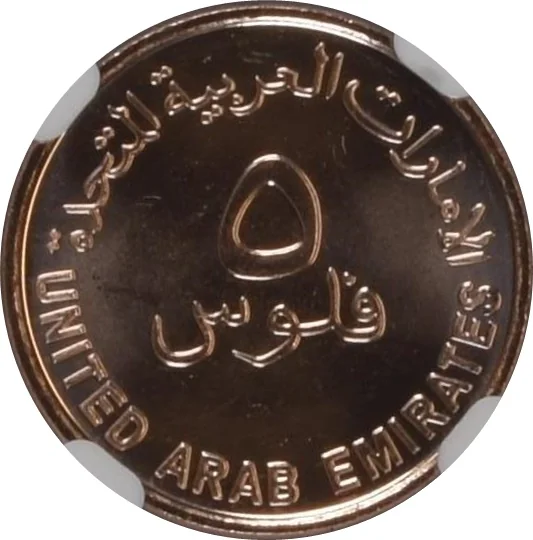
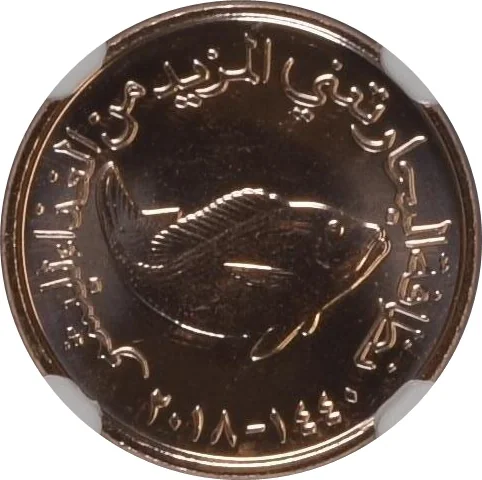
5 Fils – United Arab Emirates
Circulating commemorative coins
Commemoration: FAO
United Arab Emirates
Context
Year: 2018
Islamic (Hijri) Year: 1440
Issuer: United Arab Emirates 
Ruler: Khalifa bin Zayed Al Nahyan
Currency:
(since 1973)
Material
References
Numista: #151450
Value
Exchange value: 0.05 AED
Obverse
Reverse
Edge
Plain
Categories
| Animal> Fish |
| Organization> FAO |
Mintings
| Year | Mint Mark | Mintage | Quality | Collection |
|---|---|---|---|---|
| 2018 | — | — |
Historical background
In 2018, the United Arab Emirates' currency situation was characterized by stability and strategic alignment, anchored by the UAE Dirham's (AED) long-standing peg to the US Dollar. This peg, established in 1997 at a fixed rate of approximately AED 3.6725 per USD, provided a cornerstone for the nation's economic policy, ensuring predictability for trade, investment, and monetary policy. As a major oil exporter, the UAE's linkage of its currency to the dollar helped mitigate volatility from fluctuating hydrocarbon revenues and solidified its role as a stable global financial and business hub. The Central Bank of the UAE maintained substantial foreign currency reserves, primarily in US dollars, to confidently defend the peg, which was considered unwavering.
The year saw the dirham indirectly influenced by US Federal Reserve policy, as the Fed continued its cycle of interest rate hikes that began in 2015. To maintain the peg's integrity and prevent capital outflows, the UAE Central Bank mirrored these increases, raising its key interest rates in lockstep. This alignment, while necessary for currency stability, translated into higher borrowing costs within the domestic economy, affecting mortgages, business loans, and liquidity. Nevertheless, this was accepted as the primary cost of the peg's benefits, with no serious public debate about abandoning the arrangement due to its perceived critical role in the nation's economic success.
Furthermore, 2018 was a period of proactive financial innovation within this stable framework. The UAE government continued to promote diversification efforts under "Vision 2021," with a growing focus on fintech and digital transactions. Notably, the year saw significant strides in developing a national digital payment infrastructure and discussions around blockchain technology, positioning the UAE for a digital financial future. Simultaneously, the country actively pursued bilateral currency swap agreements, such as with China, to facilitate trade in local currencies and reduce dollar dependency for non-oil transactions, showcasing a nuanced approach to financial diplomacy within the constraints of its dollar peg.
The year saw the dirham indirectly influenced by US Federal Reserve policy, as the Fed continued its cycle of interest rate hikes that began in 2015. To maintain the peg's integrity and prevent capital outflows, the UAE Central Bank mirrored these increases, raising its key interest rates in lockstep. This alignment, while necessary for currency stability, translated into higher borrowing costs within the domestic economy, affecting mortgages, business loans, and liquidity. Nevertheless, this was accepted as the primary cost of the peg's benefits, with no serious public debate about abandoning the arrangement due to its perceived critical role in the nation's economic success.
Furthermore, 2018 was a period of proactive financial innovation within this stable framework. The UAE government continued to promote diversification efforts under "Vision 2021," with a growing focus on fintech and digital transactions. Notably, the year saw significant strides in developing a national digital payment infrastructure and discussions around blockchain technology, positioning the UAE for a digital financial future. Simultaneously, the country actively pursued bilateral currency swap agreements, such as with China, to facilitate trade in local currencies and reduce dollar dependency for non-oil transactions, showcasing a nuanced approach to financial diplomacy within the constraints of its dollar peg.
🌟 Uncommon