

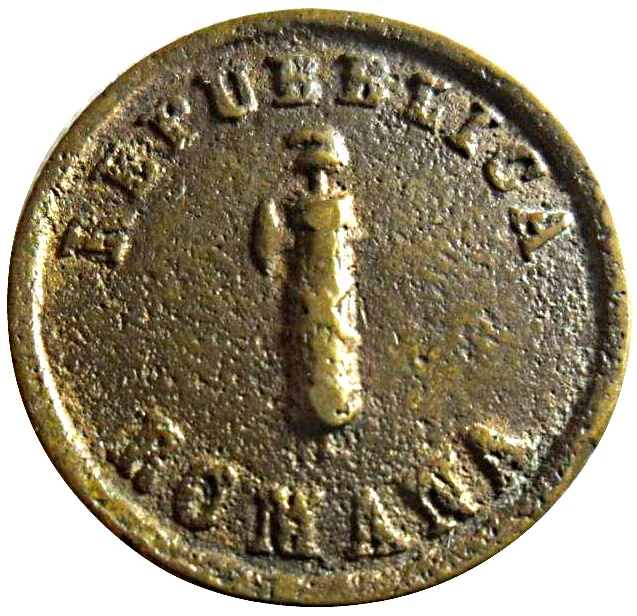
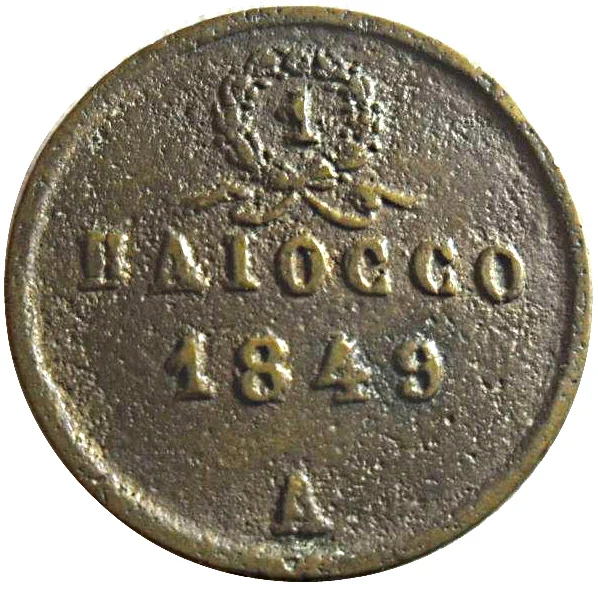
1 Baiocco – Roman Republic
Italy
Context
Years: 1848–1849
Country: Italy 
Issuer: Roman Republic
Period:
Currency:
(since 1849)
Demonetized: Yes
Material
References
KM: #Click to copy to clipboard12
Numista: #50803
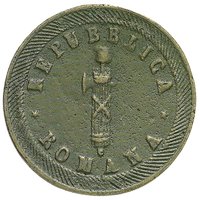
Obverse
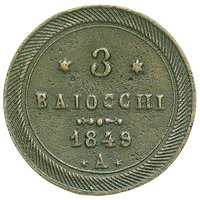
Reverse
Edge
Reeded at a 45 degree angle.
Mints
| Name | Mark |
|---|---|
| Ancona | A |
Historical background
The currency situation in the Roman Republic of 1848 was a direct product of its revolutionary and precarious birth. Proclaimed in February 1849 after the pope fled, the Republic inherited the monetary systems of the Papal States, which were in a state of disarray. The circulating medium was a complex mix of coins from various Italian states, foreign currencies (particularly French francs), and the scudo issued by the former papal government. This lack of a unified, trusted currency mirrored the Republic's political fragility and hindered both daily commerce and the state's ability to fund its operations.
Facing immediate military threat from French, Austrian, and Neapolitan forces, the Republican government's primary financial strategy was not monetary reform but desperate fiscal measures. Led by Finance Minister Carlo Armellini, the treasury resorted to forced loans, the seizure and sale of church properties, and the issuance of public debt bonds. While plans for a new, decimal-based currency to replace the old papal system were discussed by the revolutionary assembly, the pressing reality of siege and war meant these modernizing ideas never moved beyond theory. The state's promissory notes and bonds rapidly depreciated as confidence waned.
Thus, the currency "situation" was ultimately one of collapse and substitution. As the French siege of Rome tightened in the spring and summer of 1849, the Republic's financial instruments became nearly worthless, and the economy regressed to barter and the use of any remaining hard currency. The fall of Rome in July 1849 and the restoration of papal authority rendered the Republic's financial decrees null. Pope Pius IX subsequently reintroduced the papal scudo, ending the brief and tumultuous period of revolutionary finance, which had been characterized more by emergency survival tactics than by any lasting monetary innovation.
Facing immediate military threat from French, Austrian, and Neapolitan forces, the Republican government's primary financial strategy was not monetary reform but desperate fiscal measures. Led by Finance Minister Carlo Armellini, the treasury resorted to forced loans, the seizure and sale of church properties, and the issuance of public debt bonds. While plans for a new, decimal-based currency to replace the old papal system were discussed by the revolutionary assembly, the pressing reality of siege and war meant these modernizing ideas never moved beyond theory. The state's promissory notes and bonds rapidly depreciated as confidence waned.
Thus, the currency "situation" was ultimately one of collapse and substitution. As the French siege of Rome tightened in the spring and summer of 1849, the Republic's financial instruments became nearly worthless, and the economy regressed to barter and the use of any remaining hard currency. The fall of Rome in July 1849 and the restoration of papal authority rendered the Republic's financial decrees null. Pope Pius IX subsequently reintroduced the papal scudo, ending the brief and tumultuous period of revolutionary finance, which had been characterized more by emergency survival tactics than by any lasting monetary innovation.
💎 Very Rare