

100 Lire – Italy
Italy
Context
Years: 1937–1940
Issuer: Italy 
Ruler: Vittorio Emanuele III
Currency:
(1861—2001)
Demonetized: Yes
Total mintage: 249
Material
References
KM: #Click to copy to clipboard84
Numista: #50635
Value
Exchange value: 100 ITL
Bullion value: $780.37
Obverse
Description:
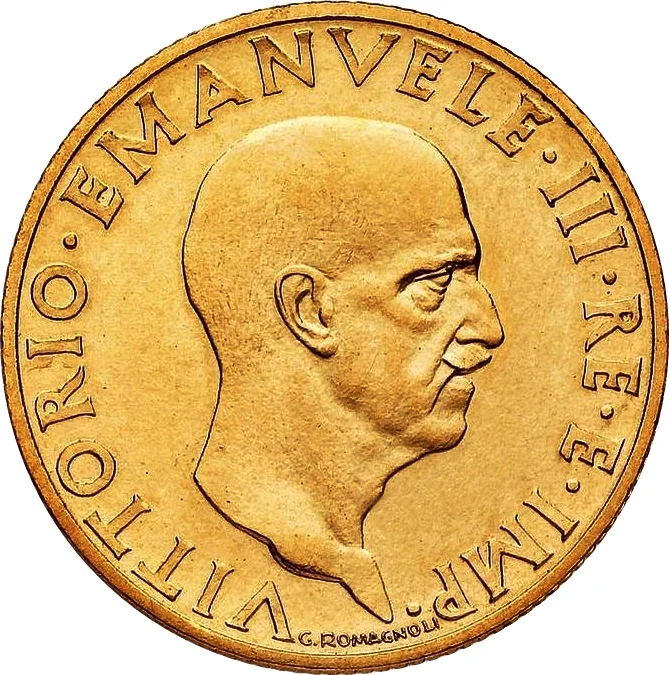
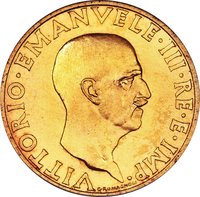
King Vittorio Emanuele III facing right, with engraver's name below.
Inscription:
VITTORIO·EMANUELE·III·RE·E·IMP·
G·ROMAGNOLI
G·ROMAGNOLI
Translation:
Victor Emmanuel III King and Emperor
G. Romagnoli
G. Romagnoli
Script: Latin
Language: Latin
Engraver: Giuseppe Romagnoli
Reverse
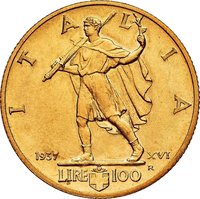
Description:
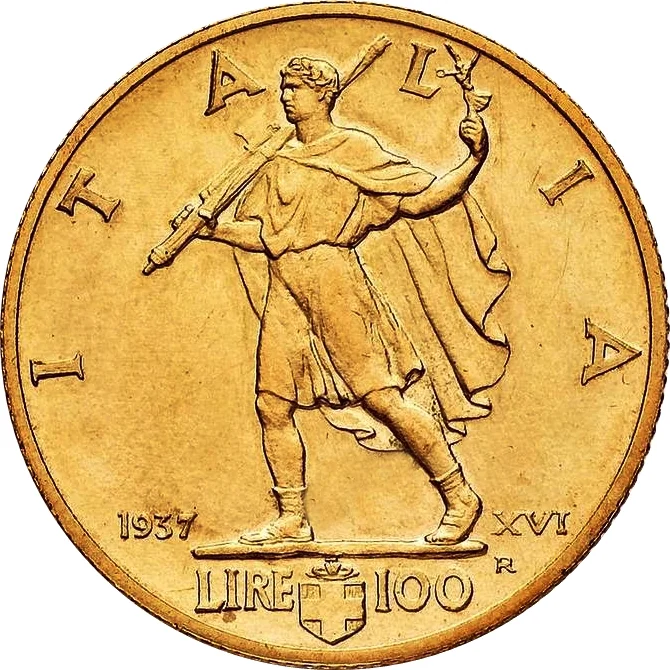
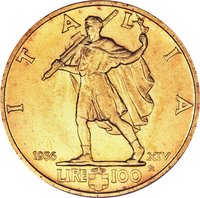
A Littore walks left, holding a fasces on his shoulder and a Victory statuette aloft. Below, the crowned Savoy shield divides the value, with the date left and mintmark/Fascist Era date right.
Inscription:
ITALIA
1937 XVI R
LIRE 100
1937 XVI R
LIRE 100
Translation:
Italy
1937 Year 16 [of the Fascist Era]
Lire 100
1937 Year 16 [of the Fascist Era]
Lire 100
Script: Latin
Engraver: Giuseppe Romagnoli
Edge
Reeded
Mints
| Name | Mark |
|---|---|
| Rome | R |
Historical background
In 1937, Italy's currency situation was firmly under the control of Benito Mussolini's Fascist regime, which prioritized political prestige and autarky (economic self-sufficiency) over monetary stability. The official currency was the lira, whose external value was artificially maintained by the government at the so-called "Quota 90" rate of 92.46 lire to the British pound, established in 1927. This overvaluation was a symbol of Fascist strength, but it severely damaged Italian exports by making them more expensive on the international market, exacerbating a persistent trade deficit.
Domestically, the economy was strained by the costs of the invasion of Ethiopia (1935-36) and the ongoing intervention in the Spanish Civil War. To finance these military ventures and shield the population from their economic impact, the regime imposed strict capital controls, import quotas, and complex bilateral barter agreements. These measures created a stark divide between the official, government-managed lira and various black-market exchange rates, where the lira traded at a significant discount. Rationing of raw materials and consumer goods began to emerge, signaling underlying inflationary pressures suppressed by state decree rather than sound economic fundamentals.
Overall, the currency picture in 1937 was one of growing fragility masked by rigid controls. The lira's stability was an artificial façade, dependent on extensive state intervention, a draining of gold and foreign currency reserves, and the isolation of Italy from normal international financial flows. This unsustainable model left the economy vulnerable, setting the stage for greater difficulties as the regime moved closer to wider European conflict and further away from economic realism.
Domestically, the economy was strained by the costs of the invasion of Ethiopia (1935-36) and the ongoing intervention in the Spanish Civil War. To finance these military ventures and shield the population from their economic impact, the regime imposed strict capital controls, import quotas, and complex bilateral barter agreements. These measures created a stark divide between the official, government-managed lira and various black-market exchange rates, where the lira traded at a significant discount. Rationing of raw materials and consumer goods began to emerge, signaling underlying inflationary pressures suppressed by state decree rather than sound economic fundamentals.
Overall, the currency picture in 1937 was one of growing fragility masked by rigid controls. The lira's stability was an artificial façade, dependent on extensive state intervention, a draining of gold and foreign currency reserves, and the isolation of Italy from normal international financial flows. This unsustainable model left the economy vulnerable, setting the stage for greater difficulties as the regime moved closer to wider European conflict and further away from economic realism.
✨ Legendary