

Obverse
Description:
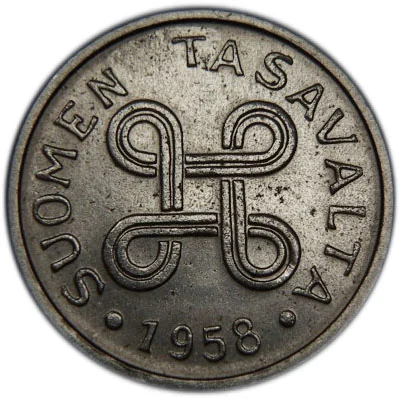
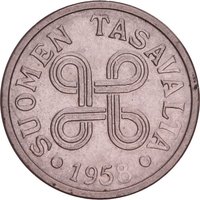
Four loops joined, date below.
Inscription:
SUOMEN TASAVALTA
1958
1958
Translation:
REPUBLIC OF FINLAND
1958
1958
Script: Latin
Language: Finnish
Engraver: Peippo Uolevi Helle
Reverse
Description:
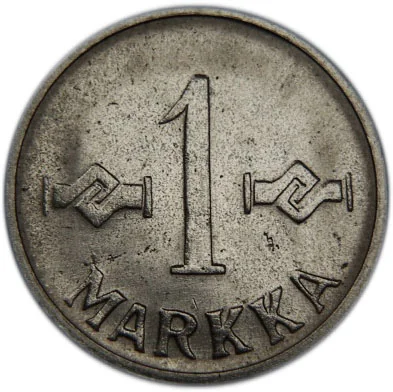
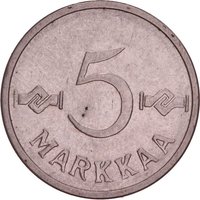
Hands cradle the value.
Inscription:
1
MARKKA
MARKKA
Script: Latin
Engraver: Peippo Uolevi Helle
Edge
Plain
Mints
| Name | Mark |
|---|---|
| Mint of Finland | — |
Mintings
| Year | Mint Mark | Mintage | Quality | Collection |
|---|---|---|---|---|
| 1953 | — | 6,570,000 | ||
| 1954 | — | 36,400,000 | ||
| 1955 | — | 38,100,000 | ||
| 1956 | — | 35,600,000 | ||
| 1957 | — | 29,108,000 | ||
| 1958 | — | 19,940,000 | ||
| 1959 | — | 23,920,000 | ||
| 1960 | — | 22,016,000 | ||
| 1961 | — | 32,220,000 | ||
| 1962 | — | 29,040,000 |
Historical background
In 1953, Finland's currency situation was characterized by a complex system of monetary controls and a dual-track economy, a legacy of the post-war reconstruction period. The country was still grappling with the economic consequences of World War II, including war reparations to the Soviet Union, which demanded a significant portion of industrial output. To manage inflation, conserve foreign exchange, and direct resources toward reparations and vital imports, Finland maintained a strict regime of currency regulations. The Finnish markka (FIM) had an official, fixed exchange rate set by the Bank of Finland, but this rate was overvalued and did not reflect market realities, leading to a persistent shortage of hard currency.
Alongside the official economy, a vibrant and tolerated black market for foreign currency operated, where the markka traded at a significantly depreciated value. This created a two-tier system where essential government-approved transactions used the strong official rate, while many other international dealings were forced into the weaker black-market rate. Furthermore, the government employed a system of multiple "special rates" for specific sectors like shipping and travel, adding another layer of complexity. This fragmented system distorted trade, encouraged illicit transactions, and hampered Finland's economic integration with the West.
The year 1953 marked a pivotal step toward normalization. With war reparations scheduled for completion in 1952, Finland could begin to liberalize its economy. In September 1953, a significant devaluation of the official markka was implemented, bringing the fixed rate closer to the black-market level and unifying some of the special rates. This move, while not eliminating controls entirely, was a crucial shift toward a more realistic and unified currency system. It aimed to boost exports by making Finnish goods cheaper abroad, reduce the incentive for black-market activity, and lay the groundwork for the more comprehensive monetary reforms and gradual liberalization that would follow in the latter half of the 1950s.
Alongside the official economy, a vibrant and tolerated black market for foreign currency operated, where the markka traded at a significantly depreciated value. This created a two-tier system where essential government-approved transactions used the strong official rate, while many other international dealings were forced into the weaker black-market rate. Furthermore, the government employed a system of multiple "special rates" for specific sectors like shipping and travel, adding another layer of complexity. This fragmented system distorted trade, encouraged illicit transactions, and hampered Finland's economic integration with the West.
The year 1953 marked a pivotal step toward normalization. With war reparations scheduled for completion in 1952, Finland could begin to liberalize its economy. In September 1953, a significant devaluation of the official markka was implemented, bringing the fixed rate closer to the black-market level and unifying some of the special rates. This move, while not eliminating controls entirely, was a crucial shift toward a more realistic and unified currency system. It aimed to boost exports by making Finnish goods cheaper abroad, reduce the incentive for black-market activity, and lay the groundwork for the more comprehensive monetary reforms and gradual liberalization that would follow in the latter half of the 1950s.
🌱 Very Common