

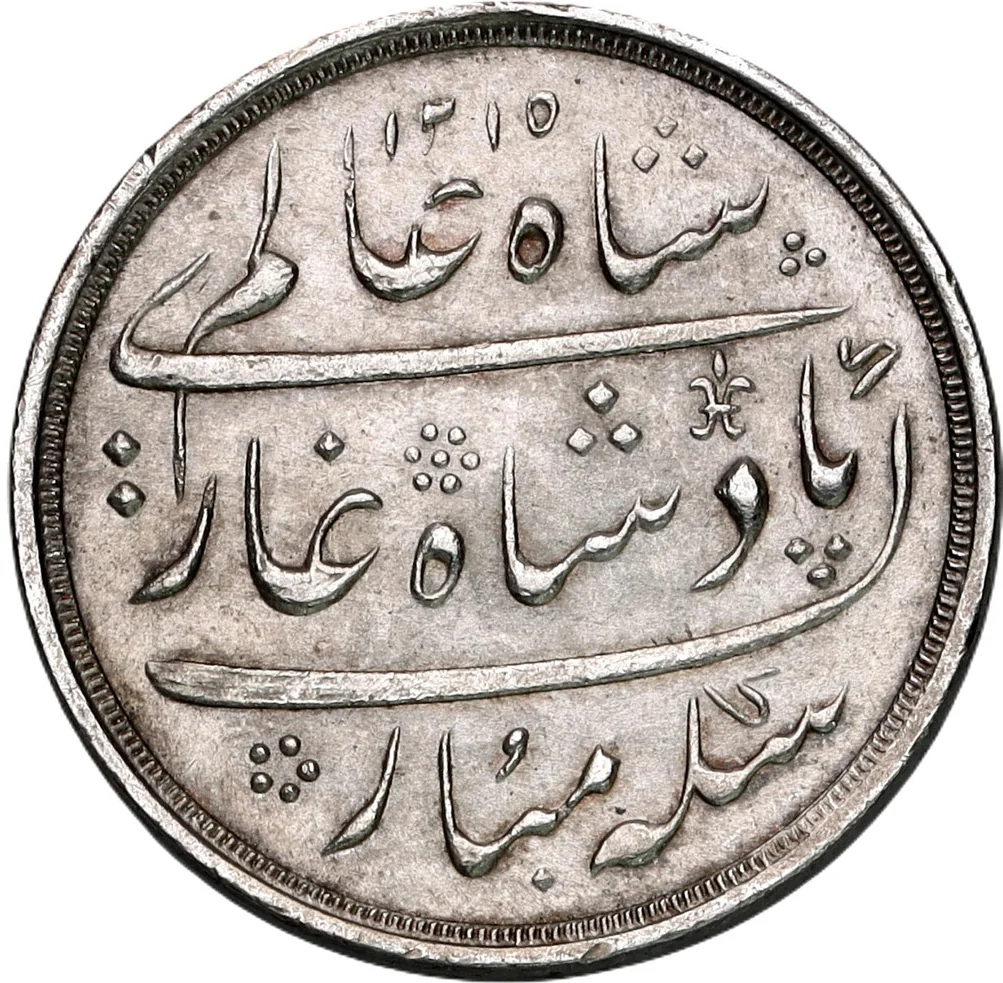
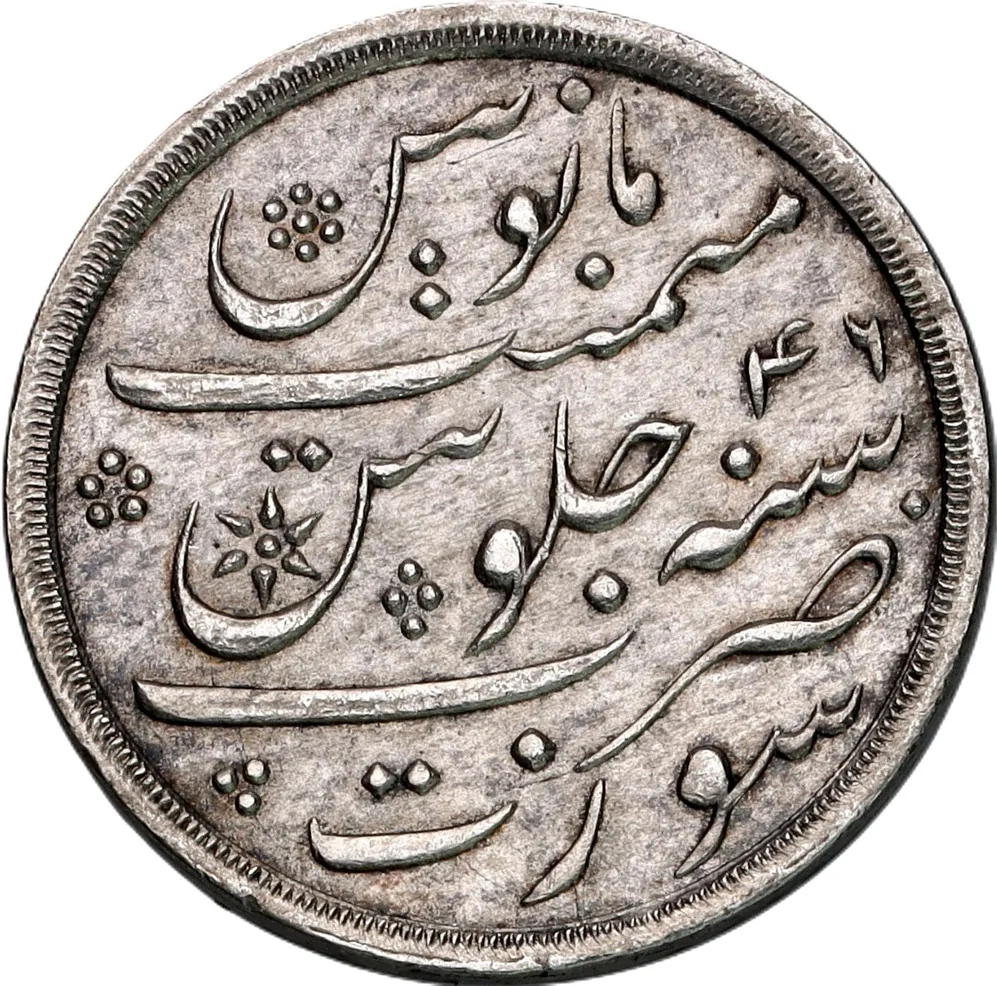
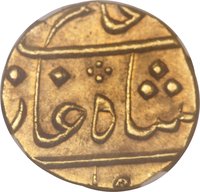
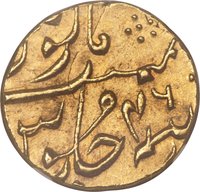
½ Rupee – Bombay Presidency
India
Context
Year: 1801
Islamic (Hijri) Year: 1215
Country: India 
Issuer: Bombay Presidency
Currency:
(1672—1835)
Demonetized: Yes
Material
References
KM: #Click to copy to clipboard223
Numista: #50491
Value
Bullion value: $16.46
Obverse
Reverse
Edge
Plain
Mintings
| Year | Mint Mark | Mintage | Quality | Collection |
|---|---|---|---|---|
| 1801 | — | — |
Historical background
In 1801, the Bombay Presidency's currency situation was a complex and chaotic tapestry of indigenous and foreign coins, reflecting its history as a major trading hub. The dominant official currency was the silver rupee of the Mughal Empire, primarily the "Sicca" rupee, but these circulated alongside a bewildering variety of other coins. Portuguese xerafins and pardaus, Ottoman sequins, and various Arabian and Persian coins were common in port cities due to maritime trade. Furthermore, different regions within the Presidency used their own local rupees and copper coins, such as the Ankushi rupee of Gujarat, leading to a lack of uniform standards and constant difficulties in exchange.
This monetary anarchy created significant problems for the East India Company's administration and commerce. The value of coins depended not only on their metallic content but also on their age and place of minting, leading to widespread confusion and fraud. Merchants and money-changers (shroffs) held considerable power, as they were essential for assessing the true value of mixed payments and converting between currencies, a process that involved heavy deductions for assay and brokerage. This inefficiency hampered revenue collection, as the Company struggled to ascertain the real value of taxes paid in assorted coin, and increased transaction costs for trade.
Recognizing this as a barrier to stable governance and economic control, the East India Company had begun to take steps toward reform. The Bombay Mint, established in the previous century, was actively engaged in producing Company rupees to gradually supplant the older varieties. The period around 1801 was one of transition, where the Company sought to impose order by defining standard weights and fineness for its own coins, thereby laying the groundwork for the more uniform currency system that would be consolidated later under the British Raj. However, in 1801, the goal of a single, regulated currency for the Presidency remained a work in progress amidst the enduring legacy of centuries of diverse commercial activity.
This monetary anarchy created significant problems for the East India Company's administration and commerce. The value of coins depended not only on their metallic content but also on their age and place of minting, leading to widespread confusion and fraud. Merchants and money-changers (shroffs) held considerable power, as they were essential for assessing the true value of mixed payments and converting between currencies, a process that involved heavy deductions for assay and brokerage. This inefficiency hampered revenue collection, as the Company struggled to ascertain the real value of taxes paid in assorted coin, and increased transaction costs for trade.
Recognizing this as a barrier to stable governance and economic control, the East India Company had begun to take steps toward reform. The Bombay Mint, established in the previous century, was actively engaged in producing Company rupees to gradually supplant the older varieties. The period around 1801 was one of transition, where the Company sought to impose order by defining standard weights and fineness for its own coins, thereby laying the groundwork for the more uniform currency system that would be consolidated later under the British Raj. However, in 1801, the goal of a single, regulated currency for the Presidency remained a work in progress amidst the enduring legacy of centuries of diverse commercial activity.
💎 Very Rare