

2 euro (Princess Grace) – Monaco
Add to wishlist
Non-circulating coins
Commemoration: 25th Anniversary of the Death of Princess Grace
Monaco
Obverse
Description:
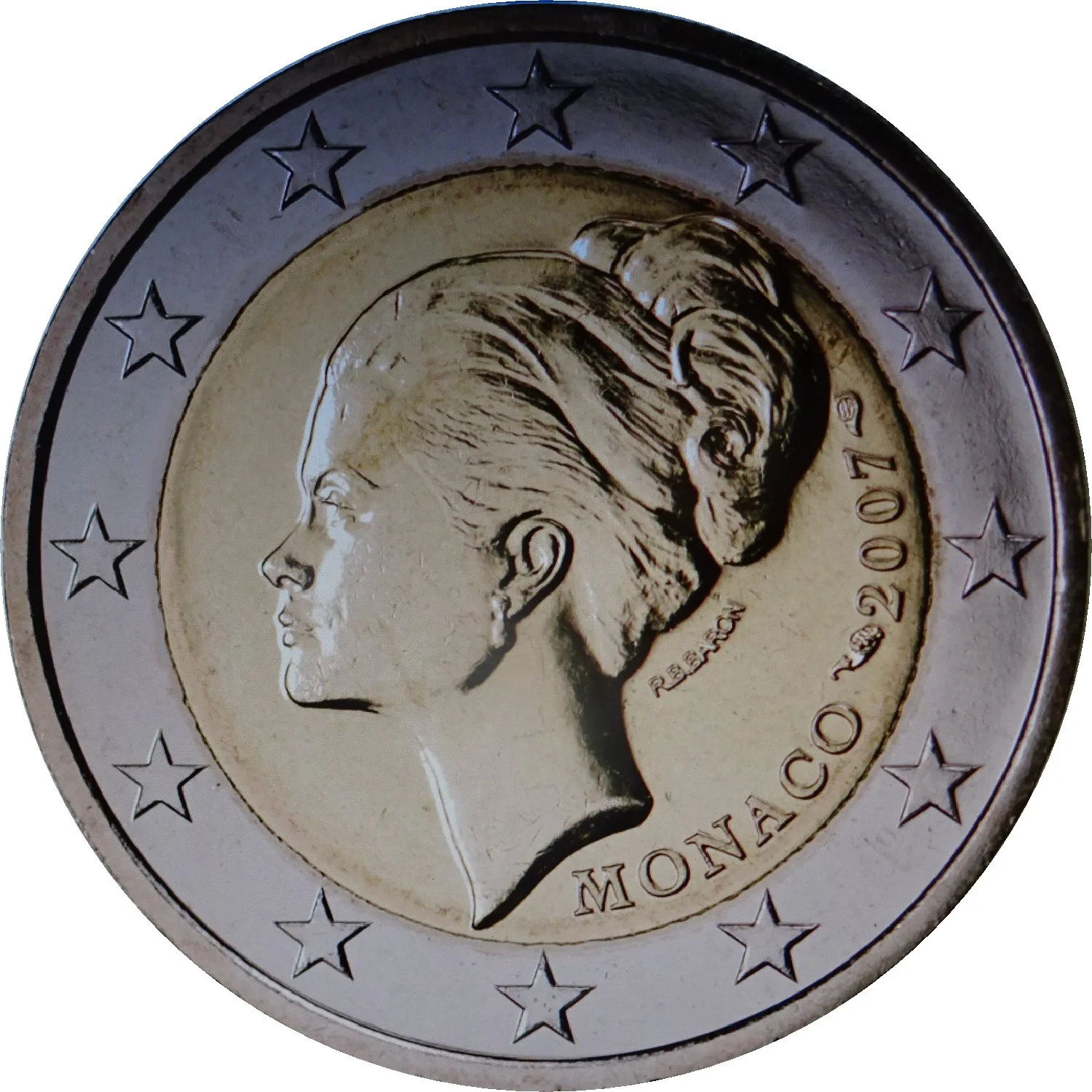
The coin shows Princess Grace facing right, with 'MONACO', the mint mark, '2007', and the engraver's mark beside her. The artist's name, 'R.B.BARON', is below her hair. The outer ring features the 12 EU stars.
Inscription:
MONACO 2007
R.B.BARON
R.B.BARON
Translation:
MONACO 2007
R.B.BARON
R.B.BARON
Script: Latin
Language: French
Engraver: Roger Bertrand Baron
Reverse
Edge
Reeded with inscription
Legend:
2 ** 2 ** 2 ** 2 ** 2 ** 2 **
Categories
| Map |
| Event> Death anniversary |
Mints
| Name | Mark |
|---|---|
| Monnaie de Paris | — |
Mintings
| Year | Mint Mark | Mintage | Quality | Collection |
|---|---|---|---|---|
| 2007 | — | 20,001 | BU |
Historical background
In 2007, Monaco, as a sovereign city-state, did not have an independent currency. Its monetary situation was entirely governed by a long-standing treaty with France, specifically the 2002 Monetary Agreement between France (acting for the European Community) and Monaco. This agreement legally granted Monaco the right to use the euro as its official currency and to issue its own euro coins, albeit with strict limitations and under French oversight. Consequently, the Principality's currency situation was stable and fully integrated into the Eurozone, with the euro circulating as the sole legal tender for all daily transactions.
Monaco's unique privilege was its ability to mint limited quantities of Monegasque euro coins. These coins, featuring designs specific to Monaco (such as the effigy of Prince Rainier III until 2005, then Prince Albert II), had the same monetary value and technical specifications as French or other euro coins. However, their issuance was tightly controlled; the volume was set by agreement with France to prevent disruption to the single currency area and to ensure they served primarily as collectibles or for symbolic national representation rather than as a significant source of seigniorage.
The background for 2007, therefore, is one of embedded stability within the European monetary framework. There were no currency crises, debates over monetary sovereignty, or significant changes to the system that year. The situation was a continuation of the post-2002 status quo, where Monaco's financial authorities focused on banking, tourism, and commerce, all operating seamlessly with the euro. Any discussion of Monaco's "currency situation" in 2007 is essentially a description of its successful and frictionless participation in the Eurozone, with its distinctive coinage serving as a numismatic expression of its sovereignty rather than an independent monetary policy.
Monaco's unique privilege was its ability to mint limited quantities of Monegasque euro coins. These coins, featuring designs specific to Monaco (such as the effigy of Prince Rainier III until 2005, then Prince Albert II), had the same monetary value and technical specifications as French or other euro coins. However, their issuance was tightly controlled; the volume was set by agreement with France to prevent disruption to the single currency area and to ensure they served primarily as collectibles or for symbolic national representation rather than as a significant source of seigniorage.
The background for 2007, therefore, is one of embedded stability within the European monetary framework. There were no currency crises, debates over monetary sovereignty, or significant changes to the system that year. The situation was a continuation of the post-2002 status quo, where Monaco's financial authorities focused on banking, tourism, and commerce, all operating seamlessly with the euro. Any discussion of Monaco's "currency situation" in 2007 is essentially a description of its successful and frictionless participation in the Eurozone, with its distinctive coinage serving as a numismatic expression of its sovereignty rather than an independent monetary policy.
🌟 Limited