

5 piastres – Syria
Add to wishlist
Circulating commemorative coins
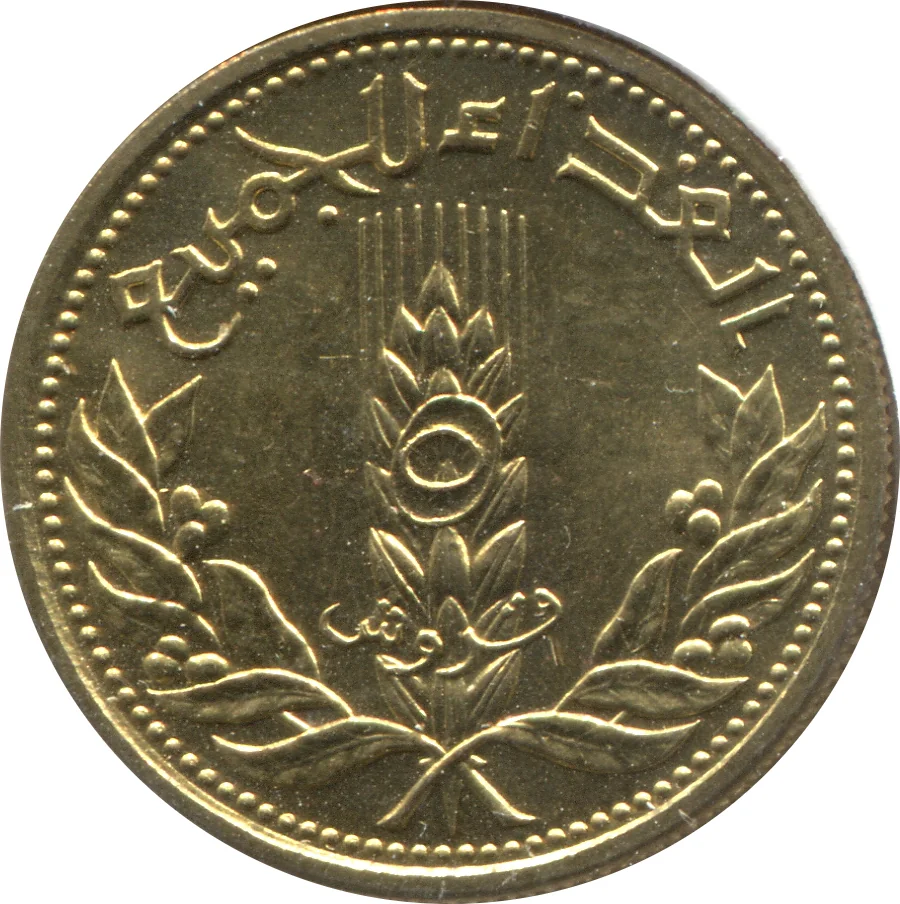
Commemoration: FAO
Syria
Context
Year: 1971
Islamic (Hijri) Year:: 1391
Issuer: Syria
Period:
(since 1961)
Currency:
(since 1919)
Demonetized: Yes
Total mintage: 15,000,000
Material
References
KM: #
Numista: #5025
Value
Exchange value: 0.05 SYP
Obverse
Description:
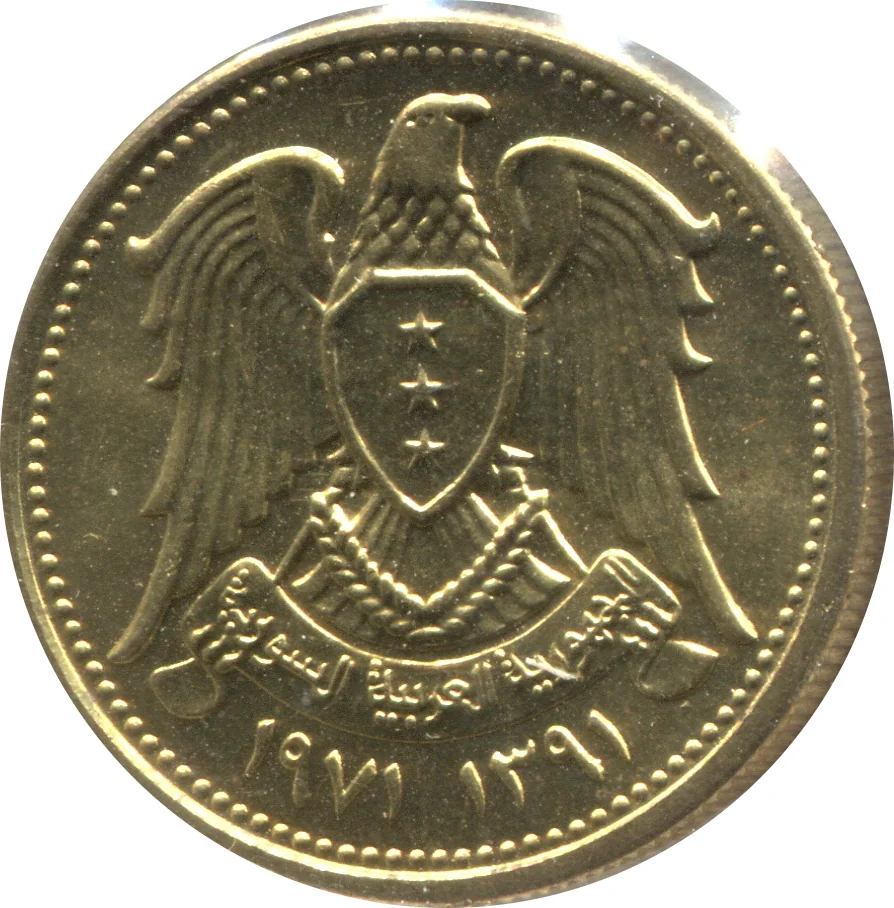
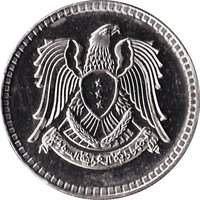
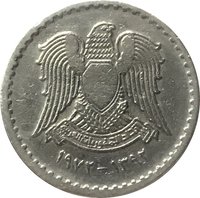
Syria's coat of arms features the Quraish hawk holding a shield with three stars and a scroll reading "Arab Republic of Syria." Arabic dates (AD and AH) appear below.
Inscription:
الجمهورية العربية السورية
١٣٩١ ١٩٧١
١٣٩١ ١٩٧١
Translation:
Syrian Arab Republic
1391 1971
1391 1971
Script: Arabic
Language: Arabic
Reverse
Edge
Reeded
Categories
| Animal> Bird |
| Organization> FAO |
| Symbols> Coat of Arms |
| Symbol> Wreath |
Mints
| Name | Mark |
|---|---|
| Royal Mint | — |
| Sherritt Mint | — |
Mintings
| Year | Mint Mark | Mintage | Quality | Collection |
|---|---|---|---|---|
| 1971 | — | 15,000,000 |
Historical background
In 1971, Syria's currency situation was characterized by relative stability under the centralized economic policies of the Ba'ath Party and the newly consolidated rule of President Hafez al-Assad. The Syrian pound (known as the lira, £S) was pegged to the U.S. dollar at an official rate of £S 3.85 = $1, a fixed parity established in the early 1960s that remained largely unchallenged. This stability was underpinned by a period of economic growth, increasing oil production, and significant financial support from other Arab states following the 1967 war with Israel, which provided the Central Bank of Syria with adequate foreign exchange reserves to maintain the peg.
The economy operated under a strict framework of state socialism and import substitution industrialization. Currency controls were rigorous, with the government mandating the surrender of foreign exchange earnings from key exports like cotton and oil. This allowed authorities to allocate hard currency for prioritized state-led industrial projects and the importation of essential goods. While the official exchange rate was stable, a very modest black market for foreign currency existed, primarily to facilitate small-scale trade and remittances, but the disparity with the official rate was minimal, indicating broad confidence in the managed system.
This controlled environment stood in stark contrast to the volatility that would emerge in later decades. The stability of 1971 was a product of a still-expanding economy, nascent oil revenues, and a political climate focused on consolidation and state-building. However, it also masked longer-term structural weaknesses, including an over-reliance on agriculture and a burgeoning public sector, which would eventually strain the fixed exchange rate regime as economic pressures mounted in the 1980s.
The economy operated under a strict framework of state socialism and import substitution industrialization. Currency controls were rigorous, with the government mandating the surrender of foreign exchange earnings from key exports like cotton and oil. This allowed authorities to allocate hard currency for prioritized state-led industrial projects and the importation of essential goods. While the official exchange rate was stable, a very modest black market for foreign currency existed, primarily to facilitate small-scale trade and remittances, but the disparity with the official rate was minimal, indicating broad confidence in the managed system.
This controlled environment stood in stark contrast to the volatility that would emerge in later decades. The stability of 1971 was a product of a still-expanding economy, nascent oil revenues, and a political climate focused on consolidation and state-building. However, it also masked longer-term structural weaknesses, including an over-reliance on agriculture and a burgeoning public sector, which would eventually strain the fixed exchange rate regime as economic pressures mounted in the 1980s.
🌱 Very Common