

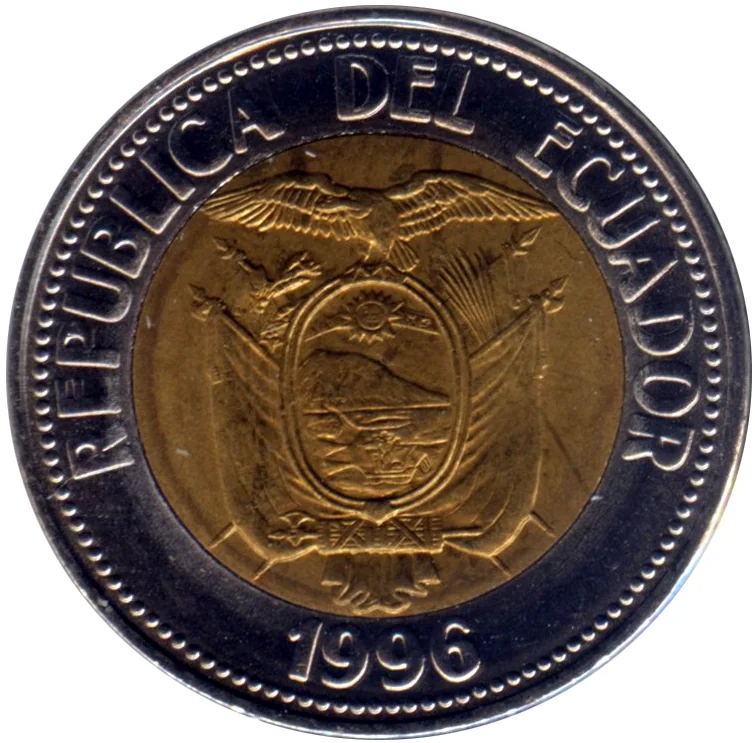
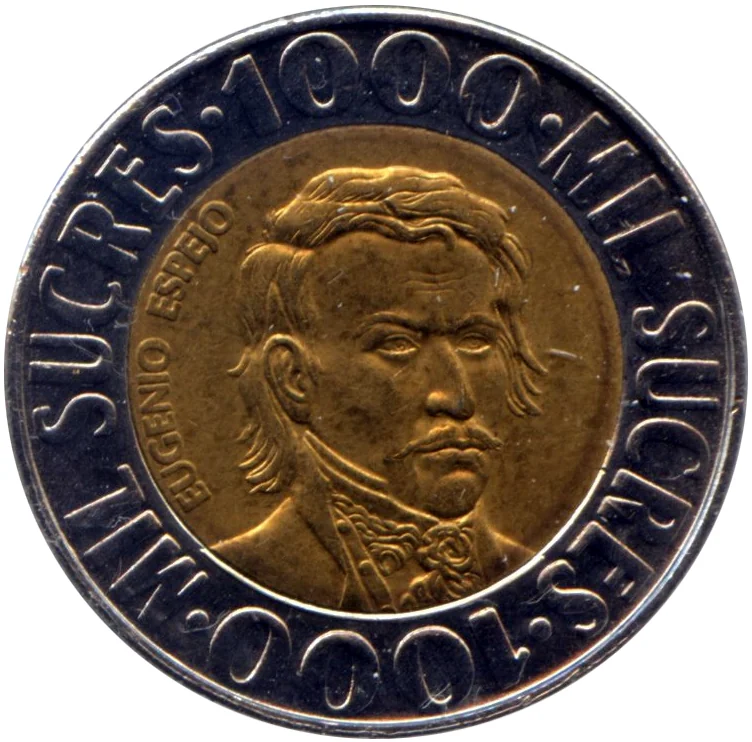
1000 sucres – Ecuador
Add to wishlist
Ecuador
Obverse
Reverse
Edge
Reeded
Categories
| Art> Literature |
| Science |
Mints
| Name | Mark |
|---|---|
| Sherritt Mint | — |
Mintings
| Year | Mint Mark | Mintage | Quality | Collection |
|---|---|---|---|---|
| 1996 | — | — |
Historical background
In 1996, Ecuador was in the late stages of a prolonged period of macroeconomic instability and currency crisis, often referred to as the "lost decade." The national currency, the sucre, was under severe pressure due to a combination of factors: chronic fiscal deficits financed by the central bank, a series of external shocks, and a loss of public and international confidence. This led to persistent and high inflation, which eroded purchasing power and spurred capital flight. Governments attempted various stabilization plans and allowed the sucre to operate within a crawling peg system, but these measures failed to restore credibility, as political fragmentation prevented consistent fiscal discipline.
The year itself was particularly turbulent, marked by the impeachment of President Abdalá Bucaram in early 1997, which underscored the political volatility exacerbating the economic woes. Throughout 1996, inflation raged at an annual rate of approximately 24%, and the sucre depreciated significantly. Efforts to defend the currency drained international reserves, while dollar-denominated debts became increasingly burdensome for the government and private sector. The economic model, reliant on volatile oil exports, proved insufficient to sustain the currency's value, leading to a widespread, de facto dollarization in many business transactions as citizens sought a stable store of value.
Thus, by the close of 1996, Ecuador was on an unsustainable path. The failure of orthodox and heterodox policies to tame inflation or stabilize the sucre set the direct stage for the profound crises that would follow in the coming years—including a catastrophic banking collapse in 1999 and the total abandonment of the national currency. The events of 1996 were therefore a critical prelude to the official adoption of the US dollar as Ecuador's legal tender in the year 2000, a radical solution born from a decade of monetary failure.
The year itself was particularly turbulent, marked by the impeachment of President Abdalá Bucaram in early 1997, which underscored the political volatility exacerbating the economic woes. Throughout 1996, inflation raged at an annual rate of approximately 24%, and the sucre depreciated significantly. Efforts to defend the currency drained international reserves, while dollar-denominated debts became increasingly burdensome for the government and private sector. The economic model, reliant on volatile oil exports, proved insufficient to sustain the currency's value, leading to a widespread, de facto dollarization in many business transactions as citizens sought a stable store of value.
Thus, by the close of 1996, Ecuador was on an unsustainable path. The failure of orthodox and heterodox policies to tame inflation or stabilize the sucre set the direct stage for the profound crises that would follow in the coming years—including a catastrophic banking collapse in 1999 and the total abandonment of the national currency. The events of 1996 were therefore a critical prelude to the official adoption of the US dollar as Ecuador's legal tender in the year 2000, a radical solution born from a decade of monetary failure.
🌱 Very Common