

10 Francs – Burundi
Circulating commemorative coins
Commemoration: FAO series
Burundi
Context
Years: 1968–1971
Issuer: Burundi 
Issuing organization: Bank of the Republic of Burundi
Period:
(since 1966)
Currency:
(since 1962)
Total mintage: 4,000,000
Material
Diameter: 28 mm
Weight: 7.85 g
Shape: Round
Standard: Silver quarter ounce
Technique: Milled
Alignment: Coin alignment
flip
References
KM: #Click to copy to clipboard17
Numista: #5002
Value
Exchange value: 10 BIF
Obverse
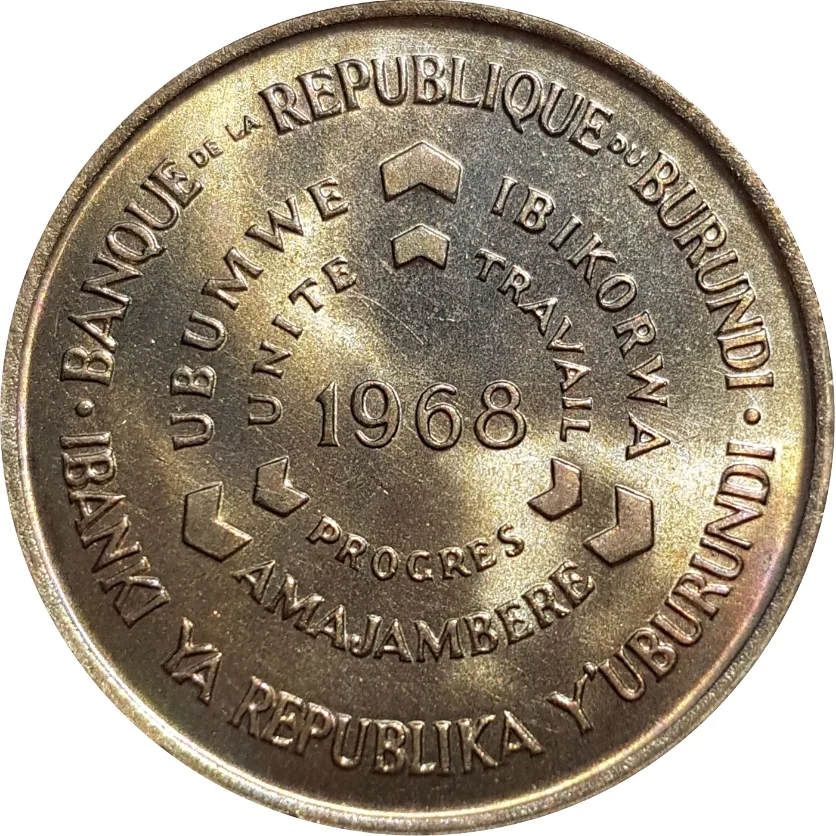
Description:
Text lines centered on date.
Inscription:
BANQUE DE LA REPUBLIQUE DU BURUNDI
UBUMWE IBIKORWA AMAJAMBERE
UNITE TRAVAIL PROGRES
1968
IBANKI YA REPUBLIKA Y'UBURUNDI
UBUMWE IBIKORWA AMAJAMBERE
UNITE TRAVAIL PROGRES
1968
IBANKI YA REPUBLIKA Y'UBURUNDI
Translation:
Bank of the Republic of Burundi
Unity Work Progress
1968
Bank of the Republic of Burundi
Unity Work Progress
1968
Bank of the Republic of Burundi
Script: Latin
Engraver: Stuart Devlin
Reverse
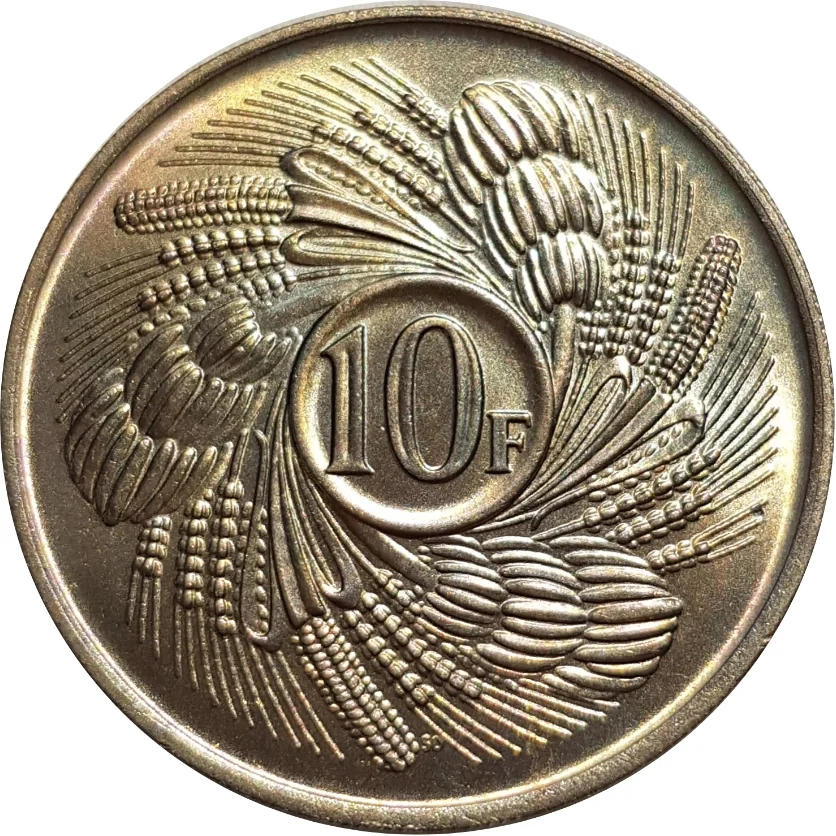
Description:
Wheel of banana, maize, and sorghum encircling the central denomination.
Inscription:
10 F
Script: Latin
Edge
Reeded
Categories
| Organization> FAO |
| Plant> Fruit |
Mints
| Name | Mark |
|---|---|
| Royal Mint (Tower Hill) | — |
| Royal Mint | — |
Mintings
| Year | Mint Mark | Mintage | Quality | Collection |
|---|---|---|---|---|
| 1968 | — | 2,000,000 | ||
| 1971 | — | 2,000,000 |
Historical background
In 1968, the currency situation in Burundi was defined by its recent independence and its membership in the Franc Zone (Zone Franc). The nation used the Burundi Franc (BIF), which was pegged to the French Franc at a fixed parity and guaranteed by the French Treasury through the Comptoir Français des Monnaies. This arrangement, managed alongside Rwanda within the Banque d'Emission du Rwanda et du Burundi until 1964, provided monetary stability and facilitated trade with France and other CFA franc countries, but also meant Burundi ceded significant control over its monetary policy to external institutions.
Economically, the period was challenging. Burundi was one of the world's poorest nations, with an economy heavily reliant on subsistence agriculture and a single cash crop, coffee, which accounted for the vast majority of its export earnings. This made the currency vulnerable to fluctuations in global coffee prices and harvest yields. The fixed exchange rate, while stable, could not shield the economy from these structural weaknesses, and the government had limited tools to devalue or manipulate the currency to boost competitiveness.
Politically, the currency's stability occurred against a backdrop of significant turmoil. The year 1968 fell within the reign of King Mwambutsa IV, a period marked by ethnic tension between the Hutu and Tutsi groups and a series of coups and political assassinations. While the Franc Zone provided a technical anchor, the domestic environment was one of insecurity and nascent nation-building. The central challenge was less about the currency's mechanics and more about fostering a national economy robust enough to benefit from that stability, a task complicated by deep-rooted social divisions and a lack of diversified industry.
Economically, the period was challenging. Burundi was one of the world's poorest nations, with an economy heavily reliant on subsistence agriculture and a single cash crop, coffee, which accounted for the vast majority of its export earnings. This made the currency vulnerable to fluctuations in global coffee prices and harvest yields. The fixed exchange rate, while stable, could not shield the economy from these structural weaknesses, and the government had limited tools to devalue or manipulate the currency to boost competitiveness.
Politically, the currency's stability occurred against a backdrop of significant turmoil. The year 1968 fell within the reign of King Mwambutsa IV, a period marked by ethnic tension between the Hutu and Tutsi groups and a series of coups and political assassinations. While the Franc Zone provided a technical anchor, the domestic environment was one of insecurity and nascent nation-building. The central challenge was less about the currency's mechanics and more about fostering a national economy robust enough to benefit from that stability, a task complicated by deep-rooted social divisions and a lack of diversified industry.
🌱 Common