


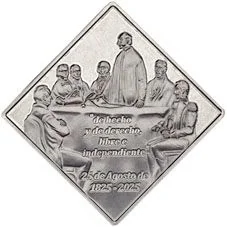
2000 pesos uruguayos (Independence) – Uruguay
Add to wishlist
Circulating commemorative coins
Commemoration: 200 th. Anniversary of Independence
Uruguay
Obverse
Description:
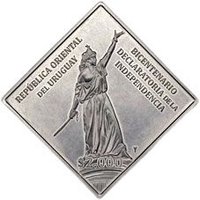
Diamond position. Detail of Independence monument by Giovanni Ferrari, country name top left, event top right.
Inscription:
REPÚBLICA ORIENTAL
DEL URUGUAY
BICENTENARIO
DECLARATORIA DE LA
INDEPENDENCIA
DEL URUGUAY
BICENTENARIO
DECLARATORIA DE LA
INDEPENDENCIA
Translation:
Eastern Republic
of Uruguay
Bicentennial
Declaration of
Independence
of Uruguay
Bicentennial
Declaration of
Independence
Script: Latin
Language: Spanish
Reverse
Description:
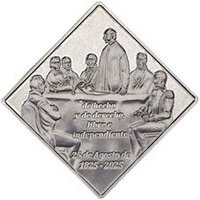
"Florida Assembly" by Eduardo Amézaga. Includes the Declaration's motto, event date, and issuing year.
Inscription:
"de hecho
y de derecho,
libre e
independiente"
25 de Agosto de
1825-2025
y de derecho,
libre e
independiente"
25 de Agosto de
1825-2025
Translation:
In fact
and by law,
free and
independent
25th of August
1825-2025
and by law,
free and
independent
25th of August
1825-2025
Script: Latin
Language: Spanish
Edge
Plain
Categories
| Symbol> Allegory |
| Art> Painting |
| Art> Sculpture |
| Event> Independence |
| Person> Politician |
Mints
| Name | Mark |
|---|---|
| Royal Dutch Mint | — |
Mintings
| Year | Mint Mark | Mintage | Quality | Collection |
|---|---|---|---|---|
| 2025 | — | 1,500 | Proof |
Historical background
In 2025, Uruguay maintains its long-standing and distinctive dual-currency system, where the Uruguayan peso (UYU) and the US dollar (USD) circulate freely alongside each other in daily transactions. This system, formalized in the 1970s, remains a cornerstone of the country's financial stability, driven by a historical preference for dollar savings due to past inflationary crises. While prices are often quoted in both currencies, the dollar is heavily favored for major purchases like real estate and vehicles, and for savings, reflecting deep-seated public trust. The Central Bank of Uruguay (BCU) continues to manage this duality without a fixed exchange rate, allowing for a floating regime with occasional interventions to curb excessive volatility.
The economic landscape in 2025 is characterized by moderate inflation, which remains a key policy challenge. After the global inflationary spike of the early 2020s, the BCU has successfully guided inflation downward, though it still hovers above the target range of 3% to 6%. This persistent inflationary pressure, influenced by both domestic demand and imported costs, continues to exert gradual depreciation pressure on the peso against the dollar. The government's commitment to fiscal discipline and the BCU's credible inflation-targeting framework have been crucial in maintaining investor confidence and preventing a loss-of-confidence spiral in the local currency.
Looking forward, the main debates in Uruguayan economic circles focus on the sustainability and costs of full dollarization versus the potential benefits of greater "pesification." Proponents of deeper dollarization argue it would permanently eliminate exchange rate risk and lower borrowing costs. However, the prevailing consensus, supported by the BCU and the ruling coalition, favors maintaining the current mixed system. This approach preserves monetary policy autonomy to respond to economic shocks, while the organic use of dollars provides a natural hedge for the financial system. The primary policy emphasis remains on further strengthening institutions, maintaining fiscal surpluses, and implementing structural reforms to enhance productivity, thereby fostering a stronger and more trusted peso over the long term.
The economic landscape in 2025 is characterized by moderate inflation, which remains a key policy challenge. After the global inflationary spike of the early 2020s, the BCU has successfully guided inflation downward, though it still hovers above the target range of 3% to 6%. This persistent inflationary pressure, influenced by both domestic demand and imported costs, continues to exert gradual depreciation pressure on the peso against the dollar. The government's commitment to fiscal discipline and the BCU's credible inflation-targeting framework have been crucial in maintaining investor confidence and preventing a loss-of-confidence spiral in the local currency.
Looking forward, the main debates in Uruguayan economic circles focus on the sustainability and costs of full dollarization versus the potential benefits of greater "pesification." Proponents of deeper dollarization argue it would permanently eliminate exchange rate risk and lower borrowing costs. However, the prevailing consensus, supported by the BCU and the ruling coalition, favors maintaining the current mixed system. This approach preserves monetary policy autonomy to respond to economic shocks, while the organic use of dollars provides a natural hedge for the financial system. The primary policy emphasis remains on further strengthening institutions, maintaining fiscal surpluses, and implementing structural reforms to enhance productivity, thereby fostering a stronger and more trusted peso over the long term.
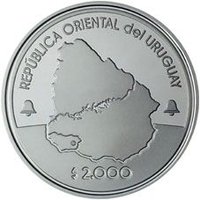
✨ Legendary