

50 Pence (Benjamin Britten) – United Kingdom
Circulating commemorative coins
Commemoration: 100th anniversary of the birth of Sir Benjamin Britten
United Kingdom
Context
Year: 2013
Issuer: United Kingdom 
Ruler: Elizabeth II
Currency:
(since 1971)
Total mintage: 5,305,098
Material
Diameter: 27.3 mm
Weight: 8 g
Thickness: 1.78 mm
Shape: Equilateral curve heptagon
Composition: Copper-nickel
Technique: Milled
Alignment: Medal alignment
flip
References
KM: #Click to copy to clipboard1253
Numista: #49190
Value
Exchange value: 0.50 GBP = $0.68
Inflation-adjusted value: 0.75 GBP
Obverse
Description:
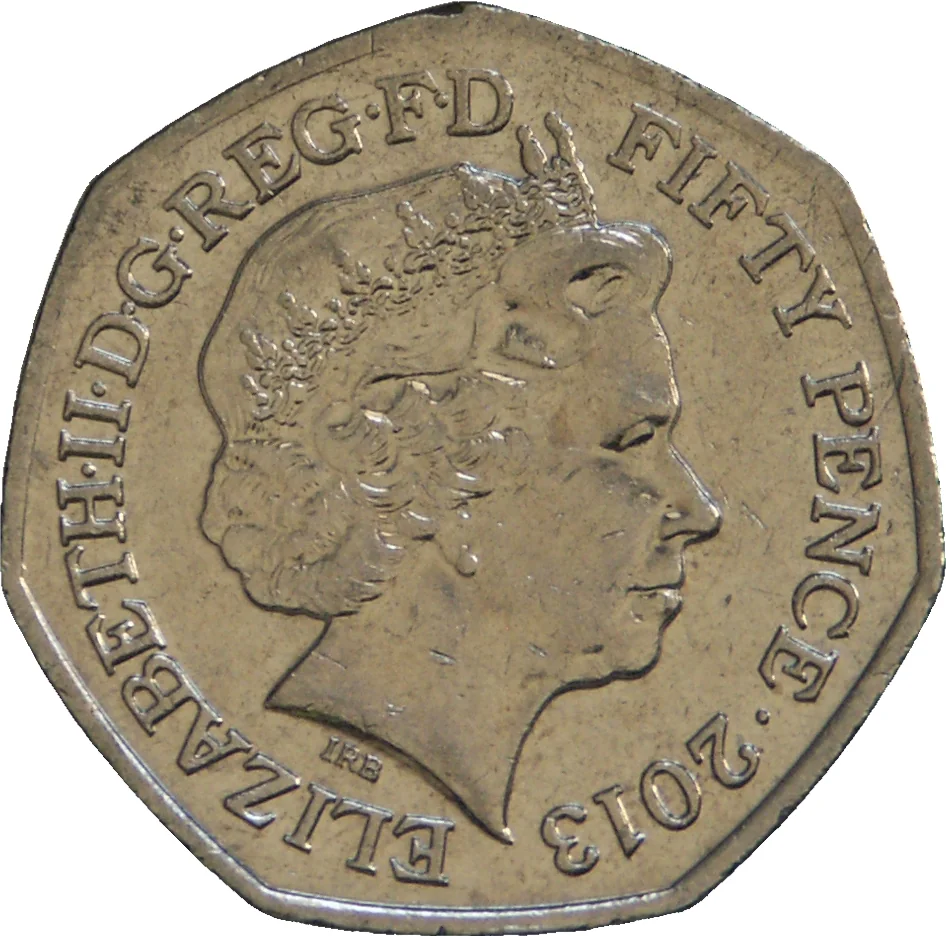
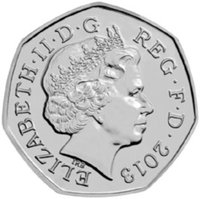
Queen Elizabeth IV facing right, wearing the Girls of Great Britain and Ireland tiara.
Inscription:
ELIZABETH·II D·G·REG·F·D FIFTY PENCE · 2013
IRB
IRB
Translation:
Elizabeth the Second, by the Grace of God, Queen, Defender of the Faith, Fifty Pence, 2013
IRB
IRB
Script: Latin
Engraver: Ian Rank-Broadley
Reverse
Description:
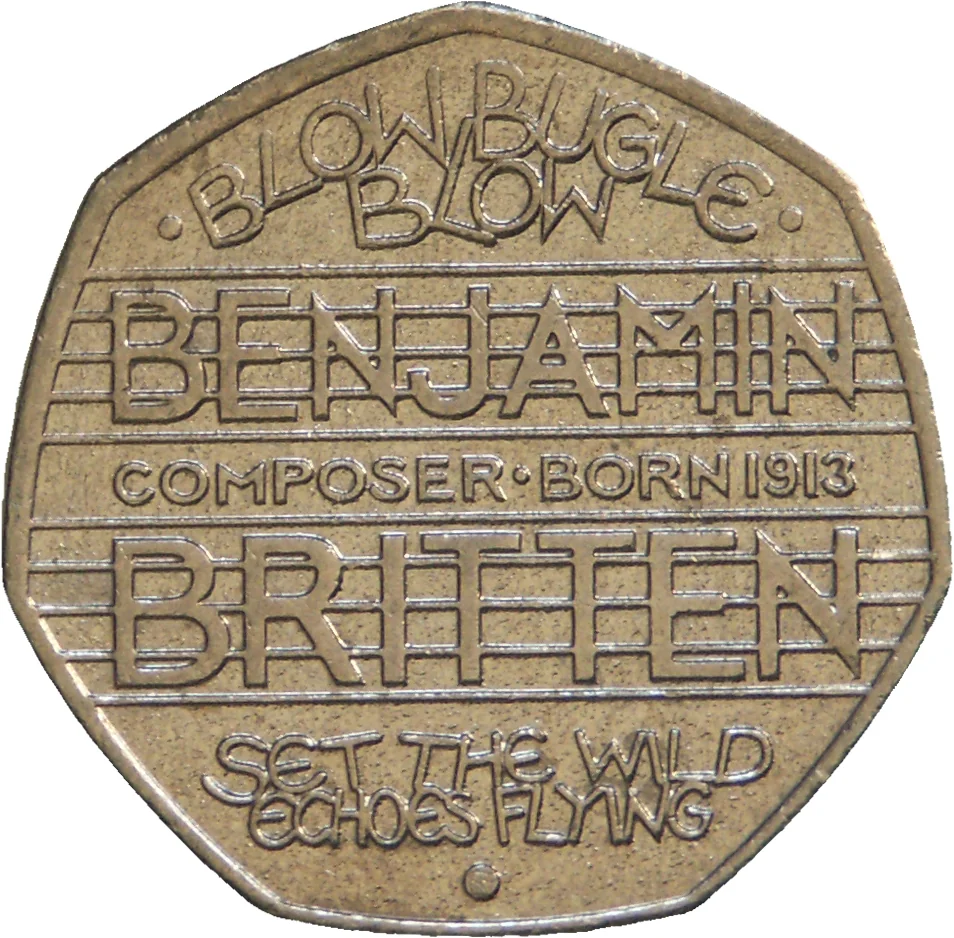
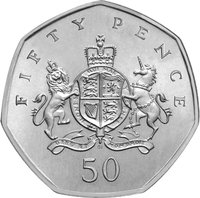
Lettering across seven lines with two staves.
Inscription:
· BLOW BUGLE ·
BLOW
BENJAMIN
COMPOSER·BORN 1913
BRITTEN
SET THE WILD
ECHOES FLYING
TP
BLOW
BENJAMIN
COMPOSER·BORN 1913
BRITTEN
SET THE WILD
ECHOES FLYING
TP
Script: Latin
Engraver: Tom Phillips
Edge
Plain
Categories
| Art> Music |
| Event> Birth anniversary |
Mints
| Name | Mark |
|---|---|
| Royal Mint | — |
Mintings
| Year | Mint Mark | Mintage | Quality | Collection |
|---|---|---|---|---|
| 2013 | — | 5,300,000 | ||
| 2013 | — | 5,098 | BU |
Historical background
In 2013, the United Kingdom's currency situation was dominated by the ongoing effects of the global financial crisis and the Bank of England's (BoE) unconventional policy response. Under the leadership of Governor Sir Mervyn King (and from July, Mark Carney), the BoE maintained its Bank Rate at a historic low of 0.5%, a level it had held since March 2009. More significantly, the Bank's Quantitative Easing (QE) programme, which involved creating new money to purchase government bonds (gilts), was expanded to a total of £375 billion. The primary aim of this sustained monetary stimulus was to keep borrowing costs low, encourage lending, and ward off the threat of deflation, thereby supporting a fragile economic recovery.
The value of the pound sterling (GBP) reflected this cautious and interventionist environment. Throughout much of the year, sterling experienced significant volatility but ended on a strong upward trend, particularly against a weakening US dollar and the euro. This appreciation was not driven by hawkish UK monetary policy, but rather by growing market confidence that the UK recovery was gaining more solid footing compared to its European neighbours, leading to anticipations of future interest rate rises. The government's austerity programme, while politically contentious, was seen by currency markets as fiscally credible, which also provided underlying support for the pound.
However, a defining feature of the 2013 currency landscape was the BoE's forward guidance framework, introduced by Mark Carney in August. This committed the Monetary Policy Committee to not consider raising interest rates until the UK unemployment rate fell to 7%, a threshold not expected to be reached for several years. The policy was explicitly designed to manage market expectations, suppress the value of sterling to aid exports, and provide certainty to businesses and households. While initially causing sterling to dip, its impact was short-lived as improving economic data quickly led markets to bet that the 7% threshold would be hit far sooner than the BoE projected, setting the stage for policy tensions in the years ahead.
The value of the pound sterling (GBP) reflected this cautious and interventionist environment. Throughout much of the year, sterling experienced significant volatility but ended on a strong upward trend, particularly against a weakening US dollar and the euro. This appreciation was not driven by hawkish UK monetary policy, but rather by growing market confidence that the UK recovery was gaining more solid footing compared to its European neighbours, leading to anticipations of future interest rate rises. The government's austerity programme, while politically contentious, was seen by currency markets as fiscally credible, which also provided underlying support for the pound.
However, a defining feature of the 2013 currency landscape was the BoE's forward guidance framework, introduced by Mark Carney in August. This committed the Monetary Policy Committee to not consider raising interest rates until the UK unemployment rate fell to 7%, a threshold not expected to be reached for several years. The policy was explicitly designed to manage market expectations, suppress the value of sterling to aid exports, and provide certainty to businesses and households. While initially causing sterling to dip, its impact was short-lived as improving economic data quickly led markets to bet that the 7% threshold would be hit far sooner than the BoE projected, setting the stage for policy tensions in the years ahead.

🌱 Very Common