

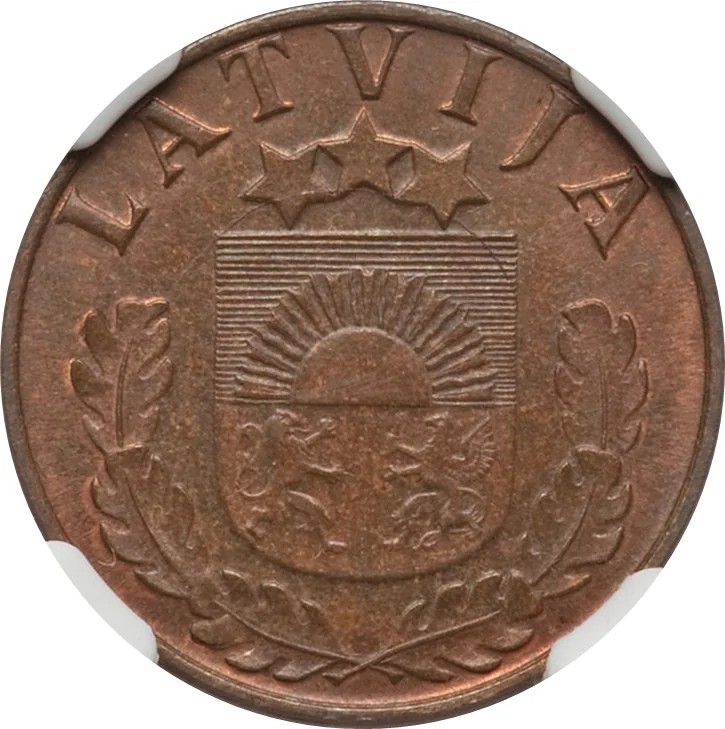
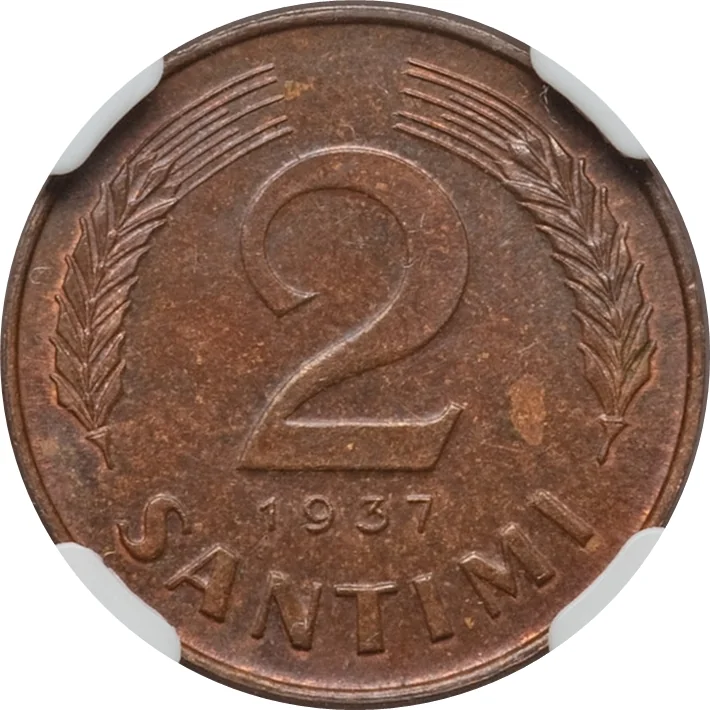

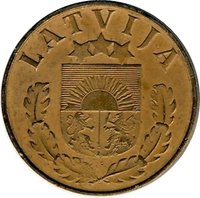
Obverse
Description:
National arms over sprigs.
Inscription:
LATVIJA
Script: Latin
Engraver: Ludolfs Liberts
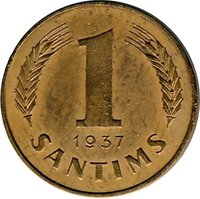
Reverse
Edge
Plain
Categories
| Symbols> Coat of Arms |
Mints
| Name | Mark |
|---|---|
| State Printing House and Mint | — |
Mintings
| Year | Mint Mark | Mintage | Quality | Collection |
|---|---|---|---|---|
| 1937 | — | 44,600 | ||
| 1939 | — | 5,000,000 |
Historical background
In 1937, Latvia's currency situation was defined by stability and national sovereignty, underpinned by the Latvian lats. Introduced in 1922 after a period of hyperinflation with the Latvian rublis, the lats had become a symbol of the young nation's economic resilience and was often referred to locally as "the little lion" for its strength. It was backed by a substantial gold and foreign exchange reserve, adhering to the gold standard at a fixed rate of 50 lati to one British pound sterling. This conservative monetary policy, managed by the Bank of Latvia, ensured low inflation and fostered confidence both domestically and internationally.
The Latvian economy in this period was primarily agricultural, but it was increasingly integrated into global trade, exporting butter, bacon, timber, and textiles. The stability of the lats was crucial for this trade, providing predictable exchange rates with major trading partners like the United Kingdom and Germany. Domestically, the currency's strength supported a growing manufacturing sector and a rising standard of living during the mid-1930s. The physical lats coins, made of silver, were renowned for their high quality and artistic design, further cementing the currency's role as a point of national pride.
However, this stability existed within a fragile geopolitical context. While the Latvian economy was robust in 1937, the shadow of the Great Depression had only recently lifted, and the looming threat of war in Europe began to cast uncertainty over the future. The fixed exchange rate and gold-backed system, while a pillar of strength, would soon be tested by external pressures. Within two years, the events of World War II would irrevocably alter Latvia's sovereignty and, consequently, the fate of the strong and independent lats.
The Latvian economy in this period was primarily agricultural, but it was increasingly integrated into global trade, exporting butter, bacon, timber, and textiles. The stability of the lats was crucial for this trade, providing predictable exchange rates with major trading partners like the United Kingdom and Germany. Domestically, the currency's strength supported a growing manufacturing sector and a rising standard of living during the mid-1930s. The physical lats coins, made of silver, were renowned for their high quality and artistic design, further cementing the currency's role as a point of national pride.
However, this stability existed within a fragile geopolitical context. While the Latvian economy was robust in 1937, the shadow of the Great Depression had only recently lifted, and the looming threat of war in Europe began to cast uncertainty over the future. The fixed exchange rate and gold-backed system, while a pillar of strength, would soon be tested by external pressures. Within two years, the events of World War II would irrevocably alter Latvia's sovereignty and, consequently, the fate of the strong and independent lats.
🌱 Common