

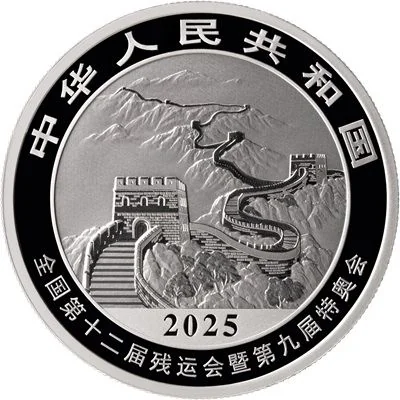
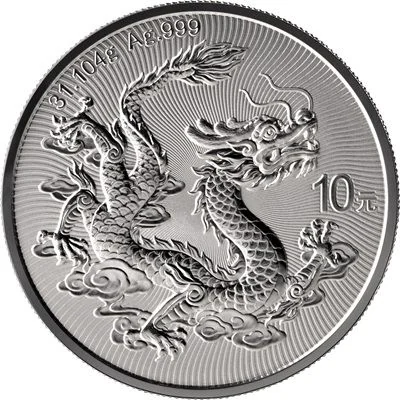
10 yuan – People's Republic of China
Add to wishlist
Non-circulating coins
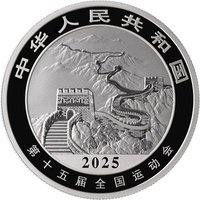
Commemoration: 12th National Games for Persons with Disabilities and 9th National Special Olympic Games
China
Context
Year: 2025
Country: China
Issuer: People's Republic of China
Issuing organization: People's Bank of China
Period:
(since 1949)
Currency:
(since 1955)
Total mintage: 10,000
Material
Diameter: 38 mm
Weight: 31.1 g
Silver Weight:: 31.07 g
Shape: Round
Composition: 99.9% Silver
Standard: Silver ounce
Magnetic: No
Technique: Milled
Alignment: Medal alignment
flip
References
Numista: #491781
Value
Exchange value: 10 CNY
Bullion value: $77.85
Obverse
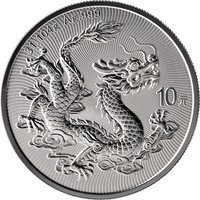
Reverse
Edge
Reeded
Categories
| Mythology> Fantastic animal |
Mints
| Name | Mark |
|---|---|
| Shenzhen Mint | — |
Mintings
| Year | Mint Mark | Mintage | Quality | Collection |
|---|---|---|---|---|
| 2025 | — | 10,000 |
Historical background
In 2025, the currency situation of the People's Republic of China is defined by a strategic balancing act between domestic stability, internationalization ambitions, and external pressures. The primary focus of the People's Bank of China (PBOC) remains on managing the onshore yuan (CNY) within a stable, managed float against a basket of currencies, prioritizing control over volatility to underpin economic planning and financial security. This "managed" approach involves careful interventions and macro-prudential tools to counteract speculative flows, ensuring the currency acts as a shock absorber rather than a source of instability amid property market adjustments and targeted fiscal stimulus. Domestically, the digital yuan (e-CNY) has seen accelerated integration into the retail and wholesale payment ecosystems, further solidifying state oversight over the monetary base while enhancing financial inclusion.
Internationally, the yuan's role continues to grow incrementally, driven by its weight in IMF's Special Drawing Rights (SDR), expanded bilateral swap lines, and its use in settling a growing share of China's commodity and trade transactions, particularly with Global South partners and within regional blocs like the BRICS payment infrastructure initiatives. However, full convertibility remains deliberately constrained, with the capital account carefully gated to prevent destabilizing outflows. The offshore yuan (CNH) market in Hong Kong and other hubs remains a critical pressure valve and testing ground for international demand, though its valuation continues to be anchored by the mainland's central parity rate setting mechanism.
External factors present significant headwinds. The currency faces persistent downward pressure from the interest rate differential with major Western economies, particularly if the U.S. Federal Reserve maintains relatively high policy rates. Geopolitical tensions and "de-risking" strategies by Western nations also create volatility in cross-border investment flows. Consequently, Chinese authorities in 2025 are navigating a narrow path: allowing sufficient yuan flexibility to reflect economic fundamentals and maintain export competitiveness, while rigorously defending against any self-reinforcing cycles of depreciation that could trigger capital flight or imported inflation, all within the overarching framework of state-led financial governance.
Internationally, the yuan's role continues to grow incrementally, driven by its weight in IMF's Special Drawing Rights (SDR), expanded bilateral swap lines, and its use in settling a growing share of China's commodity and trade transactions, particularly with Global South partners and within regional blocs like the BRICS payment infrastructure initiatives. However, full convertibility remains deliberately constrained, with the capital account carefully gated to prevent destabilizing outflows. The offshore yuan (CNH) market in Hong Kong and other hubs remains a critical pressure valve and testing ground for international demand, though its valuation continues to be anchored by the mainland's central parity rate setting mechanism.
External factors present significant headwinds. The currency faces persistent downward pressure from the interest rate differential with major Western economies, particularly if the U.S. Federal Reserve maintains relatively high policy rates. Geopolitical tensions and "de-risking" strategies by Western nations also create volatility in cross-border investment flows. Consequently, Chinese authorities in 2025 are navigating a narrow path: allowing sufficient yuan flexibility to reflect economic fundamentals and maintain export competitiveness, while rigorously defending against any self-reinforcing cycles of depreciation that could trigger capital flight or imported inflation, all within the overarching framework of state-led financial governance.

✨ Legendary