

5 Pesos (General Urquiza) – Argentina
Non-circulating coins
Commemoration: 200th Anniversary of Birth of General Urquiza
Argentina
Obverse
Description:
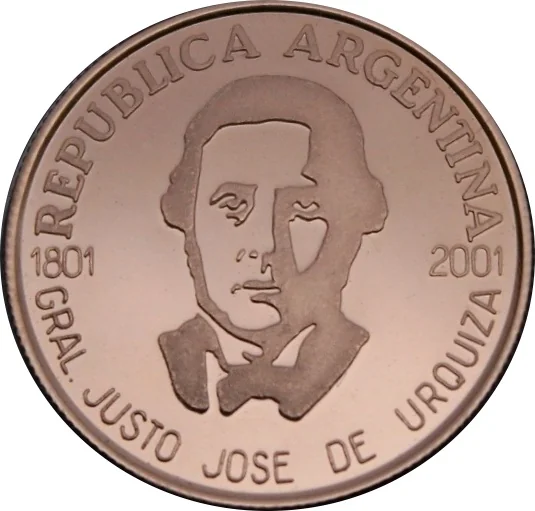
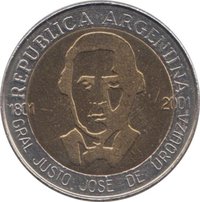
General Urquiza facing forward; to his left, "1801", and to his right, "2001". Above, "REPUBLICA ARGENTINA"; below, "Gral. JUSTO JOSE de URQUIZA".
Inscription:
REPUBLICA ARGENTINA
1901 2001
GRAL JUSTO JOSE DE URQUIZA
1901 2001
GRAL JUSTO JOSE DE URQUIZA
Translation:
REPUBLIC OF ARGENTINA
1901 2001
GEN JUSTO JOSE DE URQUIZA
1901 2001
GEN JUSTO JOSE DE URQUIZA
Script: Latin
Language: Spanish
Reverse
Description:
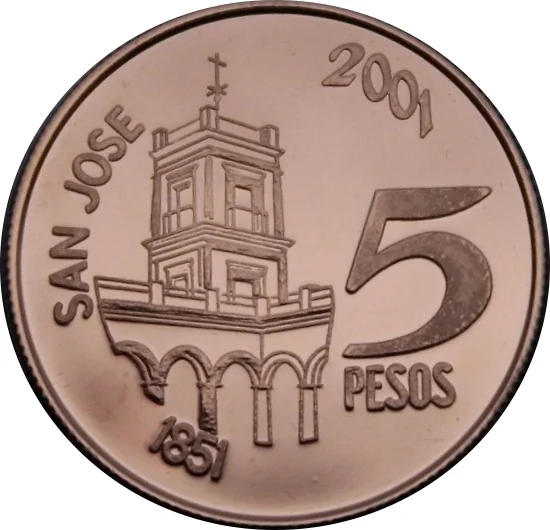
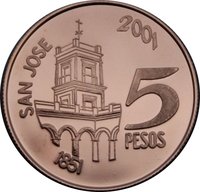
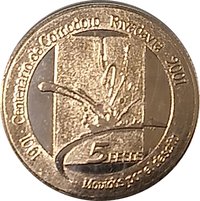
It depicts a sector of Estancia San José, with the face value "5 PESOS" and year "2001" opposite the commemorative year "1851". "SAN JOSE" appears inverted, and the coin's axis of rotation is vertical.
Inscription:
1851 SAN JOSE 2001
5
PESOS
5
PESOS
Script: Latin
Edge
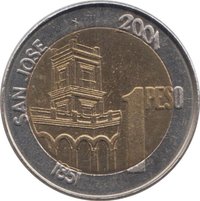
San José palace in Entre Ríos, Argentina.
Legend:
SAN JOSE 1851 2001
1 PESO
1 PESO
Categories
| Person> Military leader |
| Person> Politician |
Mints
| Name | Mark |
|---|---|
| Buenos Aires | — |
Mintings
| Year | Mint Mark | Mintage | Quality | Collection |
|---|---|---|---|---|
| 2001 | — | 1,000 | Proof |
Historical background
Argentina entered 2001 in a state of profound economic and political crisis, the culmination of a decade under the Convertibility Plan. Established in 1991, this plan had pegged the Argentine peso at a one-to-one parity with the U.S. dollar, successfully ending hyperinflation but severely restricting monetary policy. By the late 1990s, the rigid peg became a straitjacket. A strong U.S. dollar made Argentine exports expensive, leading to a deep recession, while massive government debt—much of it denominated in dollars—soared as tax revenues collapsed. Public faith in the banking system and the government's ability to maintain the peg began to evaporate.
In a desperate attempt to stop capital flight and preserve dwindling dollar reserves, the government imposed the "corralito" in December 2001—a strict freeze on bank withdrawals. This measure proved catastrophic, effectively freezing the savings of the middle class and paralyzing the economy. Street protests and riots erupted, leading to the resignation of President Fernando de la Rúa. In a chaotic two-week period, Argentina cycled through five presidents, defaulting on over $100 billion in public debt—the largest sovereign default in history at the time.
The currency regime finally collapsed in January 2002. The government abandoned the peso-dollar peg, leading to a massive devaluation where the peso lost nearly 75% of its value against the dollar within a year. This ended the convertibility era, causing widespread impoverishment as savings were wiped out, but also allowing for a painful economic rebalancing. The 2001 crisis left a deep scar on the national psyche, creating a lasting distrust of financial institutions, political elites, and the International Monetary Fund, whose prescribed austerity measures were widely blamed for exacerbating the disaster.
In a desperate attempt to stop capital flight and preserve dwindling dollar reserves, the government imposed the "corralito" in December 2001—a strict freeze on bank withdrawals. This measure proved catastrophic, effectively freezing the savings of the middle class and paralyzing the economy. Street protests and riots erupted, leading to the resignation of President Fernando de la Rúa. In a chaotic two-week period, Argentina cycled through five presidents, defaulting on over $100 billion in public debt—the largest sovereign default in history at the time.
The currency regime finally collapsed in January 2002. The government abandoned the peso-dollar peg, leading to a massive devaluation where the peso lost nearly 75% of its value against the dollar within a year. This ended the convertibility era, causing widespread impoverishment as savings were wiped out, but also allowing for a painful economic rebalancing. The 2001 crisis left a deep scar on the national psyche, creating a lasting distrust of financial institutions, political elites, and the International Monetary Fund, whose prescribed austerity measures were widely blamed for exacerbating the disaster.
✨ Legendary