

5 Pesos (Jorge Luis Borges) – Argentina
Non-circulating coins
Commemoration: 100th anniversary - Birth of Jorge Luis Borges
Argentina

Obverse
Description:
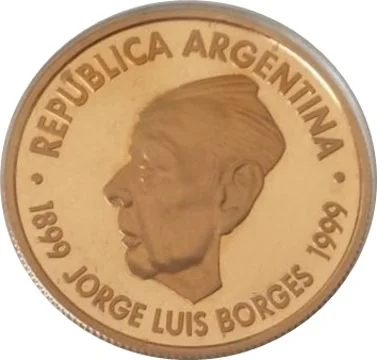
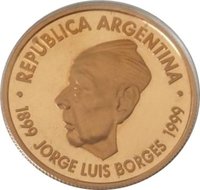
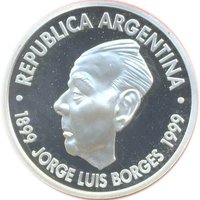
The central field features a left profile of Jorge Luis Borges. Above, "REPUBLICA ARGENTINA" arches along the edge, while below, "1899 JORGE LUIS BORGES 1999" is set between pearls.
Inscription:
REPÚBLICA ARGENTINA
· 1899 JORGE LUIS BORGES 1999 ·
· 1899 JORGE LUIS BORGES 1999 ·
Translation:
REPUBLIC OF ARGENTINA
· 1899 JORGE LUIS BORGES 1999 ·
· 1899 JORGE LUIS BORGES 1999 ·
Script: Latin
Language: Spanish
Reverse
Description:
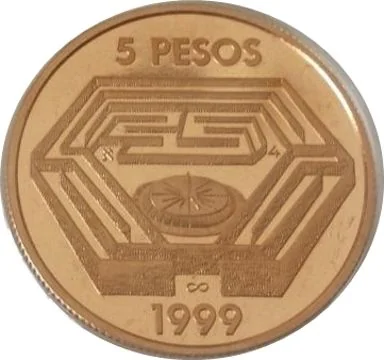
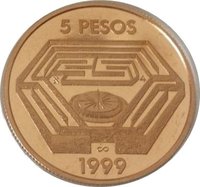
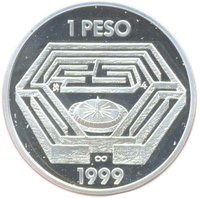
A labyrinth centers the design, with a sundial at its middle. Above is "5 PESOS"; below, the year "1999".
Inscription:
5 PESOS
1999
1999
Script: Latin
Edge
Reeded
Mints
| Name | Mark |
|---|---|
| Monnaie de Paris | — |
Mintings
| Year | Mint Mark | Mintage | Quality | Collection |
|---|---|---|---|---|
| 1999 | — | 2,000 | Proof |
Historical background
By 1999, Argentina was in the third year of a painful recession, trapped by the rigid constraints of its Convertibility Plan. Established in 1991 to halt hyperinflation, this plan had fixed the Argentine peso at a one-to-one parity with the U.S. dollar and required full backing of the monetary base with foreign reserves. Initially successful in stabilizing prices and attracting foreign investment, the system ultimately created a profound loss of competitiveness. As the U.S. dollar strengthened in the late 1990s, Argentina's peso became overvalued, making its exports expensive and imports cheap, which devastated local industry and widened the trade deficit.
The government of President Carlos Menem, and later Fernando de la Rúa who took office in December 1999, faced a severe fiscal crisis exacerbated by this economic straitjacket. With the currency peg preventing devaluation or independent monetary policy, the only tools available were harsh austerity and borrowing. Public debt soared as the state tried to maintain the peg while funding deficits, leaving the economy vulnerable to external shocks. The situation was further strained by Brazil's 1999 devaluation, which undercut Argentina's key trading partner and made Brazilian goods far cheaper, dealing another blow to Argentine exports.
Consequently, Argentina in 1999 was characterized by a deepening sense of entrapment. The currency regime that had once been a savior was now widely seen as unsustainable, yet abandoning it was considered politically and economically catastrophic, threatening a massive bank run and a return to hyperinflation. This created a policy paralysis, with the country caught between the severe pain of continuing recession under convertibility and the feared chaos of abandoning it, setting the stage for the profound crisis that would fully erupt in 2001-2002.
The government of President Carlos Menem, and later Fernando de la Rúa who took office in December 1999, faced a severe fiscal crisis exacerbated by this economic straitjacket. With the currency peg preventing devaluation or independent monetary policy, the only tools available were harsh austerity and borrowing. Public debt soared as the state tried to maintain the peg while funding deficits, leaving the economy vulnerable to external shocks. The situation was further strained by Brazil's 1999 devaluation, which undercut Argentina's key trading partner and made Brazilian goods far cheaper, dealing another blow to Argentine exports.
Consequently, Argentina in 1999 was characterized by a deepening sense of entrapment. The currency regime that had once been a savior was now widely seen as unsustainable, yet abandoning it was considered politically and economically catastrophic, threatening a massive bank run and a return to hyperinflation. This created a policy paralysis, with the country caught between the severe pain of continuing recession under convertibility and the feared chaos of abandoning it, setting the stage for the profound crisis that would fully erupt in 2001-2002.
💎 Extremely Rare