


10 dollars – Canada
Add to wishlist
Canada
Context
Material
Diameter: 20 mm
Weight: 7.8 g
Gold Weight:: 7.80 g
Shape: Round
Composition: 99.99% Gold
Standard: Silver quarter ounce
Magnetic: No
Technique: Milled
Alignment: Medal alignment
flip

References
KM: #
Numista: #490198
Value
Exchange value: 10 CAD
Bullion value: $1195.03
Inflation-adjusted value: 11.90 CAD
Obverse
Description:
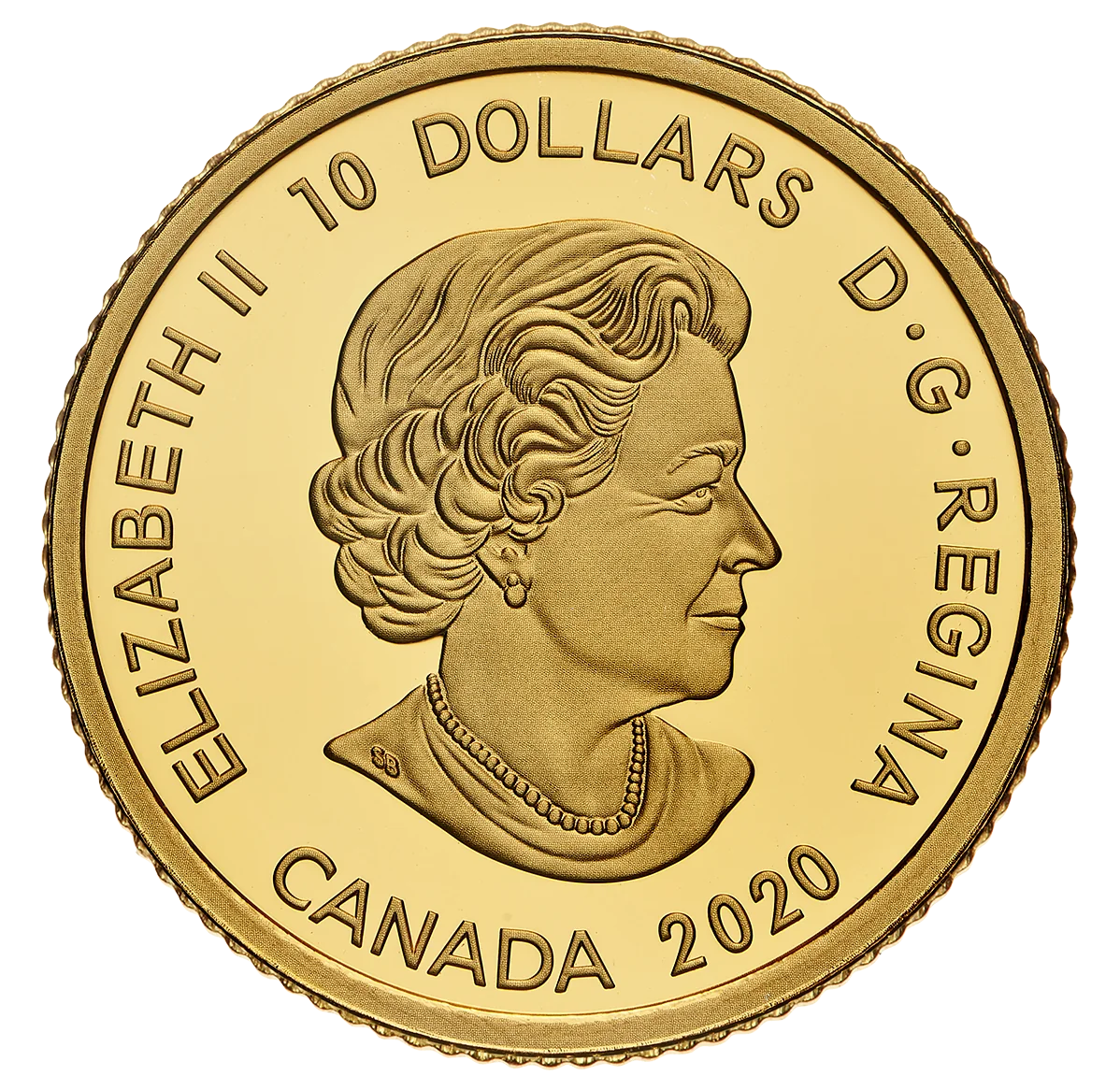
Queen Elizabeth II at 77, facing right, wearing a necklace and earrings.
Inscription:
ELIZABETH II 10 DOLLARS D·G·REGINA
CANADA 2020
CANADA 2020
Translation:
Elizabeth II by the Grace of God Queen 10 Dollars
Canada 2020
Canada 2020
Script: Latin
Engraver: Susan Taylor
Designer: Susanna Blunt
Reverse
Description:
A modern interpretation of Louis XIV's 1670 15-sol coin.
Inscription:
GLORIAM REGNITVI DICENT 1670
A
A
Script: Latin
Edge
Reeded
Mints
| Name | Mark |
|---|---|
| Royal Canadian Mint of Ottawa | — |
Mintings
| Year | Mint Mark | Mintage | Quality | Collection |
|---|---|---|---|---|
| 2020 | — | 1,000 | Proof |
Historical background
In 2020, Canada's currency, the Canadian dollar (CAD), was dominated by the profound economic shock of the COVID-19 pandemic. The year began with the loonie trading in a relatively stable range near 77 US cents. However, as the global crisis escalated in March, a simultaneous collapse in oil prices—due to a Saudi-Russia price war and plummeting demand—and a worldwide dash for safe-haven US dollars triggered a sharp depreciation. The CAD plunged to multi-year lows, briefly touching approximately 69 US cents in mid-March, reflecting Canada's dual vulnerability as a commodity exporter and a nation integrated into global risk sentiment.
The Bank of Canada (BoC) responded with unprecedented monetary policy measures to stabilize financial markets and support the economy. It slashed its benchmark interest rate three times in rapid succession, from 1.75% to 0.25%, effectively reaching the effective lower bound. Complementing this, the BoC launched large-scale asset purchase (quantitative easing) programs, including provincial and corporate bonds, which expanded its balance sheet dramatically. These actions, alongside massive federal fiscal support, provided a backstop and helped the CAD recover from its lows. By year's end, a weakening US dollar and a tentative recovery in oil prices and global risk appetite pushed the loonie back to around 78 US cents.
Overall, 2020 was a year of extreme volatility that tested the resilience of Canada's financial system. The currency's trajectory mirrored the pandemic's phases: a crisis-driven selloff, followed by a stabilization and recovery fueled by aggressive policy support. While the CAD ended the year close to where it started in nominal terms, the journey highlighted its enduring sensitivity to commodity prices, global risk sentiment, and the critical role of central bank intervention during a period of profound economic uncertainty.
The Bank of Canada (BoC) responded with unprecedented monetary policy measures to stabilize financial markets and support the economy. It slashed its benchmark interest rate three times in rapid succession, from 1.75% to 0.25%, effectively reaching the effective lower bound. Complementing this, the BoC launched large-scale asset purchase (quantitative easing) programs, including provincial and corporate bonds, which expanded its balance sheet dramatically. These actions, alongside massive federal fiscal support, provided a backstop and helped the CAD recover from its lows. By year's end, a weakening US dollar and a tentative recovery in oil prices and global risk appetite pushed the loonie back to around 78 US cents.
Overall, 2020 was a year of extreme volatility that tested the resilience of Canada's financial system. The currency's trajectory mirrored the pandemic's phases: a crisis-driven selloff, followed by a stabilization and recovery fueled by aggressive policy support. While the CAD ended the year close to where it started in nominal terms, the journey highlighted its enduring sensitivity to commodity prices, global risk sentiment, and the critical role of central bank intervention during a period of profound economic uncertainty.


✨ Legendary