

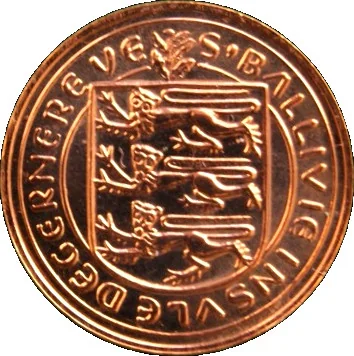
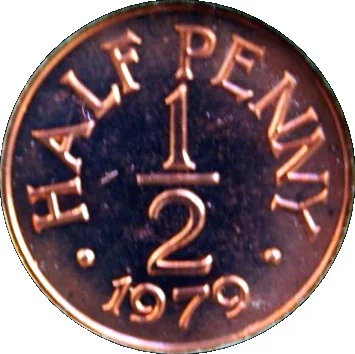
½ Penny – Guernsey
Context
Year: 1979
Country: British Crown dependencies
Issuer: Guernsey
Ruler: Elizabeth II
Currency:
(since 1971)
Demonetized: Yes
Total mintage: 20,000
Material
References
KM: #Click to copy to clipboard33
Numista: #49010
Value
Exchange value: 0.005 GGP
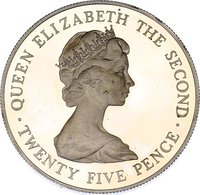
Obverse
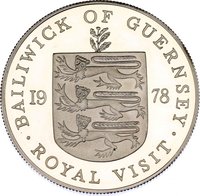
Reverse
Edge
Plain
Mints
| Name | Mark |
|---|---|
| Royal Mint | — |
Mintings
| Year | Mint Mark | Mintage | Quality | Collection |
|---|---|---|---|---|
| 1979 | — | 20,000 | Proof |
Historical background
In 1979, Guernsey's currency situation was characterised by its long-standing and pragmatic use of British sterling, but with a unique local dimension. As a British Crown Dependency, the island was not part of the United Kingdom and had its own government responsible for domestic affairs, including the issue of currency. The UK pound sterling (£) was legal tender and formed the basis of the economy, but Guernsey had issued its own distinct banknotes and coins for decades. These local issues, denominated in pounds sterling, circulated alongside English and Scottish notes, creating a mixed but functionally unified monetary environment.
The year itself was not one of dramatic monetary change, but it fell within a period of significant economic pressure and inflation that affected the entire British Isles. Following the 1976 sterling crisis and the UK's International Monetary Fund (IMF) loan, the late 1970s were a time of high inflation and industrial unrest. Guernsey, while fiscally conservative and with its own reserves, was not insulated from the inflationary trends impacting the sterling zone. The value of the Guernsey pound was pegged 1:1 with sterling, meaning the island's currency and purchasing power were directly tied to the economic fortunes and monetary policy of the UK.
Against this backdrop, the States of Guernsey continued to manage its local note issue as a practical tool for generating revenue through seigniorage (the profit made from issuing currency) and as a symbol of its constitutional autonomy. The local notes, featuring distinct Guernsey imagery, remained a point of pride and a daily reminder of the island's separate identity, even while its monetary policy was effectively set by the Bank of England. Thus, in 1979, Guernsey's currency system was a stable hybrid: deeply integrated with the struggling UK economy for its value, yet operationally and symbolically distinct in its physical manifestation.
The year itself was not one of dramatic monetary change, but it fell within a period of significant economic pressure and inflation that affected the entire British Isles. Following the 1976 sterling crisis and the UK's International Monetary Fund (IMF) loan, the late 1970s were a time of high inflation and industrial unrest. Guernsey, while fiscally conservative and with its own reserves, was not insulated from the inflationary trends impacting the sterling zone. The value of the Guernsey pound was pegged 1:1 with sterling, meaning the island's currency and purchasing power were directly tied to the economic fortunes and monetary policy of the UK.
Against this backdrop, the States of Guernsey continued to manage its local note issue as a practical tool for generating revenue through seigniorage (the profit made from issuing currency) and as a symbol of its constitutional autonomy. The local notes, featuring distinct Guernsey imagery, remained a point of pride and a daily reminder of the island's separate identity, even while its monetary policy was effectively set by the Bank of England. Thus, in 1979, Guernsey's currency system was a stable hybrid: deeply integrated with the struggling UK economy for its value, yet operationally and symbolically distinct in its physical manifestation.
⭐ Rare