

1 Rupia – Portuguese India
India
Context
Years: 1829–1833
Country: India 
Issuer: Portuguese India
Ruler: Miguel I
Currency:
(1706—1880)
Demonetized: Yes
Material
Diameter: 23 mm
Weight: 11 g
Silver weight: 11.00 g
Shape: Irregular round
Composition: Silver
Magnetic: No
Technique: Hammered
References
KM: #Click to copy to clipboard254
Numista: #48986
Value
Bullion value: $30.86
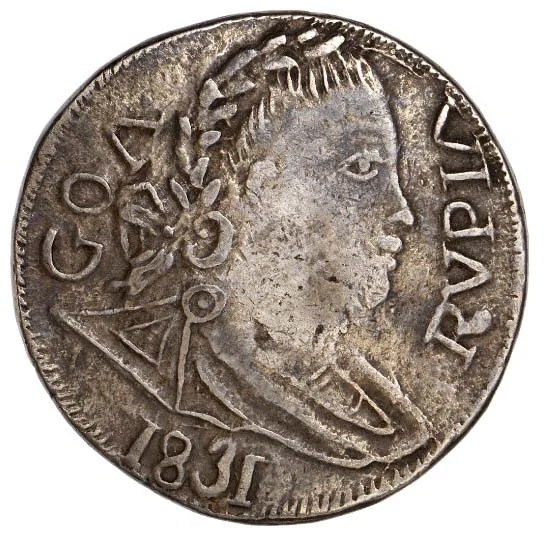
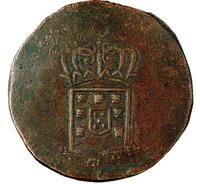
Obverse
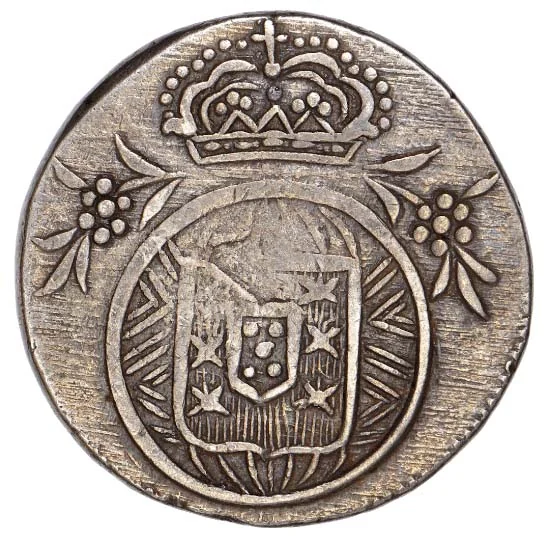
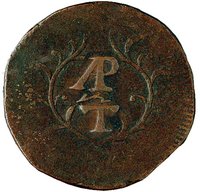
Reverse
Description:
Royal Arms
Edge
Mints
| Name | Mark |
|---|---|
| Goa | — |
Mintings
| Year | Mint Mark | Mintage | Quality | Collection |
|---|---|---|---|---|
| 1829 | GOA | — | ||
| 1830 | GOA | — | ||
| 1831 | DOA | — | ||
| 1831 | GOA | — | ||
| 1832 | GOA | — | ||
| 1833 | GOA | — |
Historical background
In 1829, the currency situation in Portuguese India, centered on the territories of Goa, Daman, and Diu, was characterized by monetary fragmentation and economic strain. The official currency was the Portuguese Indian Rupia, a silver coin theoretically pegged to the British Indian Rupee, which dominated regional trade. However, the circulation was a chaotic mix of actual Portuguese coins, a vast array of older and debased local and regional currencies (like the Xerafim and Tangas), and a heavy influx of British Indian Rupees. This proliferation created significant challenges for commerce and administration, as exchange rates between these units were unstable and often arbitrary.
This monetary disarray was symptomatic of Portugal's wider imperial decline and the shifting economic gravity in the Indian Ocean. Following the end of the lucrative Portuguese monopoly on the Goa-to-Lisbon trade route in the early 19th century, the enclave's economy had atrophied. British India's overwhelming commercial and financial power meant its currency naturally flowed into Portuguese territories, undermining local monetary authority. The Portuguese administration, financially weak and administratively inefficient, lacked the resources to impose a uniform currency system or control the quality and quantity of money in circulation.
Consequently, by 1829, the monetary landscape was one of practical dependency and confusion. While official accounts were kept in Réis (the metropolitan Portuguese unit), daily transactions were conducted in a jumble of physical coins. This instability hindered economic development, facilitated fraud, and reflected the broader reality of Portuguese India's precarious position: a relic of a former empire now operating in the economic orbit of the British Raj, struggling to maintain a coherent fiscal system amidst profound regional change.
This monetary disarray was symptomatic of Portugal's wider imperial decline and the shifting economic gravity in the Indian Ocean. Following the end of the lucrative Portuguese monopoly on the Goa-to-Lisbon trade route in the early 19th century, the enclave's economy had atrophied. British India's overwhelming commercial and financial power meant its currency naturally flowed into Portuguese territories, undermining local monetary authority. The Portuguese administration, financially weak and administratively inefficient, lacked the resources to impose a uniform currency system or control the quality and quantity of money in circulation.
Consequently, by 1829, the monetary landscape was one of practical dependency and confusion. While official accounts were kept in Réis (the metropolitan Portuguese unit), daily transactions were conducted in a jumble of physical coins. This instability hindered economic development, facilitated fraud, and reflected the broader reality of Portuguese India's precarious position: a relic of a former empire now operating in the economic orbit of the British Raj, struggling to maintain a coherent fiscal system amidst profound regional change.
✨ Legendary