

2 lire – Italy
Add to wishlist
Italy
Context
Years: 1901–1907
Issuer: Italy
Ruler: Vittorio Emanuele III
Currency:
(1861—2001)
Demonetization: 1 October 1917
Total mintage: 4,690,502
Material
References
KM: #
Numista: #4898
Value
Exchange value: 2 ITL
Bullion value: $21.29
Obverse
Description:
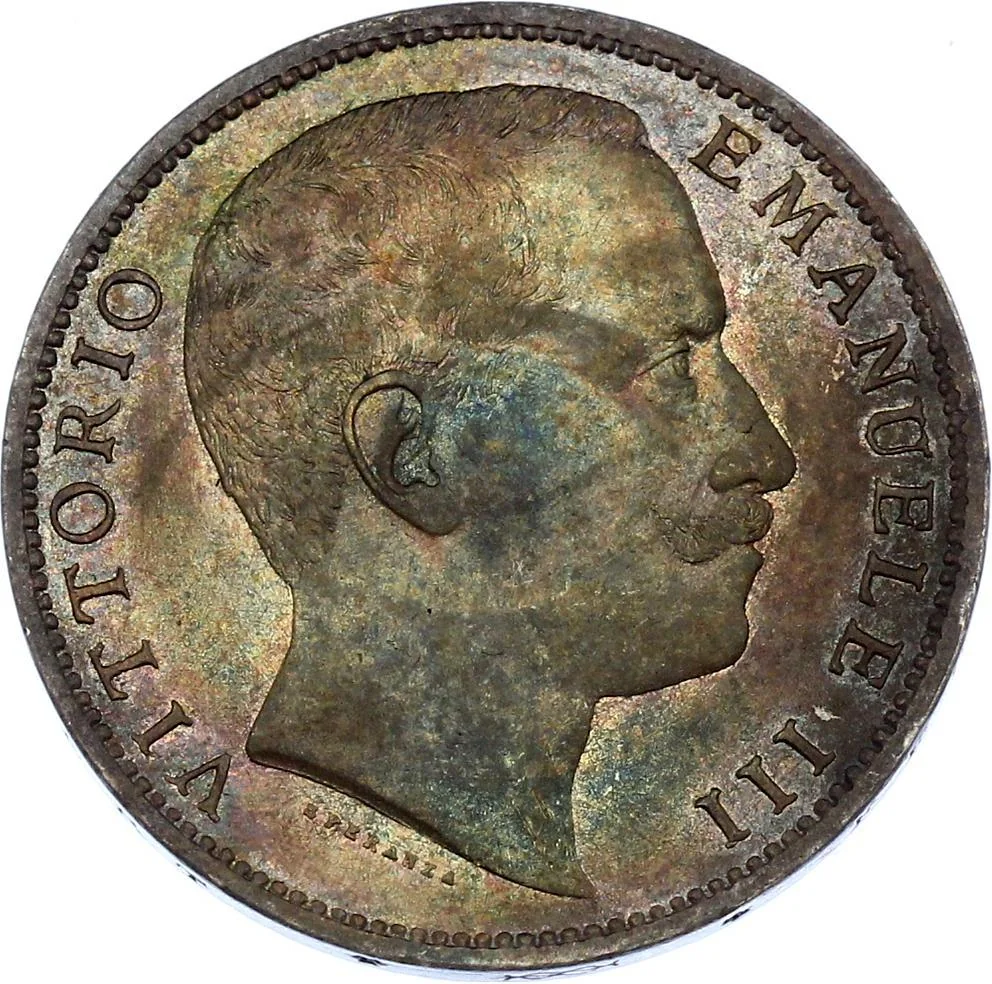
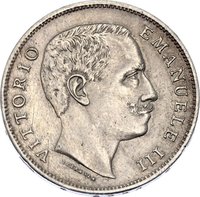
King Vittorio Emanuele III, right-facing portrait. Engraver's name below.
Inscription:
VITTORIO EMANUELE III
SPERANZA
SPERANZA
Translation:
Victor Emmanuel III
Hope
Hope
Script: Latin
Language: Italian
Engraver: Filippo Speranza
Reverse
Description:
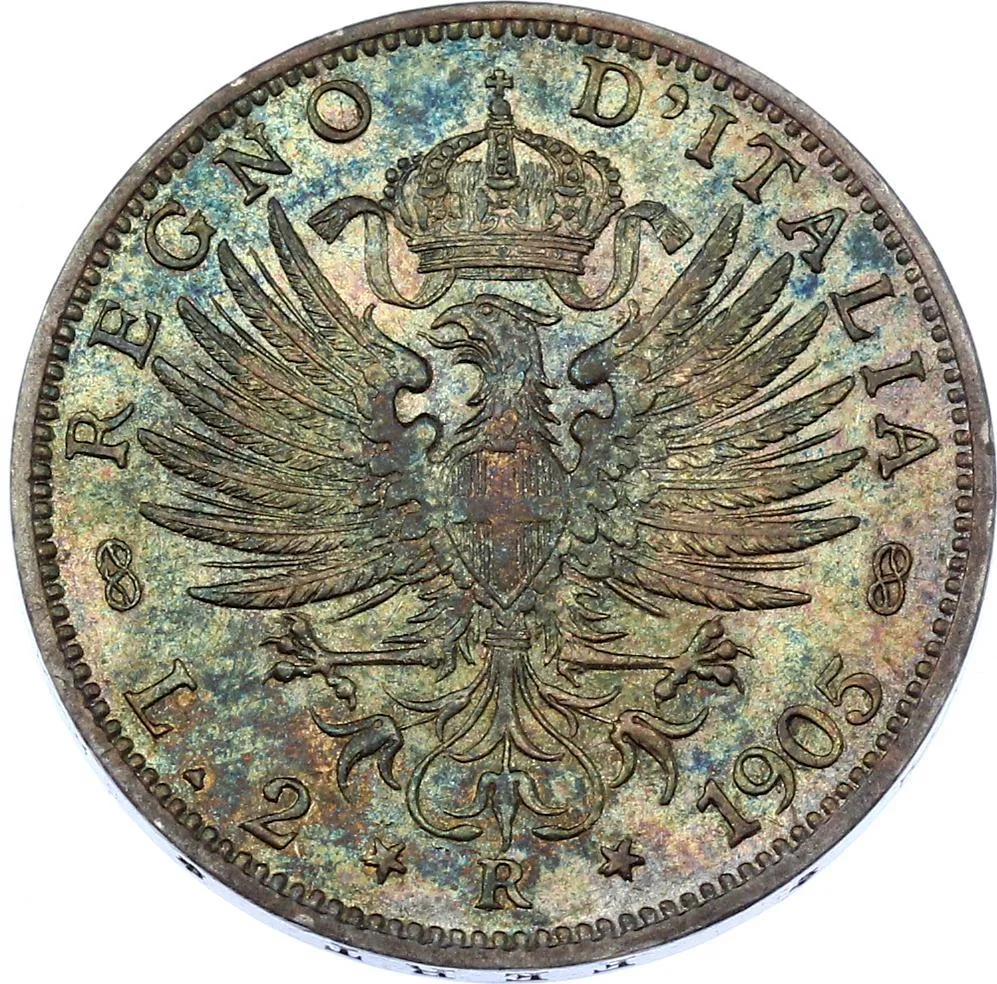
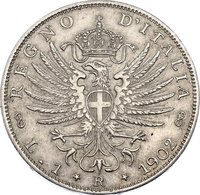
Crowned heraldic eagle with Savoia shield, flanked by value and date, mintmark below tail.
Inscription:
REGNO D'ITALIA
L.2
R
1906
L.2
R
1906
Translation:
Kingdom of Italy
2 Lire
R
1906
2 Lire
R
1906
Script: Latin
Engraver: Filippo Speranza
Edge
Plain with inscription between knots and rosettes
Legend:
FERT FERT FERT
Translation:
FERT FERT FERT
Language: Latin
Mints
| Name | Mark |
|---|---|
| Rome | R |
Mintings
Historical background
In 1901, Italy's currency situation was defined by its membership in the Latin Monetary Union (LMU), a continental system it had helped found in 1865. The country was officially on a bimetallic standard, with the lira pegged to both gold and silver. However, this parity was largely theoretical. Decades of fiscal strain, driven by ambitious unification projects and military expenditures, had led the government to issue excessive paper money (carta moneta) not fully backed by specie. Consequently, a wide gap existed between the face value of coins and paper notes and their actual metallic worth, creating a de facto "forced currency" (corso forzoso) regime where convertibility was suspended.
This financial instability manifested in a persistent premium on gold, meaning gold coins traded at a value higher than their official face value in paper lire. While ordinary silver coins circulated domestically, high-value silver scudi were often hoarded or exported. The result was a fragmented and inefficient monetary circulation, with a distrust of state-issued paper and a preference for metallic currency in everyday transactions, especially in the more economically developed north. The government struggled to restore true convertibility and stabilize the lira's value, objectives seen as crucial for national prestige and international trade.
The situation placed Italy in a vulnerable position within the LMU, as its chronically depreciated paper lira strained the union's rules. Domestically, the currency instability exacerbated regional economic divides and complicated industrial financing. The period around 1901 was thus one of transition and tension, as policymakers, including Finance Minister Luigi Luzzatti, grappled with the legacy of past deficits while laying the groundwork for a eventual return to the gold standard, a goal that would be partially achieved later in the decade.
This financial instability manifested in a persistent premium on gold, meaning gold coins traded at a value higher than their official face value in paper lire. While ordinary silver coins circulated domestically, high-value silver scudi were often hoarded or exported. The result was a fragmented and inefficient monetary circulation, with a distrust of state-issued paper and a preference for metallic currency in everyday transactions, especially in the more economically developed north. The government struggled to restore true convertibility and stabilize the lira's value, objectives seen as crucial for national prestige and international trade.
The situation placed Italy in a vulnerable position within the LMU, as its chronically depreciated paper lira strained the union's rules. Domestically, the currency instability exacerbated regional economic divides and complicated industrial financing. The period around 1901 was thus one of transition and tension, as policymakers, including Finance Minister Luigi Luzzatti, grappled with the legacy of past deficits while laying the groundwork for a eventual return to the gold standard, a goal that would be partially achieved later in the decade.
🌱 Fairly Common