

10 cents – Seychelles
Add to wishlist
Seychelles
Context
Years: 1953–1974
Issuer: Seychelles
Ruler: Elizabeth II
Currency:
(since 1914)
Demonetized: Yes
Total mintage: 795,000
Material
Diameter: 21.57 mm
Weight: 6.04 g
Thickness: 2.3 mm
Shape: Dodecagonal
Magnetic: No
Technique: Milled
Alignment: Medal alignment
flip
References
KM: #
Numista: #4890
Value
Exchange value: 0.10 SCR
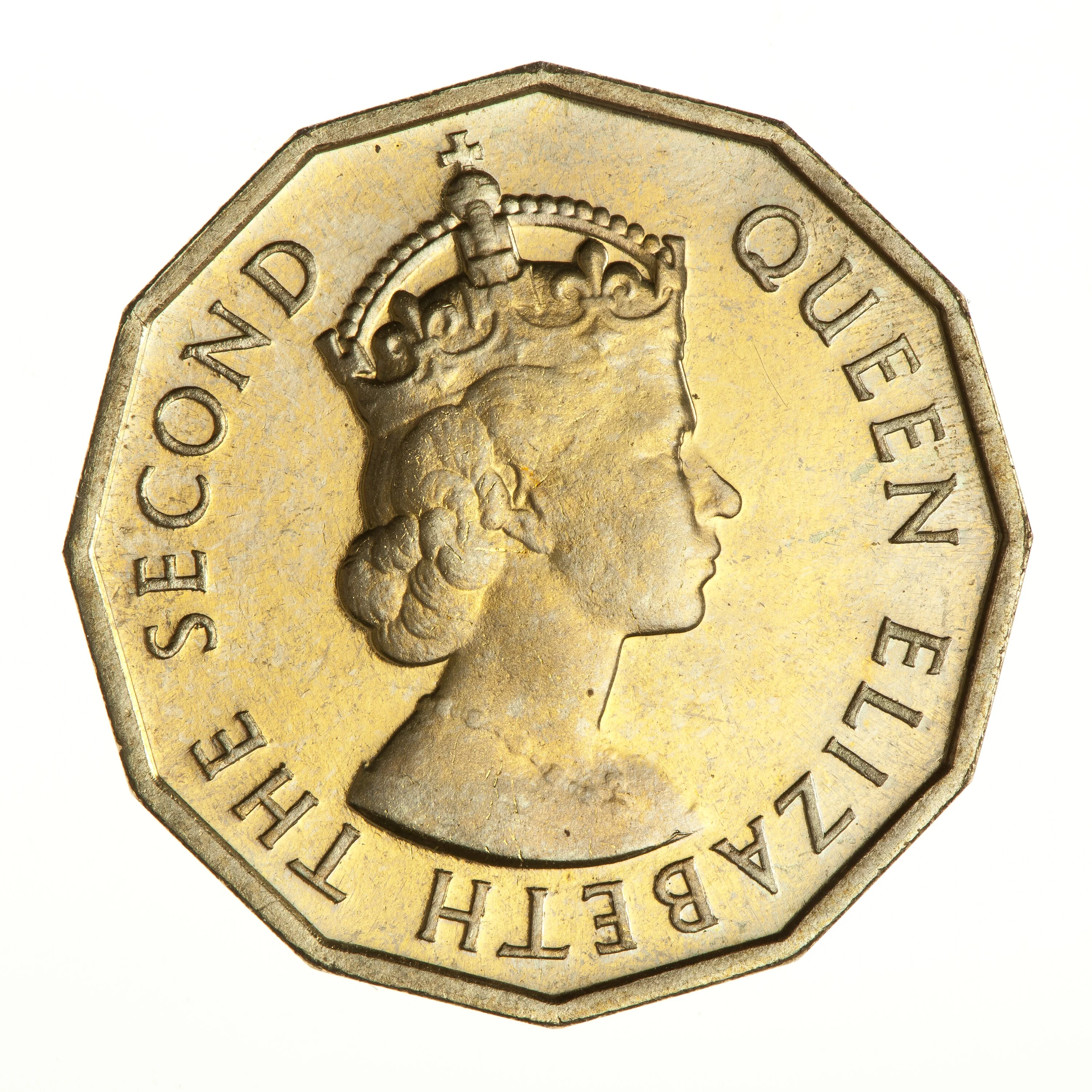
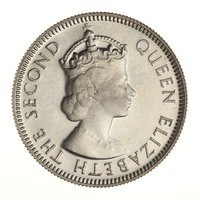
Obverse
Description:
Queen Elizabeth II facing right
Inscription:
QUEEN ELIZABETH THE SECOND
Script: Latin
Engraver: Cecil Thomas
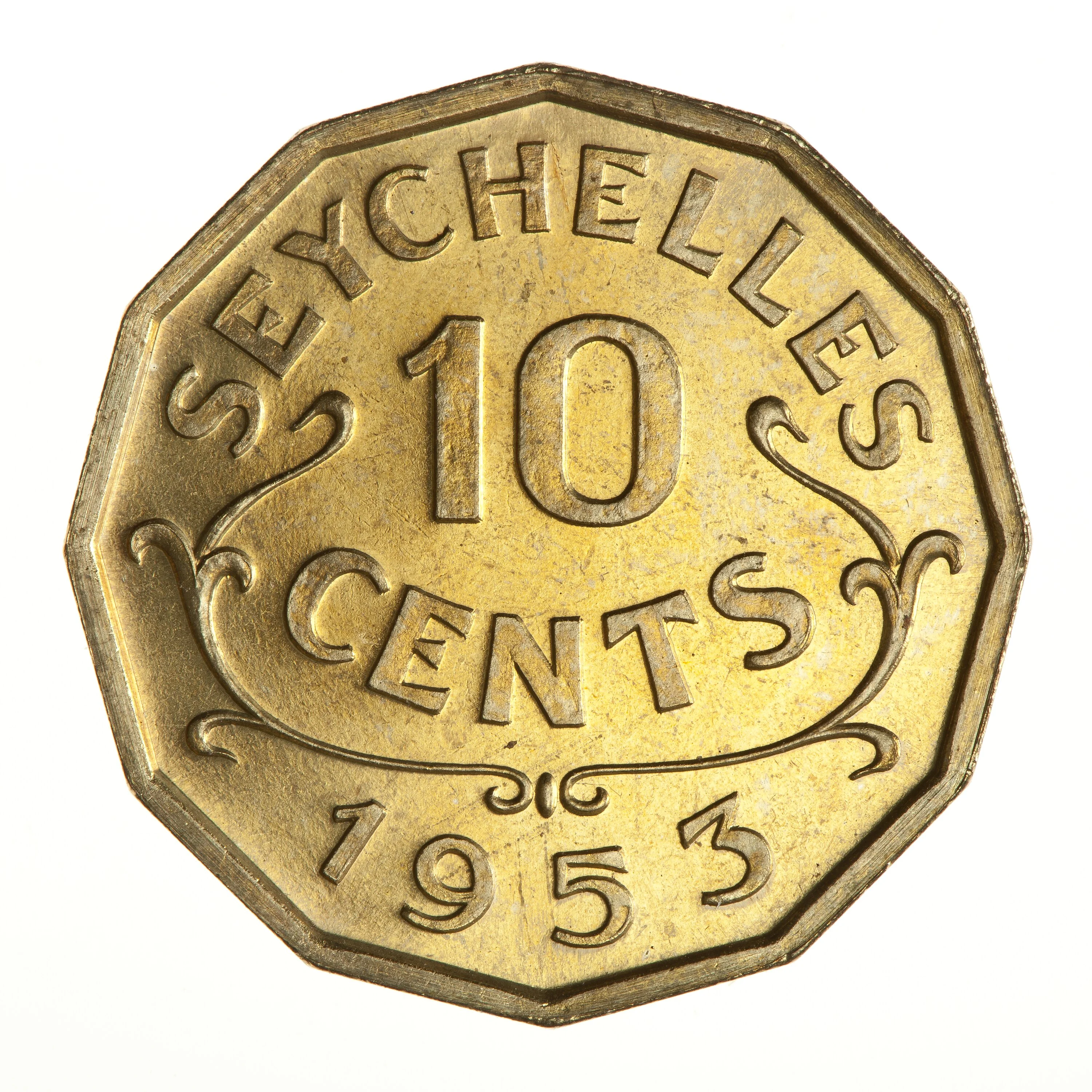
Reverse
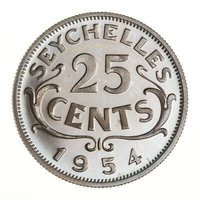
Description:
Treasure in ornament. Myth.
Inscription:
SEYCHELLES
10 CENTS
1953
10 CENTS
1953
Script: Latin
Engraver: George Kruger Gray
Edge
Plain
Mints
| Name | Mark |
|---|---|
| Royal Mint (Tower Hill) | — |
| Royal Mint | — |
Mintings
| Year | Mint Mark | Mintage | Quality | Collection |
|---|---|---|---|---|
| 1953 | — | 130,000 | ||
| 1953 | — | — | Proof | |
| 1965 | — | 40,000 | ||
| 1967 | — | 20,000 | ||
| 1968 | — | 50,000 | ||
| 1969 | — | 60,000 | ||
| 1969 | — | — | Proof | |
| 1970 | — | 75,000 | ||
| 1971 | — | 100,000 | ||
| 1972 | — | 120,000 | ||
| 1973 | — | 100,000 | ||
| 1974 | — | 100,000 |
Historical background
In 1953, Seychelles was a British Crown Colony, and its currency situation was entirely governed by the colonial monetary system. The official currency was the Seychelles rupee, but it was not an independent currency. It was pegged at par to the Mauritian rupee, which in turn was pegged to the British pound sterling. This meant the Seychelles rupee's value was ultimately derived from and stabilized by the Sterling Area, a system of fixed exchange rates within the British Empire and Commonwealth. Physical currency in circulation consisted of Mauritian rupee notes and coins, as Seychelles did not issue its own distinct banknotes until 1968.
The economy in this period was modest and heavily reliant on the export of copra (dried coconut kernel) and cinnamon bark, with a growing administration sector. There was little financial infrastructure; the first local bank, Barclays Bank DCO, had only opened in 1953, highlighting the territory's underdeveloped banking sector. The currency arrangement with Mauritius was practical for a small island colony, as it provided monetary stability and facilitated trade with its larger regional neighbour and the wider Sterling Area, simplifying transactions for the few import and export businesses.
Therefore, the currency situation in 1953 was one of dependency and integration. Seychelles had no autonomous monetary policy, with its currency value and supply effectively managed through the colonial link to Mauritius and London. This system provided stability but reflected the islands' limited economic development and political autonomy at the time, a full two decades before internal self-government and eventual independence.
The economy in this period was modest and heavily reliant on the export of copra (dried coconut kernel) and cinnamon bark, with a growing administration sector. There was little financial infrastructure; the first local bank, Barclays Bank DCO, had only opened in 1953, highlighting the territory's underdeveloped banking sector. The currency arrangement with Mauritius was practical for a small island colony, as it provided monetary stability and facilitated trade with its larger regional neighbour and the wider Sterling Area, simplifying transactions for the few import and export businesses.
Therefore, the currency situation in 1953 was one of dependency and integration. Seychelles had no autonomous monetary policy, with its currency value and supply effectively managed through the colonial link to Mauritius and London. This system provided stability but reflected the islands' limited economic development and political autonomy at the time, a full two decades before internal self-government and eventual independence.
🌱 Common