


10 euro (Spanish postage stamp) – Spain
Add to wishlist
Non-circulating coins
Commemoration: 175th anniversary of the first Spanish postage stamp
Spain


Obverse
Description:
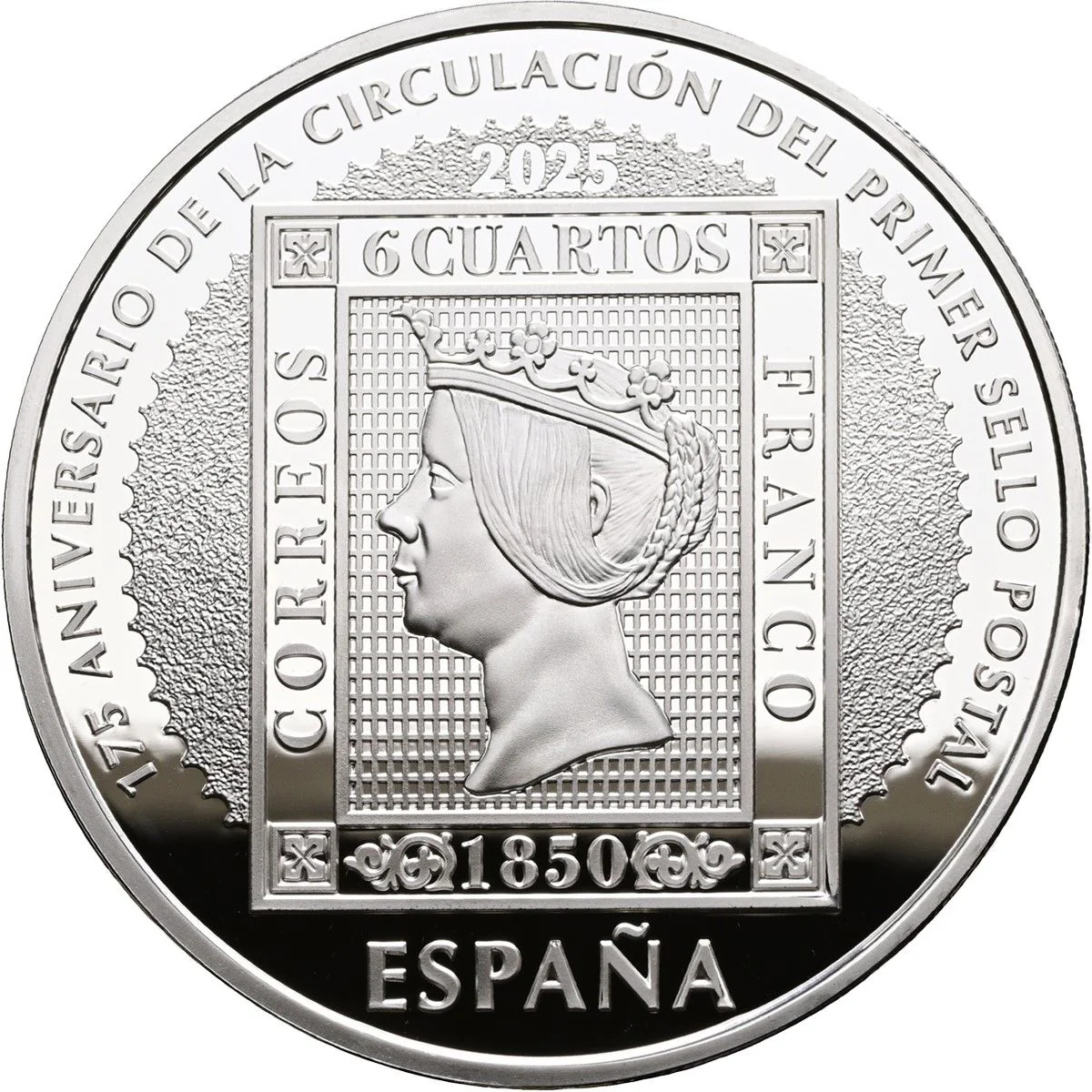
Reproduction of Spain's first stamp, featuring a left-facing crowned portrait of Isabella II.
Inscription:
175 ANIVERSARIO DE LA CIRCULACIÓN DEL PRIMER SELLO POSTAL
CORREOS 6 CUARTOS FRANCO
1850
ESPAÑA
CORREOS 6 CUARTOS FRANCO
1850
ESPAÑA
Translation:
175TH ANNIVERSARY OF THE CIRCULATION OF THE FIRST POSTAGE STAMP
POST OFFICE 6 QUARTOS FRANCO
1850
SPAIN
POST OFFICE 6 QUARTOS FRANCO
1850
SPAIN
Script: Latin
Language: Spanish
Reverse
Edge
Reeded
Categories
| Map |
| Transportation> Bike or motorcycle |
| Currency> Stamp depiction |
| Person> Monarch |
Mints
| Name | Mark |
|---|---|
| Royal Mint of Madrid | (M) |
Mintings
| Year | Mint Mark | Mintage | Quality | Collection |
|---|---|---|---|---|
| 2025 | M | 4,000 | Proof |
Historical background
In 2025, Spain remains a fully integrated member of the Eurozone, with the euro (€) as its sole legal tender. The country's monetary policy is set by the European Central Bank (ECB), which continues its focus on maintaining price stability after the inflationary shocks of the early 2020s. By this year, the ECB has likely solidified a "higher-for-longer" interest rate environment compared to the pre-pandemic period, aiming to anchor inflation firmly at its 2% target. This monetary tightening, while necessary for the broader Eurozone, presents an ongoing challenge for Spain's economy, particularly in managing public debt servicing costs and cooling a historically sensitive housing market without triggering a severe downturn.
Domestically, the currency situation is characterized by a continued push towards digitalization and financial inclusion. The digital euro project, having progressed through its investigation and pilot phases, is a topic of significant public and political discussion, though a full launch is not yet imminent. In parallel, the Bank of Spain is actively supervising the adoption of instant payment systems and exploring the implications of Central Bank Digital Currencies (CBDCs). A key domestic tension lies in balancing the efficiency gains of a cashless society with the need to protect vulnerable populations and ensure universal access to the currency system.
The stability of the euro provides Spain with crucial benefits, including lower transaction costs, eliminated exchange rate risk within the EU, and a strong anchor for investor confidence. However, as a member of a currency union, Spain lacks the unilateral tool of devaluation to boost competitiveness. Therefore, its economic resilience in 2025 hinges heavily on internal reforms aimed at boosting productivity, managing its debt-to-GDP ratio, and leveraging NextGenerationEU funds for a green and digital transition. The primary currency-related debates in Spanish politics thus center not on leaving the euro—a fringe position—but on advocating for more accommodative ECB policies and ensuring that the Eurozone's fiscal and banking unions deepen to better support economies during asymmetric shocks.
Domestically, the currency situation is characterized by a continued push towards digitalization and financial inclusion. The digital euro project, having progressed through its investigation and pilot phases, is a topic of significant public and political discussion, though a full launch is not yet imminent. In parallel, the Bank of Spain is actively supervising the adoption of instant payment systems and exploring the implications of Central Bank Digital Currencies (CBDCs). A key domestic tension lies in balancing the efficiency gains of a cashless society with the need to protect vulnerable populations and ensure universal access to the currency system.
The stability of the euro provides Spain with crucial benefits, including lower transaction costs, eliminated exchange rate risk within the EU, and a strong anchor for investor confidence. However, as a member of a currency union, Spain lacks the unilateral tool of devaluation to boost competitiveness. Therefore, its economic resilience in 2025 hinges heavily on internal reforms aimed at boosting productivity, managing its debt-to-GDP ratio, and leveraging NextGenerationEU funds for a green and digital transition. The primary currency-related debates in Spanish politics thus center not on leaving the euro—a fringe position—but on advocating for more accommodative ECB policies and ensuring that the Eurozone's fiscal and banking unions deepen to better support economies during asymmetric shocks.




💎 Extremely Rare