

1 Lats (Richard Wagner) – Latvia
Non-circulating coins
Commemoration: 200th Anniversary of the Birth of Richard Wagner
Latvia
Context

Material
References
KM: #Click to copy to clipboard140
Numista: #48537
Value
Exchange value: 1 LVL
Bullion value: $57.56
Inflation-adjusted value: 1.47 LVL
Obverse
Description:
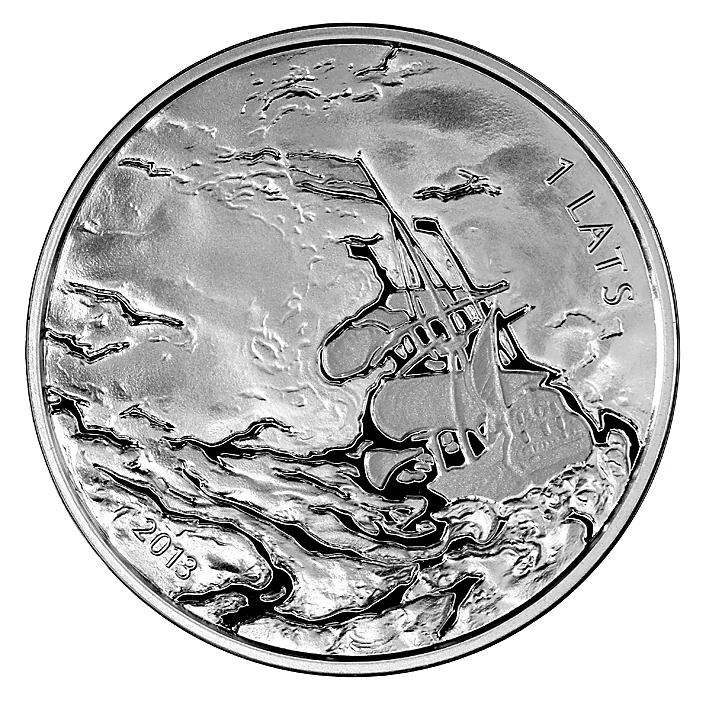
The Bank of Latvia issued this "Rihards Vāgners" coin to mark the composer's 200th birthday and his formative period in Riga. There, while working on his first major opera "Rienzi," he drew innovations from the local theater—now Wagner Hall—such as the sloped seating, darkened auditorium, and deep orchestra pit, which later influenced his Bayreuth theater. The obverse features a sailing ship on rough seas, with "1 LATS" to the right and "2013" at the bottom left.
Inscription:
1 LATS
2013
2013
Engraver: Ligita Franckeviča
Designer: Aigars Ozoliņš
Reverse
Description:
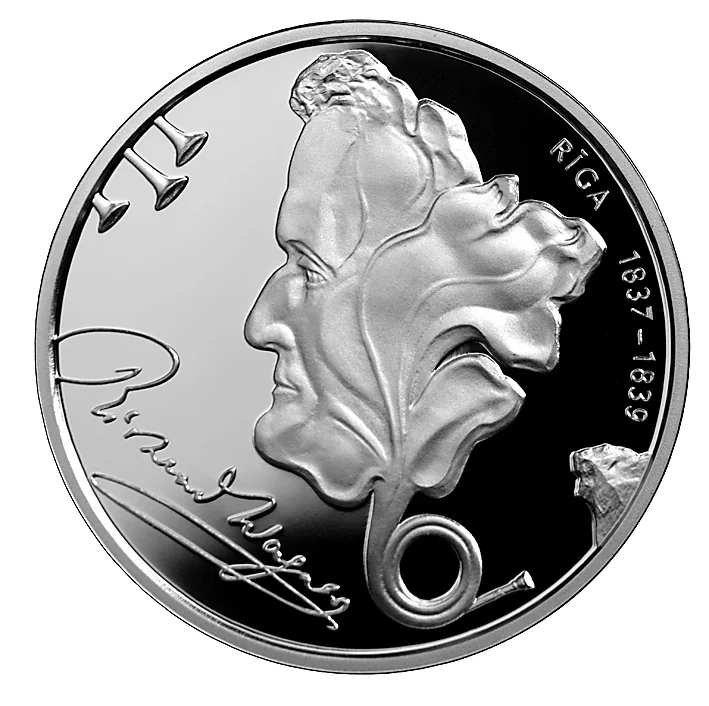
The reverse centers Wagner's profile portrait, with his signature at bottom left and a semi-circled "RĪGA 1837–1839" on the right.
Inscription:
RĪGA 1837–1839
Translation:
Riga 1837–1839
Engraver: Ligita Franckeviča
Designer: Ivo Grundulis
Edge
Legend:
LATVIJAS BANKA ◊ LATVIJAS REPUBLIKA ◊
Translation:
LATVIJAS BANKA ◊ LATVIJAS REPUBLIKA ◊
Language: Latvian
Categories
| Art> Music |
| Event> Birth anniversary |
| Transportation> Watercraft |
Mints
| Name | Mark |
|---|---|
| Royal Dutch Mint | — |
Mintings
| Year | Mint Mark | Mintage | Quality | Collection |
|---|---|---|---|---|
| 2013 | — | 5,000 | Proof |
Historical background
In 2013, Latvia stood on the brink of a significant economic milestone: adopting the euro. The country had been using the Latvian lats (LVL) since its reintroduction in 1993, following independence from the Soviet Union. However, after the severe 2008-2009 financial crisis, which necessitated an international bailout and deep austerity measures, the government made a strategic decision to pursue euro adoption. This was seen as a path to greater economic stability, deeper integration with Western Europe, and a symbolic final step away from its post-Soviet past. Throughout 2013, the nation was in a state of practical and psychological preparation for the currency switch scheduled for January 1, 2014.
The year was dominated by the final technical and legal steps required for the changeover. In July, the EU Council formally approved Latvia's accession to the euro area, having confirmed that the country met all the Maastricht convergence criteria, including low inflation, sound public finances, and a stable exchange rate (the lats had been pegged to the euro since 2005). The European Central Bank and the European Commission issued positive final reports, and the conversion rate was irrevocably fixed at 1 EUR = 0.702804 LVL. Domestically, a massive public information campaign was launched to familiarize citizens with the new currency, reassure them about the fixed conversion, and explain the dual-display period where prices would be shown in both lats and euros.
Despite the official momentum, the move was met with considerable public ambivalence. Polls consistently showed a majority of Latvians opposed to adopting the euro, driven by fears of hidden price increases, a loss of national identity symbolized by the lats, and lingering resentment from the austerity tied to the bailout. The government, led by Prime Minister Valdis Dombrovskis, argued that euro membership would lower borrowing costs, attract investment, and eliminate exchange risk, ultimately strengthening the economy. Thus, 2013 was a year of determined institutional progress toward euro adoption, unfolding against a backdrop of cautious and often skeptical public sentiment.
The year was dominated by the final technical and legal steps required for the changeover. In July, the EU Council formally approved Latvia's accession to the euro area, having confirmed that the country met all the Maastricht convergence criteria, including low inflation, sound public finances, and a stable exchange rate (the lats had been pegged to the euro since 2005). The European Central Bank and the European Commission issued positive final reports, and the conversion rate was irrevocably fixed at 1 EUR = 0.702804 LVL. Domestically, a massive public information campaign was launched to familiarize citizens with the new currency, reassure them about the fixed conversion, and explain the dual-display period where prices would be shown in both lats and euros.
Despite the official momentum, the move was met with considerable public ambivalence. Polls consistently showed a majority of Latvians opposed to adopting the euro, driven by fears of hidden price increases, a loss of national identity symbolized by the lats, and lingering resentment from the austerity tied to the bailout. The government, led by Prime Minister Valdis Dombrovskis, argued that euro membership would lower borrowing costs, attract investment, and eliminate exchange risk, ultimately strengthening the economy. Thus, 2013 was a year of determined institutional progress toward euro adoption, unfolding against a backdrop of cautious and often skeptical public sentiment.
💎 Extremely Rare