

Obverse
Description:
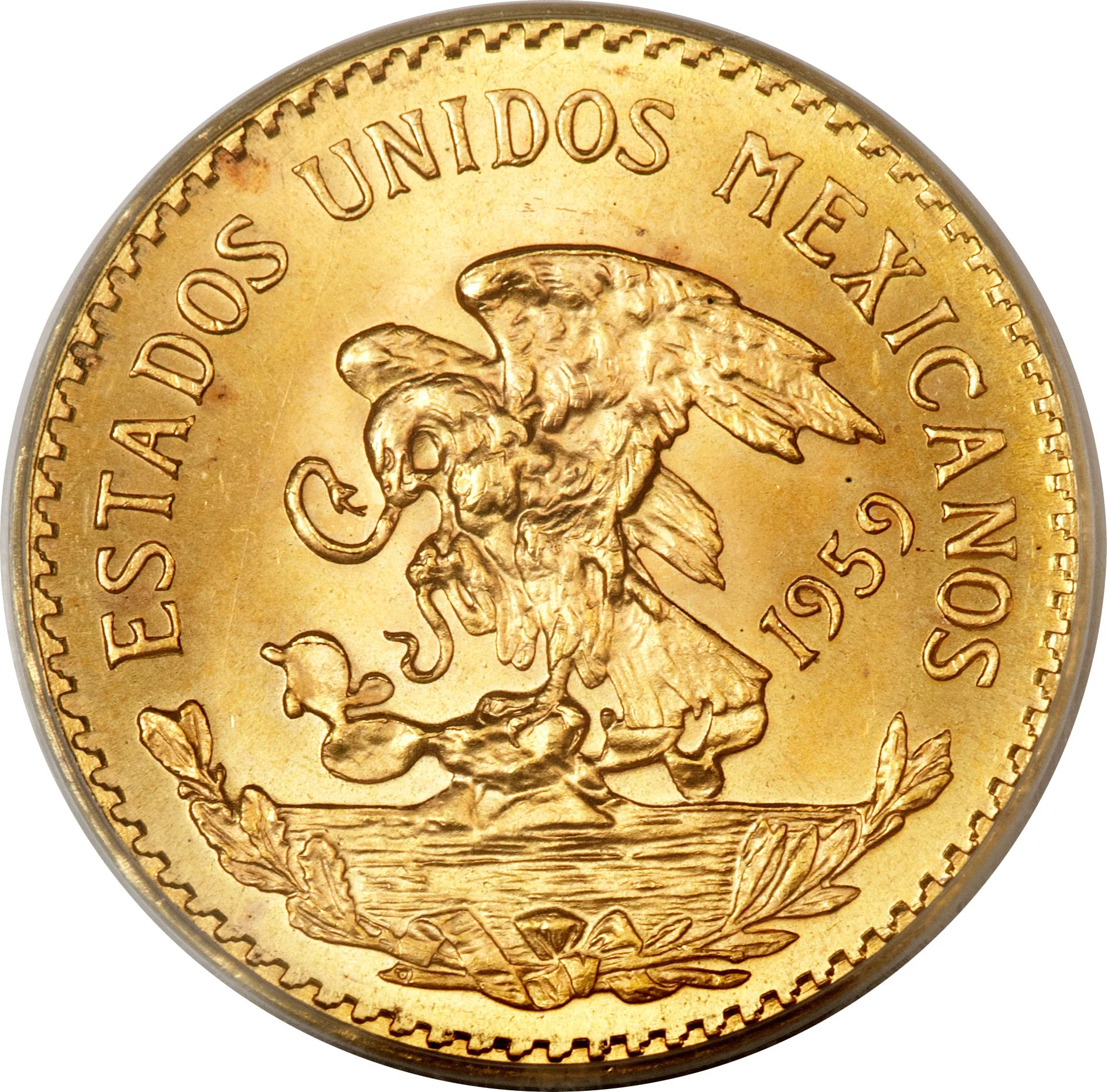
Eagle profile by Antonio Gomez R., with lettering, design by Jorge Encisco.
Inscription:
ESTADOS UNIDOS MEXICANOS
1959
1959
Translation:
UNITED MEXICAN STATES
Script: Latin
Language: Spanish
Engravers: Jorge Encisco, Antonio Gomez R.
Reverse
Description:
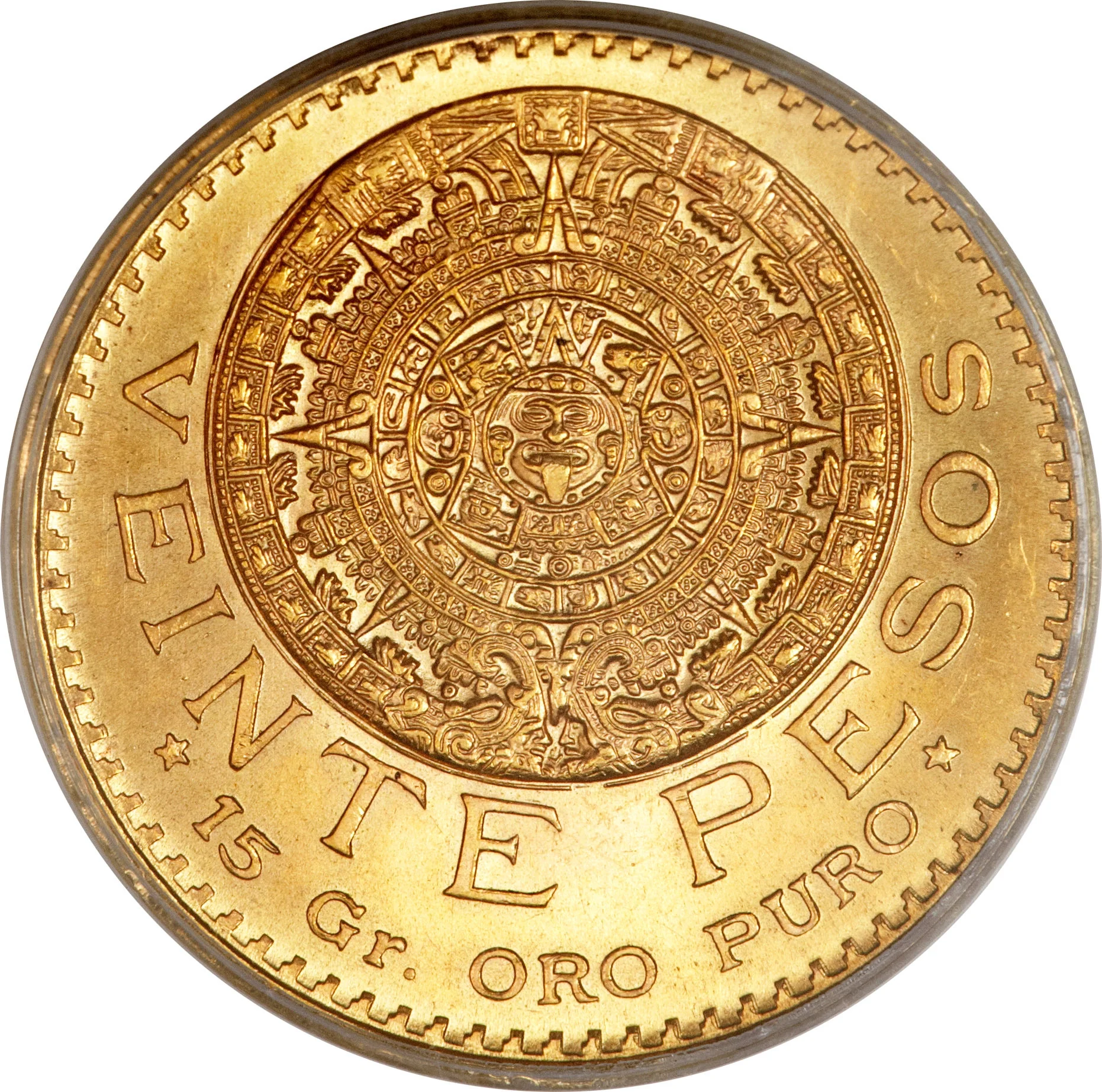
Aztec "Sun Stone" calendar with lettered value.
Inscription:
VEINTE PESOS
* 15 Gr. ORO PURO *
* 15 Gr. ORO PURO *
Script: Latin
Engraver: Jorge Encisco
Edge
Smooth with lettering
Legend:
INDEPENDENCIA Y LIBERTAD
Translation:
Independence and Liberty
Language: Spanish
Mintings
| Year | Mint Mark | Mintage | Quality | Collection |
|---|---|---|---|---|
| 1917 | — | 852,000 | ||
| 1918 | — | 2,831,000 | ||
| 1919 | — | 1,094,000 | ||
| 1920 | — | 462,000 | ||
| 1921 | — | 922,000 | ||
| 1959 | — | 13,000 | ||
| 1959 | — | 78,000 | Matte |
Historical background
The currency situation in Mexico in 1917 was one of profound instability and fragmentation, a direct legacy of the decade-long Mexican Revolution (1910-1920). The conflict had shattered the centralized financial system of the Porfirio Díaz era, leading to a chaotic monetary landscape. The victorious Constitutionalist faction, led by Venustiano Carragtua, controlled the capital and the official government mint, but their paper currency (the bilimbique) was severely depreciated and widely distrusted. Meanwhile, various revolutionary generals, regional authorities, and even commercial entities issued their own paper notes, creating a bewildering patchwork of currencies of wildly fluctuating value. This period is often described as one of "forced currency," where these notes were mandated for use but had little to no metallic backing, leading to rampant inflation and a popular retreat to silver coinage for significant transactions.
Economically, the nation was deeply divided. While the 1917 Constitution, promulgated that year, established sweeping social and labor reforms, it could not instantly resolve the monetary crisis. The fundamental problem was a lack of fiscal authority and precious metal reserves to back a unified currency. People hoarded the old Porfirian gold and silver coins (pesos fuertes), while the plethora of paper money circulated at steep discounts, often based on the military fortunes of the issuing faction. This environment crippled commerce, discouraged investment, and placed immense hardship on the population, as wages paid in unstable paper lost value rapidly.
Therefore, 1917 represents the nadir of Mexico's revolutionary monetary chaos, but also a turning point. The Carranza government, recognizing that economic reconstruction was impossible without sound money, began laying the groundwork for reform. The critical step would come in the following years with the establishment of the Bank of Mexico in 1925 and the eventual withdrawal and unification of the revolutionary currencies, restoring a single, managed monetary system. Thus, the situation in 1917 was the crisis that made subsequent central banking and monetary stability an urgent national priority.
Economically, the nation was deeply divided. While the 1917 Constitution, promulgated that year, established sweeping social and labor reforms, it could not instantly resolve the monetary crisis. The fundamental problem was a lack of fiscal authority and precious metal reserves to back a unified currency. People hoarded the old Porfirian gold and silver coins (pesos fuertes), while the plethora of paper money circulated at steep discounts, often based on the military fortunes of the issuing faction. This environment crippled commerce, discouraged investment, and placed immense hardship on the population, as wages paid in unstable paper lost value rapidly.
Therefore, 1917 represents the nadir of Mexico's revolutionary monetary chaos, but also a turning point. The Carranza government, recognizing that economic reconstruction was impossible without sound money, began laying the groundwork for reform. The critical step would come in the following years with the establishment of the Bank of Mexico in 1925 and the eventual withdrawal and unification of the revolutionary currencies, restoring a single, managed monetary system. Thus, the situation in 1917 was the crisis that made subsequent central banking and monetary stability an urgent national priority.
🌱 Fairly Common