

200 Pesos – Colombia
Non-circulating coins
Commemoration: 1971 Pan American Games, Cali
Colombia
Obverse
Description:
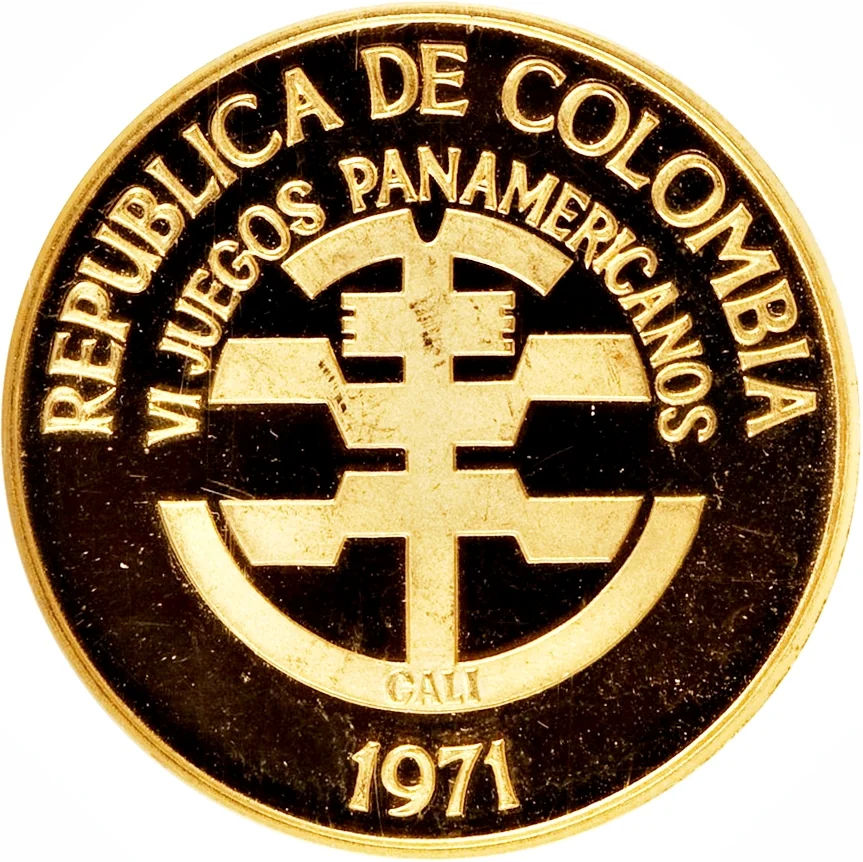
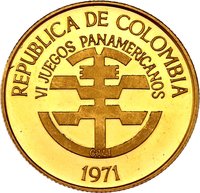
Cali emblem with surrounding legend.
Inscription:
REPUBLICA DE COLOMBIA
VI JUEGOS PANAMERICANOS
CALI
1971
VI JUEGOS PANAMERICANOS
CALI
1971
Translation:
REPUBLIC OF COLOMBIA
VI PAN AMERICAN GAMES
CALI
1971
VI PAN AMERICAN GAMES
CALI
1971
Script: Latin
Language: Spanish
Designer: Carlos Duque
Reverse
Description:
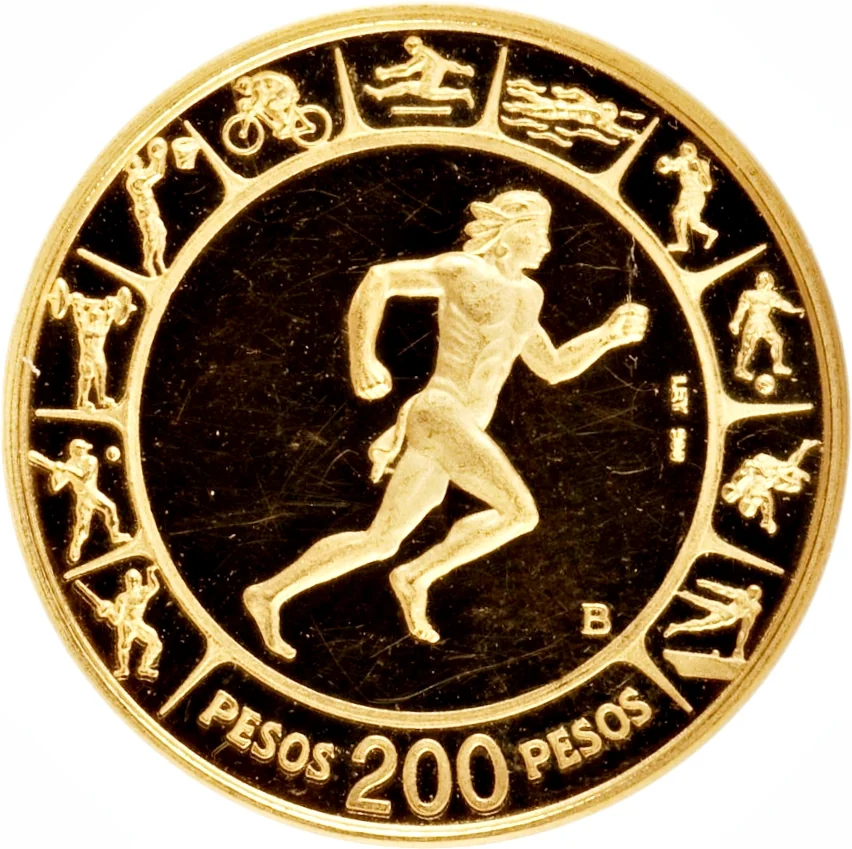
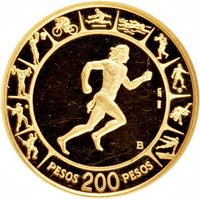
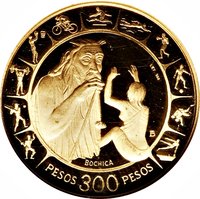
Central: Indian runner. Surrounding: eleven sports. Below: face value.
Inscription:
LEY 900
B
PESOS 200 PESOS
B
PESOS 200 PESOS
Script: Latin
Edge
Mints
| Name | Mark |
|---|---|
| Bogota Mint | B |
Mintings
| Year | Mint Mark | Mintage | Quality | Collection |
|---|---|---|---|---|
| 1971 | B | 6,000 | Proof |
Historical background
In 1971, Colombia's currency situation was characterized by a managed exchange rate system under the Bretton Woods framework, but it faced significant external pressures. The Colombian peso was pegged to the U.S. dollar, which was itself convertible to gold, creating a fixed but adjustable parity. However, the country was grappling with persistent balance of payments deficits, driven by a reliance on coffee exports (which faced volatile global prices) and a growing need for imported capital goods for industrialization. To defend the fixed parity, the Banco de la República routinely intervened in the foreign exchange market and maintained strict capital controls, creating a complex system of multiple exchange rates for different types of transactions.
The international monetary crisis of 1971 directly impacted Colombia. President Richard Nixon's announcement in August suspending the dollar's convertibility into gold and imposing a temporary 10% surcharge on imports shattered the core of the Bretton Woods system. This "Nixon Shock" created immediate uncertainty for all countries with dollar-pegged currencies, including Colombia. The peso's anchor became unstable, raising concerns about potential devaluation and increasing inflationary pressure from more expensive imports. Colombia, like many developing nations, was forced to reconsider its exchange rate policy in a suddenly fluid global monetary environment.
Domestically, the government of President Misael Pastrana Borrero responded cautiously. Rather than an abrupt devaluation, authorities initially maintained the peso's parity, relying heavily on existing exchange controls to manage the pressure. This period highlighted the structural vulnerabilities of an economy dependent on a single primary commodity. The events of 1971 set the stage for a significant policy shift later in the decade, ultimately leading to a more flexible crawling peg system in the mid-1970s as Colombia adapted to the new era of floating major currencies and sought to protect its external competitiveness.
The international monetary crisis of 1971 directly impacted Colombia. President Richard Nixon's announcement in August suspending the dollar's convertibility into gold and imposing a temporary 10% surcharge on imports shattered the core of the Bretton Woods system. This "Nixon Shock" created immediate uncertainty for all countries with dollar-pegged currencies, including Colombia. The peso's anchor became unstable, raising concerns about potential devaluation and increasing inflationary pressure from more expensive imports. Colombia, like many developing nations, was forced to reconsider its exchange rate policy in a suddenly fluid global monetary environment.
Domestically, the government of President Misael Pastrana Borrero responded cautiously. Rather than an abrupt devaluation, authorities initially maintained the peso's parity, relying heavily on existing exchange controls to manage the pressure. This period highlighted the structural vulnerabilities of an economy dependent on a single primary commodity. The events of 1971 set the stage for a significant policy shift later in the decade, ultimately leading to a more flexible crawling peg system in the mid-1970s as Colombia adapted to the new era of floating major currencies and sought to protect its external competitiveness.
✨ Legendary