

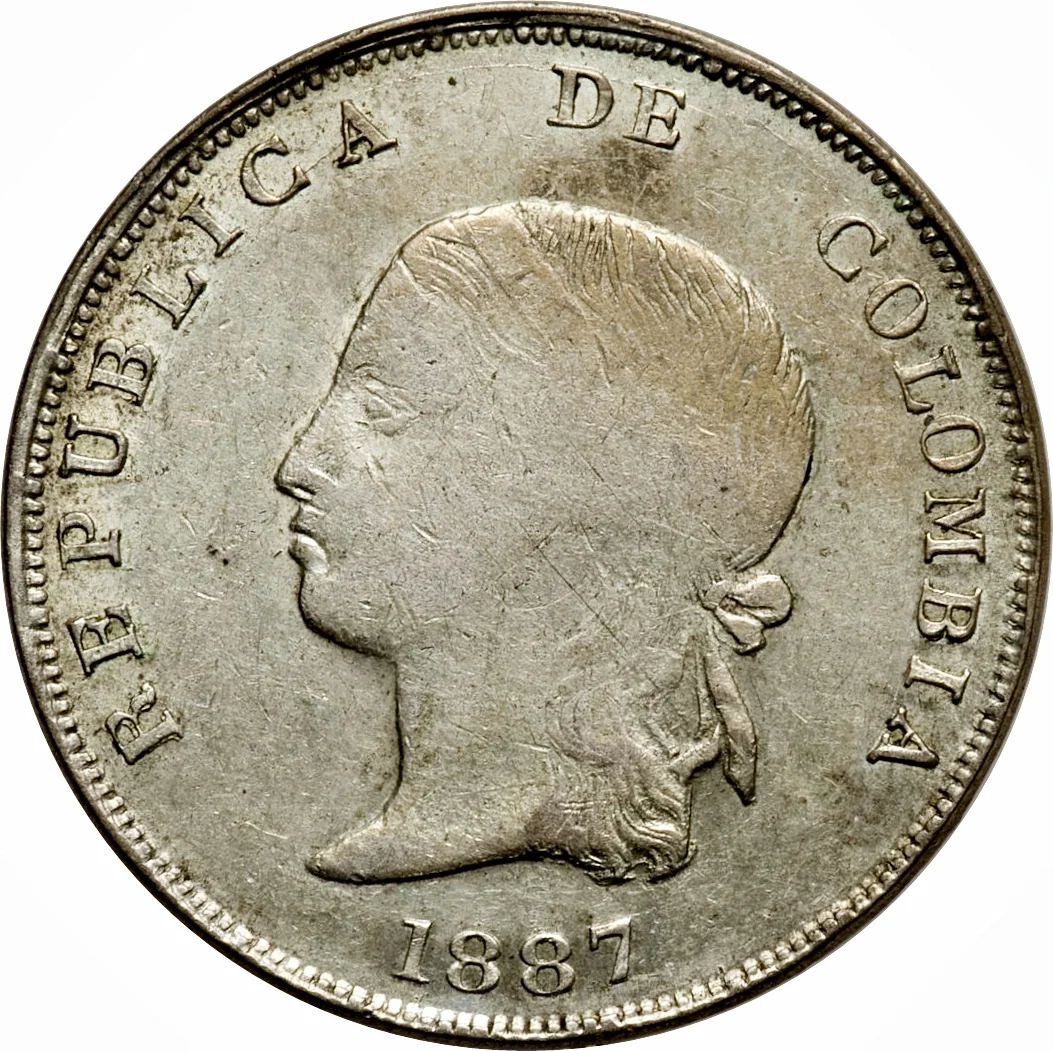

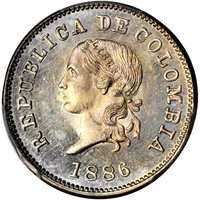
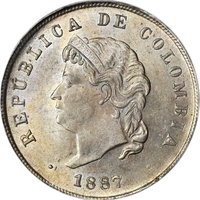
Obverse
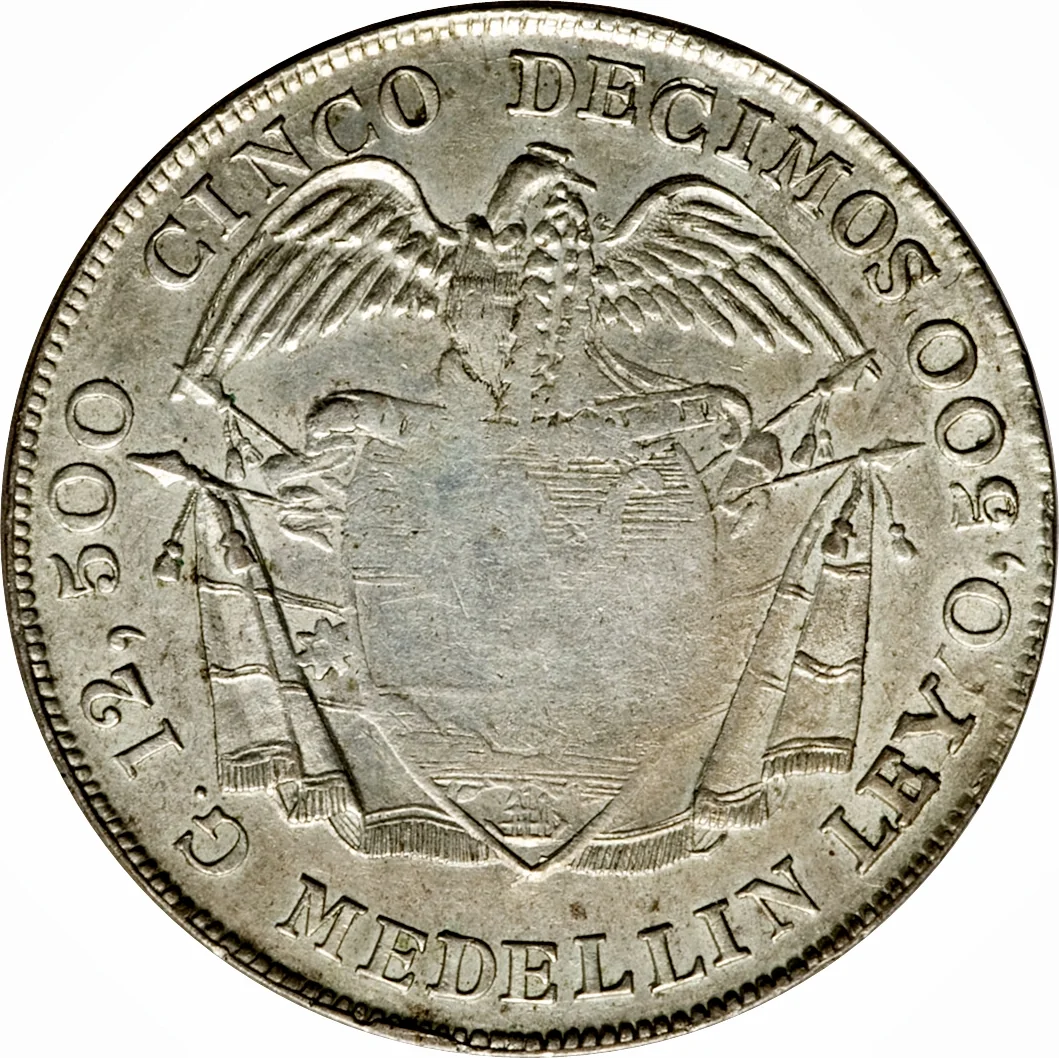
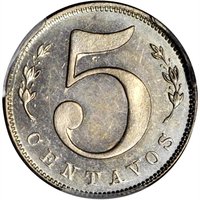
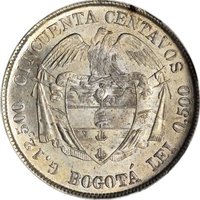
Reverse
Edge
Categories
| Symbol> Allegory |
| Symbols> Coat of Arms |
Mints
| Name | Mark |
|---|---|
| Casa de Moneda de Colombia | — |
Mintings
| Year | Mint Mark | Mintage | Quality | Collection |
|---|---|---|---|---|
| 1887 | — | 84,000 | ||
| 1888 | — | — |
Historical background
In 1887, Colombia operated under a complex and unstable currency system, a direct legacy of its 19th-century political fragmentation. Following the dissolution of Gran Colombia, the nation had experienced decades of civil war and regionalism, which was reflected in its monetary policy. The country was officially on a bimetallic standard (gold and silver), but in practice, a chaotic mix of coins circulated. These included not only domestic pesos fuertes (strong pesos) and fractional silver but also a vast quantity of foreign coins, particularly from Peru, Bolivia, France, and Britain, which were accepted at fluctuating and locally determined exchange rates. This lack of uniformity created significant obstacles for domestic trade and federal finance.
The period was marked by a chronic shortage of small-denomination coinage, leading to widespread use of fichas (private tokens) issued by haciendas, mines, and merchants to pay workers. This practice effectively created private, localized currencies and tied laborers to specific employers. Furthermore, the government, facing fiscal deficits exacerbated by internal conflicts, had resorted to issuing inconvertible paper money. While the papel moneda was legally mandated for some transactions, public distrust was high, and its value depreciated significantly against hard currency, leading to a dual-price system and economic distortion.
The situation in 1887 existed within a brief period of relative political calm under the presidency of Rafael Núñez and the recent adoption of the centralist Constitution of 1886, which aimed to consolidate national authority. This new political framework set the stage for future monetary reforms. Indeed, the instability of the late 1880s would soon lead to the decisive Law 87 of 1887, which demonetized all foreign silver coinage, and the establishment of the Banco Nacional in 1888, laying the foundational steps toward a unified national currency system managed by a central bank, a process that would culminate in the creation of the modern Colombian peso.
The period was marked by a chronic shortage of small-denomination coinage, leading to widespread use of fichas (private tokens) issued by haciendas, mines, and merchants to pay workers. This practice effectively created private, localized currencies and tied laborers to specific employers. Furthermore, the government, facing fiscal deficits exacerbated by internal conflicts, had resorted to issuing inconvertible paper money. While the papel moneda was legally mandated for some transactions, public distrust was high, and its value depreciated significantly against hard currency, leading to a dual-price system and economic distortion.
The situation in 1887 existed within a brief period of relative political calm under the presidency of Rafael Núñez and the recent adoption of the centralist Constitution of 1886, which aimed to consolidate national authority. This new political framework set the stage for future monetary reforms. Indeed, the instability of the late 1880s would soon lead to the decisive Law 87 of 1887, which demonetized all foreign silver coinage, and the establishment of the Banco Nacional in 1888, laying the foundational steps toward a unified national currency system managed by a central bank, a process that would culminate in the creation of the modern Colombian peso.
💎 Extremely Rare