

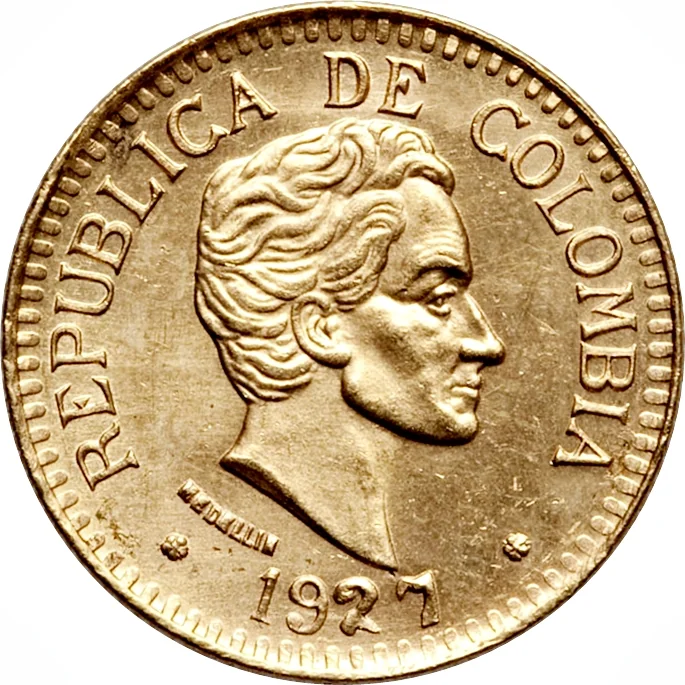

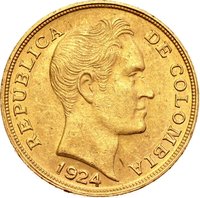
Obverse
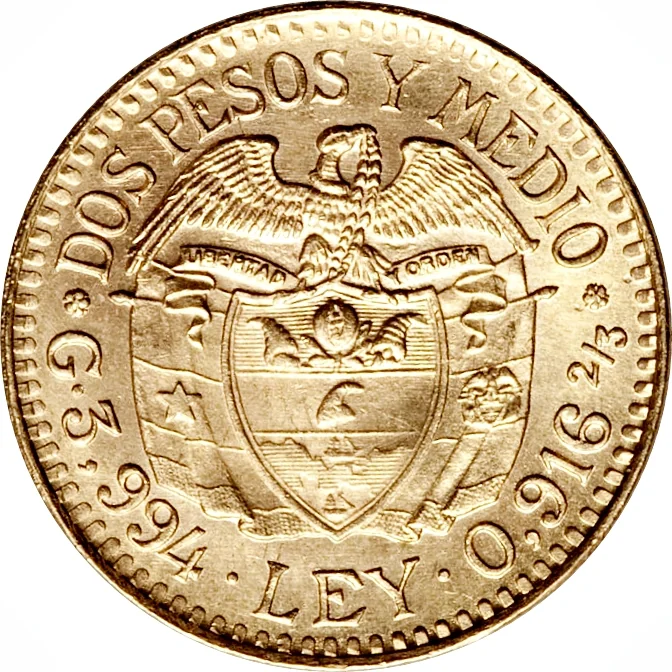
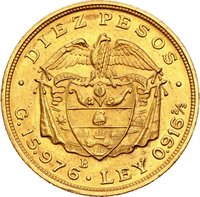
Reverse
Description:
Colombia's Coat of Arms
Inscription:
DOS PESOS Y MEDIO
✿G·3,994·LEY·0,916⅔✿
✿G·3,994·LEY·0,916⅔✿
Script: Latin
Edge
Reeded
Categories
| Symbols> Coat of Arms |
| Person> Politician |
Mintings
| Year | Mint Mark | Mintage | Quality | Collection |
|---|---|---|---|---|
| 1924 | — | — | ||
| 1925 | — | — | ||
| 1927 | — | — | ||
| 1928 | — | — | ||
| 1929 | — | — |
Historical background
In 1924, Colombia's currency system was in a state of transition and vulnerability, still grappling with the profound economic and fiscal devastation caused by the Thousand Days' War (1899-1902) and the subsequent loss of Panama. The national currency, the Colombian peso, was backed by a de facto gold standard, but the country suffered from a chronic shortage of metallic currency in circulation. This scarcity led to a reliance on paper money issued by multiple private banks, resulting in a fragmented and often unstable monetary environment with varying rates of exchange and credibility between different banknotes.
The period was marked by significant inflationary pressures. The government, needing to finance infrastructure projects like railways and to cover budget deficits, often resorted to printing money, which further eroded the peso's value. This inflation was acutely felt by the population, particularly the working class and coffee growers, whose real incomes and export earnings were diminished. While the coffee boom provided a crucial source of foreign exchange (gold), the benefits were unevenly distributed and insufficient to stabilize the broader monetary system.
Recognizing these systemic flaws, the government of Pedro Nel Ospina (1922-1926) had already initiated critical reforms. The most significant was the creation of the Banco de la República in 1923, with assistance from the Kemmerer Financial Mission. By 1924, the new central bank was beginning its operations, tasked with establishing a uniform and stable currency, controlling inflation, and acting as the sole issuer of banknotes. Thus, 1924 stands as a pivotal year, caught between the legacy of a disordered past and the implementation of a modern, centralized monetary framework intended to bring order and confidence to the Colombian economy.
The period was marked by significant inflationary pressures. The government, needing to finance infrastructure projects like railways and to cover budget deficits, often resorted to printing money, which further eroded the peso's value. This inflation was acutely felt by the population, particularly the working class and coffee growers, whose real incomes and export earnings were diminished. While the coffee boom provided a crucial source of foreign exchange (gold), the benefits were unevenly distributed and insufficient to stabilize the broader monetary system.
Recognizing these systemic flaws, the government of Pedro Nel Ospina (1922-1926) had already initiated critical reforms. The most significant was the creation of the Banco de la República in 1923, with assistance from the Kemmerer Financial Mission. By 1924, the new central bank was beginning its operations, tasked with establishing a uniform and stable currency, controlling inflation, and acting as the sole issuer of banknotes. Thus, 1924 stands as a pivotal year, caught between the legacy of a disordered past and the implementation of a modern, centralized monetary framework intended to bring order and confidence to the Colombian economy.
💎 Extremely Rare