

1000 Kwanzas – Angola
Non-circulating coins
Commemoration: Creation of the National Currency
Angola
Obverse
Description:
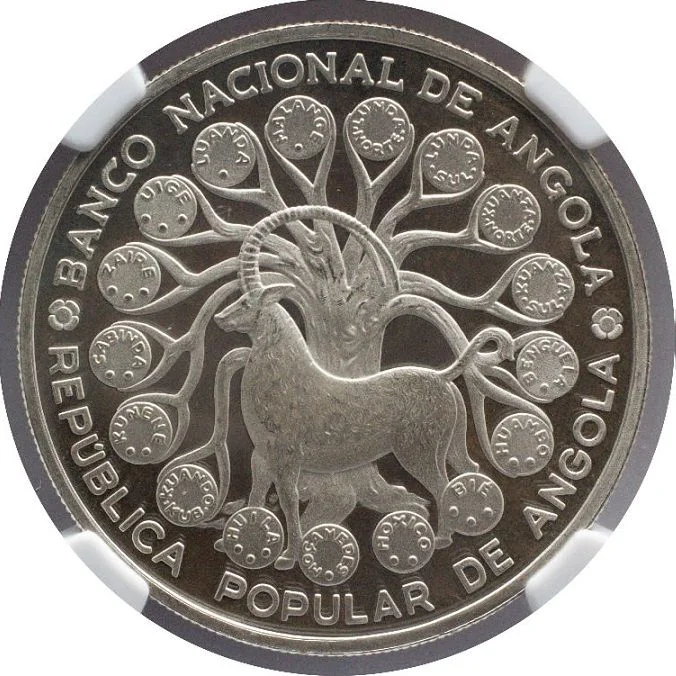
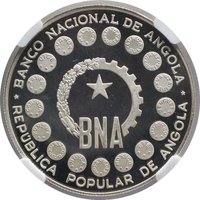
A black antelope is centered on a tree trunk, surrounded by seventeen circles naming the country's provinces. Around the edge, "Banco Nacional de Angola" is above and "República Popular de Angola" below, separated by four-petal flowers.
Inscription:
BANCO NACIONAL DE ANGOLA
ZAIRE UIGE LUANDA MALANGE LUNDA NORTE LUNDA SUL KUANZA NORTE KUANZA SUL
CABINDA KUNENE KUANDO KUEI HOCAMEDES MOXICO BIE HUAMBO BENGUELA
REPUBLICA POPULAR DE ANGOLA
ZAIRE UIGE LUANDA MALANGE LUNDA NORTE LUNDA SUL KUANZA NORTE KUANZA SUL
CABINDA KUNENE KUANDO KUEI HOCAMEDES MOXICO BIE HUAMBO BENGUELA
REPUBLICA POPULAR DE ANGOLA
Translation:
NATIONAL BANK OF ANGOLA
ZAIRE UIGE LUANDA MALANGE NORTH LUNDA SOUTH LUNDA NORTH KUANZA SOUTH KUANZA
CABINDA KUNENE KUANDO KUBANGUI HOCAMEDES MOXICO BIE HUAMBO BENGUELA
PEOPLE'S REPUBLIC OF ANGOLA
ZAIRE UIGE LUANDA MALANGE NORTH LUNDA SOUTH LUNDA NORTH KUANZA SOUTH KUANZA
CABINDA KUNENE KUANDO KUBANGUI HOCAMEDES MOXICO BIE HUAMBO BENGUELA
PEOPLE'S REPUBLIC OF ANGOLA
Script: Latin
Language: Portuguese
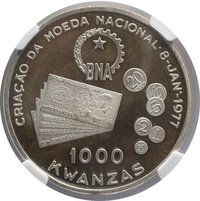
Reverse
Description:
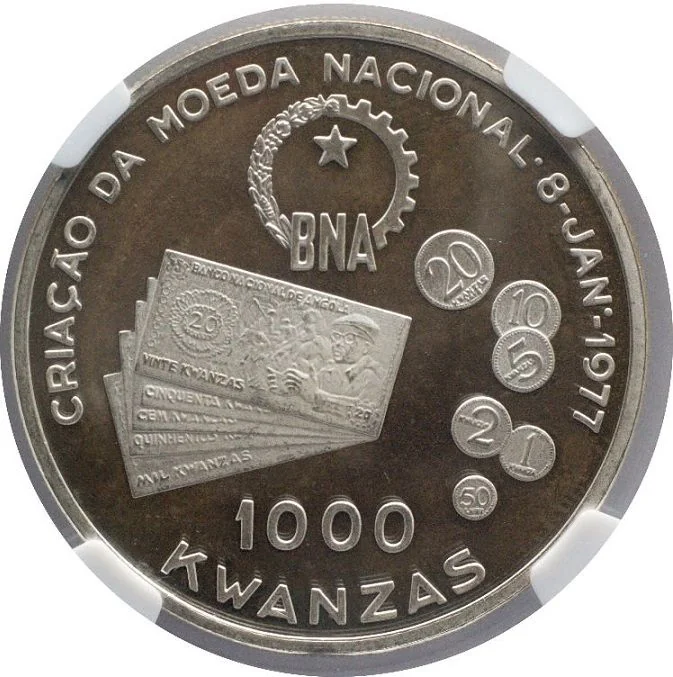
Angolan currency featuring coins and banknotes, with the National Bank emblem above and face value below. The edge is inscribed "Creation of the National Currency, January 8, 1977."
Inscription:
CRIACAO DA MOEDA NACIONAL · 8-JAN·-1977
BNA
20
KWANZAS
10
5 KWANZAS
KWANZAS 2
1
KWANZA
50
BANCO NACIONAL DE ANGOLA
20
VEINTE KWANZAS
1000
KWANZAS
BNA
20
KWANZAS
10
5 KWANZAS
KWANZAS 2
1
KWANZA
50
BANCO NACIONAL DE ANGOLA
20
VEINTE KWANZAS
1000
KWANZAS
Translation:
CREATION OF THE NATIONAL CURRENCY · 8-JAN-1977
BNA
20
KWANZAS
10
5 KWANZAS
KWANZAS 2
1
KWANZA
50
NATIONAL BANK OF ANGOLA
20
TWENTY KWANZAS
1000
KWANZAS
BNA
20
KWANZAS
10
5 KWANZAS
KWANZAS 2
1
KWANZA
50
NATIONAL BANK OF ANGOLA
20
TWENTY KWANZAS
1000
KWANZAS
Script: Latin
Languages: Portuguese, Spanish
Edge
Reeded
Categories
| Symbols> Coat of Arms |
| Animal> Deer |
| Currency> Banknote |
| Currency> Coin depiction |
Mints
| Name | Mark |
|---|---|
| Imprensa Nacional - Casa da Moeda | — |
Mintings
| Year | Mint Mark | Mintage | Quality | Collection |
|---|---|---|---|---|
| 1991 | — | 7,500 | Proof |
Historical background
In 1991, Angola was in a state of profound economic crisis and ongoing civil war, with its currency, the kwanza (AOK), rendered nearly worthless by hyperinflation and a collapsed formal economy. The Marxist-Leninist MPLA government, which had maintained a strict command economy since independence in 1975, was forced to implement a series of reforms under pressure from the International Monetary Fund (IMF). This year marked the beginning of a tumultuous transition from a centrally planned system to a market-oriented one, a shift formalized at the party's Third Congress. However, the parallel war against UNITA rebels devastated infrastructure and agricultural production, leading to severe shortages and a heavy reliance on imports.
The currency situation was characterized by a vast disparity between the official exchange rate and the black-market rate. The government fixed the kwanza at an artificially high value, but this rate was inaccessible to most citizens and businesses. In reality, the vast majority of foreign exchange transactions occurred on the lucrative black market, where the kwanza traded for a fraction of its official value. This dual system fueled corruption, as those with access to dollars at the official rate could make instant profits, while undermining any legitimate price structure and destroying public confidence in the national currency.
Consequently, the "New Kwanza" (AON) was introduced on September 25, 1990, in an attempt to restore monetary control, but its effects were still unfolding in 1991. The reform aimed to freeze prices and wages while devaluing the currency, but it failed to address fundamental structural issues. By 1991, inflation was soaring again, estimated at over 250% annually, eroding savings and wages. The economic landscape was thus one of monetary chaos, where the US dollar and South African rand functioned as de facto currencies for major transactions, while most Angolans struggled with a rapidly depreciating kwanza in a war-ravaged economy.
The currency situation was characterized by a vast disparity between the official exchange rate and the black-market rate. The government fixed the kwanza at an artificially high value, but this rate was inaccessible to most citizens and businesses. In reality, the vast majority of foreign exchange transactions occurred on the lucrative black market, where the kwanza traded for a fraction of its official value. This dual system fueled corruption, as those with access to dollars at the official rate could make instant profits, while undermining any legitimate price structure and destroying public confidence in the national currency.
Consequently, the "New Kwanza" (AON) was introduced on September 25, 1990, in an attempt to restore monetary control, but its effects were still unfolding in 1991. The reform aimed to freeze prices and wages while devaluing the currency, but it failed to address fundamental structural issues. By 1991, inflation was soaring again, estimated at over 250% annually, eroding savings and wages. The economic landscape was thus one of monetary chaos, where the US dollar and South African rand functioned as de facto currencies for major transactions, while most Angolans struggled with a rapidly depreciating kwanza in a war-ravaged economy.
✨ Legendary