

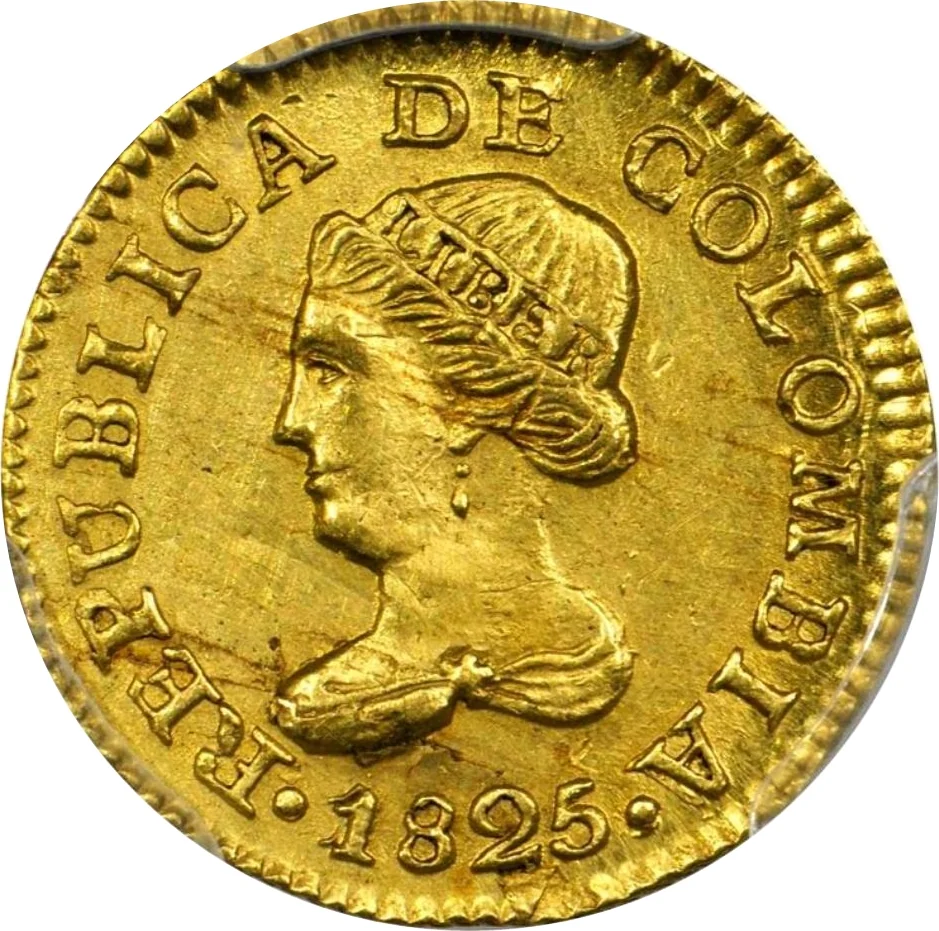
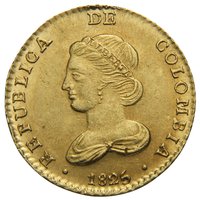
Obverse
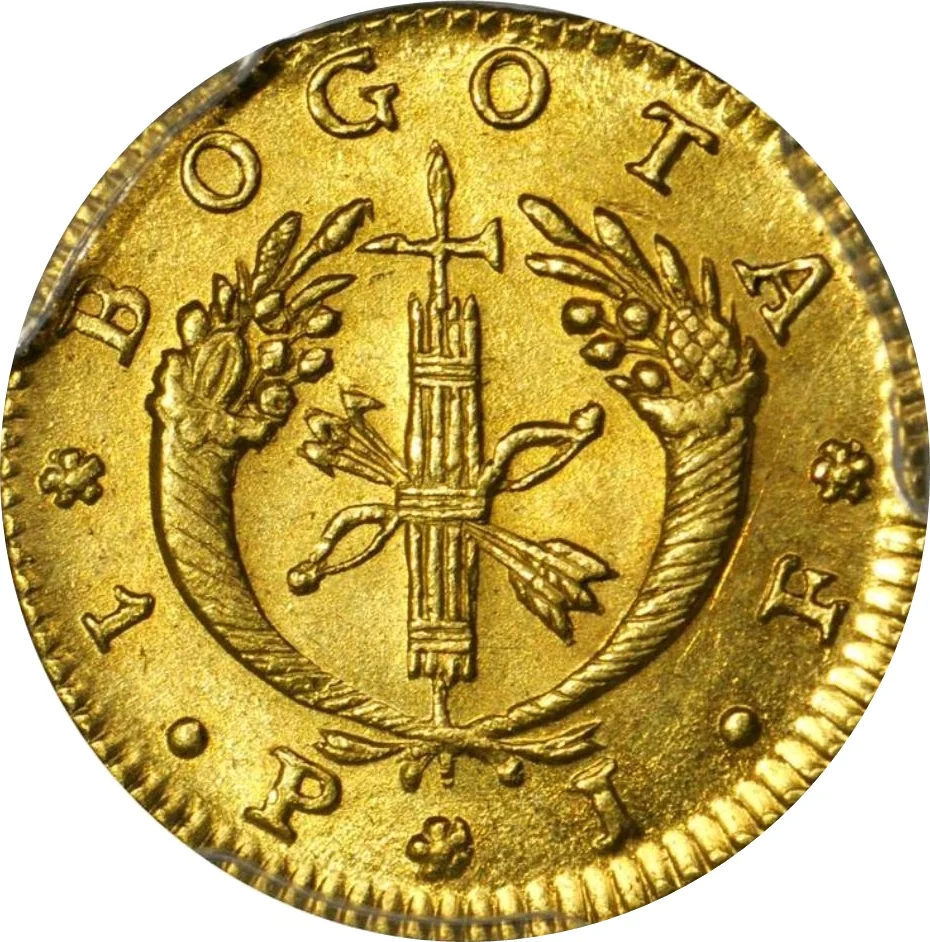
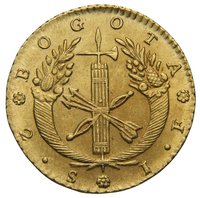
Reverse
Description:
Fasces between cornucopias, crossed by a bow and arrow.
Inscription:
BOGOTA
1 • P * J • F
1 • P * J • F
Script: Latin
Edge
Mintings
| Year | Mint Mark | Mintage | Quality | Collection |
|---|---|---|---|---|
| 1825 | JF | — | ||
| 1826 | JF | — | ||
| 1826 | JR | — | ||
| 1826 | PJ | — | ||
| 1827 | JF | — | ||
| 1827 | RR | — | ||
| 1829 | JF | — | ||
| 1829 | PJ | — | ||
| 1829 | RS | — | ||
| 1830 | RS | — | ||
| 1834 | RS | — | ||
| 1835 | RS | — | ||
| 1836 | RS | — |
Historical background
In 1825, the newly independent Republic of Gran Colombia—encompassing present-day Colombia, Venezuela, Ecuador, and Panama—faced a profound and chaotic currency crisis. The wars of independence (1810-1824) had devastated mining production, the traditional source of precious metals for coinage, and left the treasury empty. The vacuum was filled by a bewildering variety of coins: not only remnants of Spanish colonial mintages but also a flood of foreign coins, particularly from Peru, Bolivia, and even counterfeit "macuquinas" (crudely hammered coins). This lack of a uniform, trustworthy monetary system severely hampered domestic commerce and integration into international trade.
Recognizing the crisis, the central government in Bogotá undertook a major monetary reform in 1825. The cornerstone was the introduction of a new national decimal currency, the peso, divided into 10 reales (replacing the old Spanish system of 8 reales to the peso). The government planned to mint new, machine-struck coins with the republican coat of arms at the Bogotá mint, aiming to displace the chaotic mix of old and foreign coins in circulation. This reform was a bold political act, symbolizing monetary sovereignty and the modernizing ambitions of Simón Bolívar's administration.
However, the reform's success in 1825 was more theoretical than real. The government lacked the immediate bullion reserves to mint sufficient quantities of the new coins to replace the old monetary mass. Consequently, the old Spanish, republican, and foreign coins continued to circulate at officially mandated exchange rates, which the market often ignored. The scarcity of sound currency, combined with falling agricultural prices and the immense costs of maintaining the army, meant that the monetary chaos persisted. Thus, 1825 stands as a year of ambitious legislative foundation for a national currency, yet one where the practical reality remained one of severe instability and fragmentation.
Recognizing the crisis, the central government in Bogotá undertook a major monetary reform in 1825. The cornerstone was the introduction of a new national decimal currency, the peso, divided into 10 reales (replacing the old Spanish system of 8 reales to the peso). The government planned to mint new, machine-struck coins with the republican coat of arms at the Bogotá mint, aiming to displace the chaotic mix of old and foreign coins in circulation. This reform was a bold political act, symbolizing monetary sovereignty and the modernizing ambitions of Simón Bolívar's administration.
However, the reform's success in 1825 was more theoretical than real. The government lacked the immediate bullion reserves to mint sufficient quantities of the new coins to replace the old monetary mass. Consequently, the old Spanish, republican, and foreign coins continued to circulate at officially mandated exchange rates, which the market often ignored. The scarcity of sound currency, combined with falling agricultural prices and the immense costs of maintaining the army, meant that the monetary chaos persisted. Thus, 1825 stands as a year of ambitious legislative foundation for a national currency, yet one where the practical reality remained one of severe instability and fragmentation.
💎 Extremely Rare