

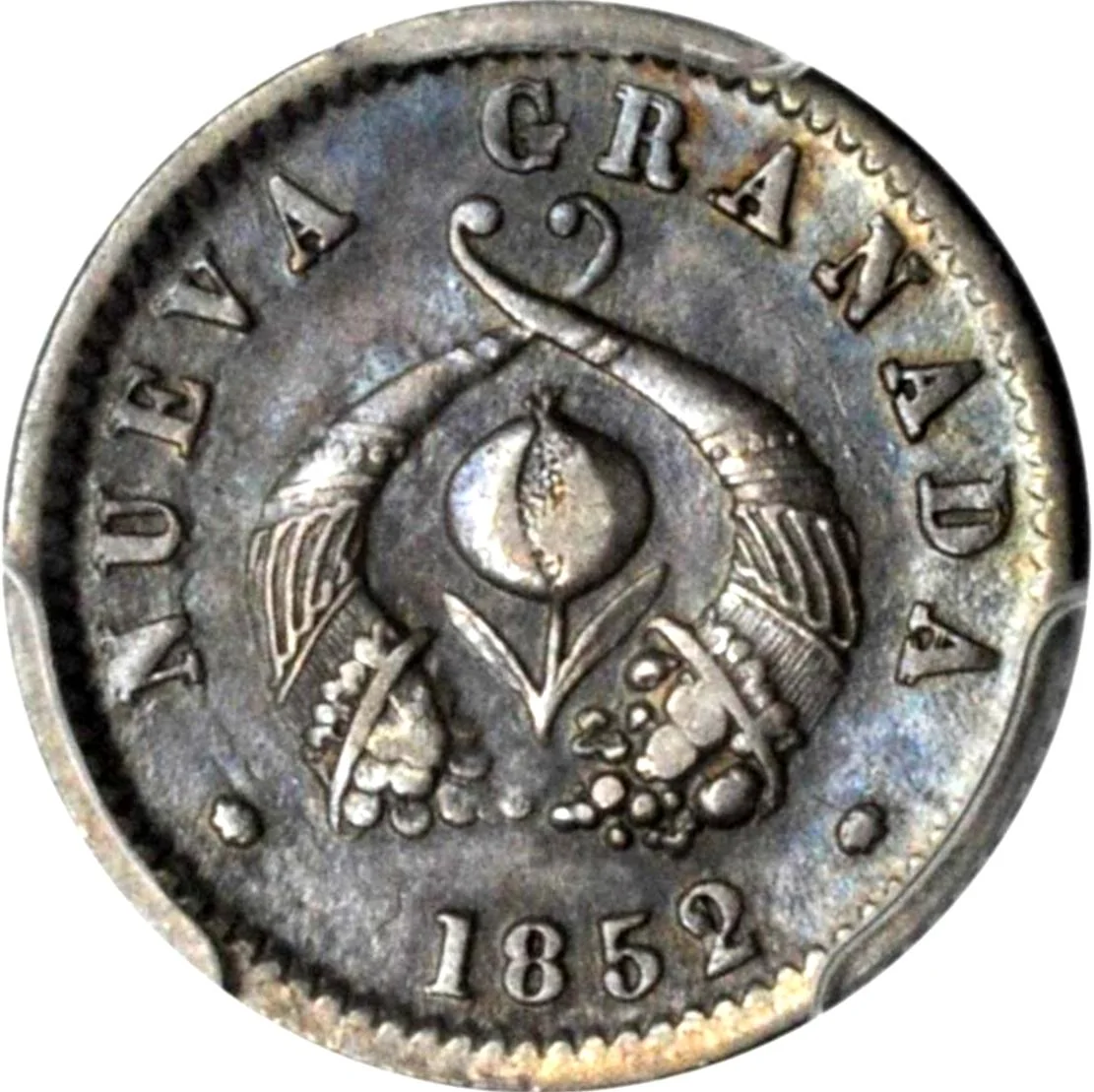
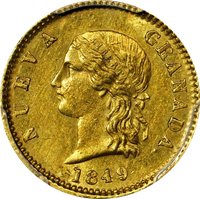
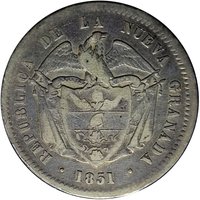
Obverse
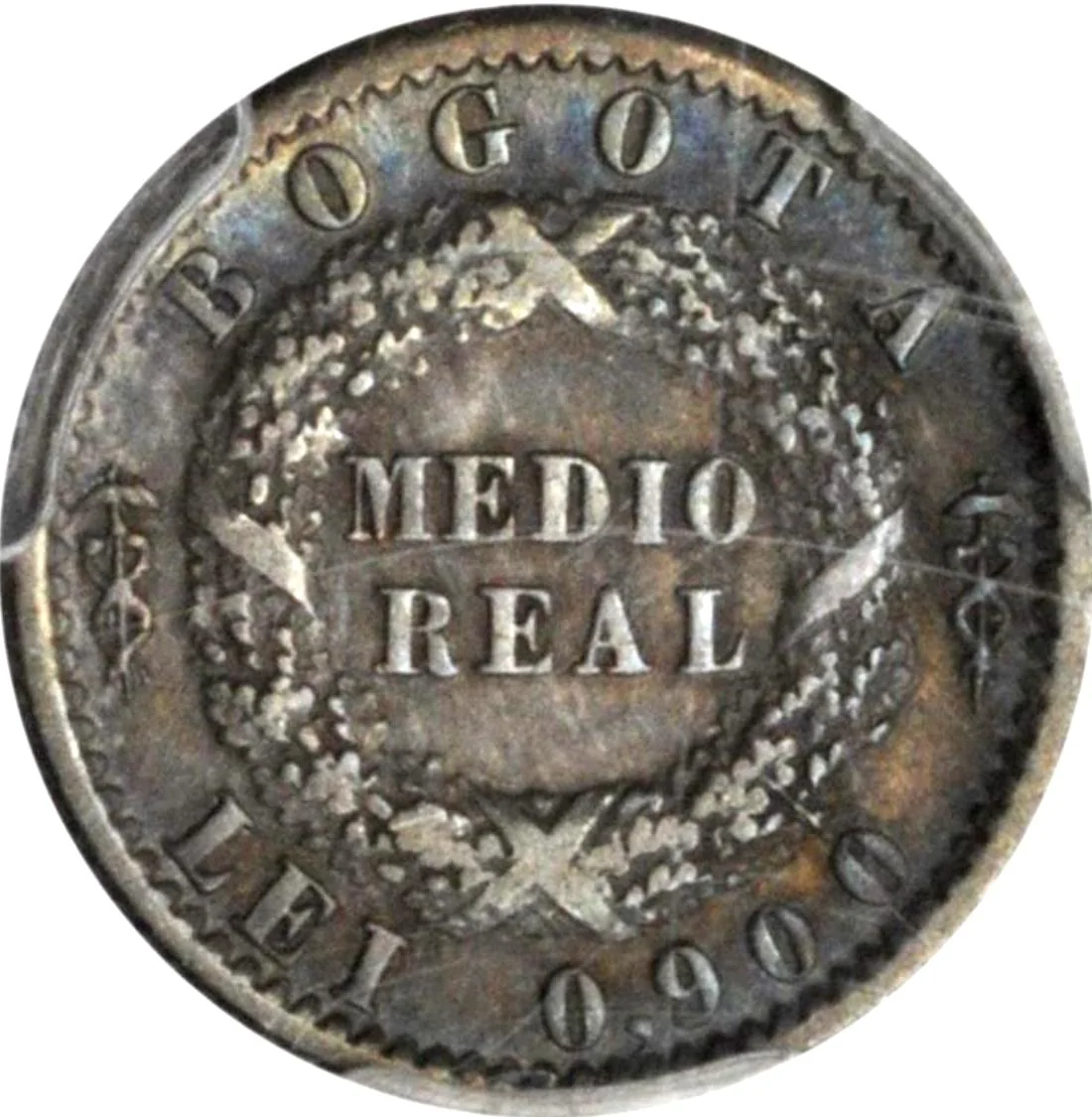
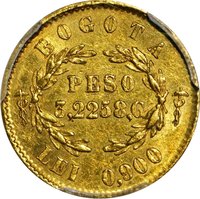
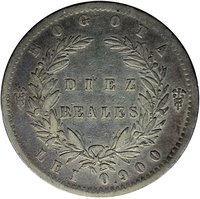
Reverse
Description:
Mint above, denomination within a central wreath flanked by caducei, fineness below.
Inscription:
BOGOTA
MEDIO
REAL
LEI 0,900
MEDIO
REAL
LEI 0,900
Script: Latin
Edge
Reeded
Mints
| Name | Mark |
|---|---|
| Bogota Mint | — |
Mintings
| Year | Mint Mark | Mintage | Quality | Collection |
|---|---|---|---|---|
| 1850 | — | — | ||
| 1851 | — | — | ||
| 1852 | — | — | ||
| 1853 | — | — |
Historical background
In the mid-19th century, Colombia (then known as the Republic of New Granada) faced a complex and chaotic currency situation, a direct legacy of the post-independence period. Following the dissolution of Gran Colombia in 1831, the nation inherited a fragmented monetary system with a severe shortage of official coinage. This vacuum was filled by a bewildering variety of coins from different eras and nations, including old Spanish colonial reales, coins from other Latin American republics, and even counterfeit pieces, all circulating simultaneously at fluctuating values. The government's attempt to introduce a new national currency, the real, struggled to gain dominance in this environment, leading to widespread confusion in commerce and public distrust.
The fundamental problem was the lack of a strong, centralized banking authority and sufficient precious metals to back a uniform currency. Much of the economy, especially in rural areas, still operated on a system of barter or used papel sellado (stamped paper) for large transactions. When coins were used, their value was often determined by their intrinsic metal content (gold or silver) rather than their face value, leading to Gresham's Law in practice where "bad money drives out good." This monetary anarchy stifled economic growth, complicated tax collection for the state, and created significant obstacles to both domestic trade and foreign investment.
Recognizing this crisis, the period around 1850 was one of intense debate and gradual reform. The 1847 monetary law had attempted to decimalize the system, but implementation was slow. The real push for standardization came with the adoption of a new political constitution in 1853, which granted greater fiscal autonomy to the provinces, paradoxically perpetuating some local monetary diversity. True consolidation would only begin in the 1860s and 1870s with the establishment of private banks issuing paper money and, eventually, the creation of the Banco Nacional in 1880. Thus, the 1850s represent a pivotal transitional decade, marked by the acute awareness of the need for a unified currency while still grappling with the entrenched disorder of the post-colonial monetary legacy.
The fundamental problem was the lack of a strong, centralized banking authority and sufficient precious metals to back a uniform currency. Much of the economy, especially in rural areas, still operated on a system of barter or used papel sellado (stamped paper) for large transactions. When coins were used, their value was often determined by their intrinsic metal content (gold or silver) rather than their face value, leading to Gresham's Law in practice where "bad money drives out good." This monetary anarchy stifled economic growth, complicated tax collection for the state, and created significant obstacles to both domestic trade and foreign investment.
Recognizing this crisis, the period around 1850 was one of intense debate and gradual reform. The 1847 monetary law had attempted to decimalize the system, but implementation was slow. The real push for standardization came with the adoption of a new political constitution in 1853, which granted greater fiscal autonomy to the provinces, paradoxically perpetuating some local monetary diversity. True consolidation would only begin in the 1860s and 1870s with the establishment of private banks issuing paper money and, eventually, the creation of the Banco Nacional in 1880. Thus, the 1850s represent a pivotal transitional decade, marked by the acute awareness of the need for a unified currency while still grappling with the entrenched disorder of the post-colonial monetary legacy.
💎 Very Rare