

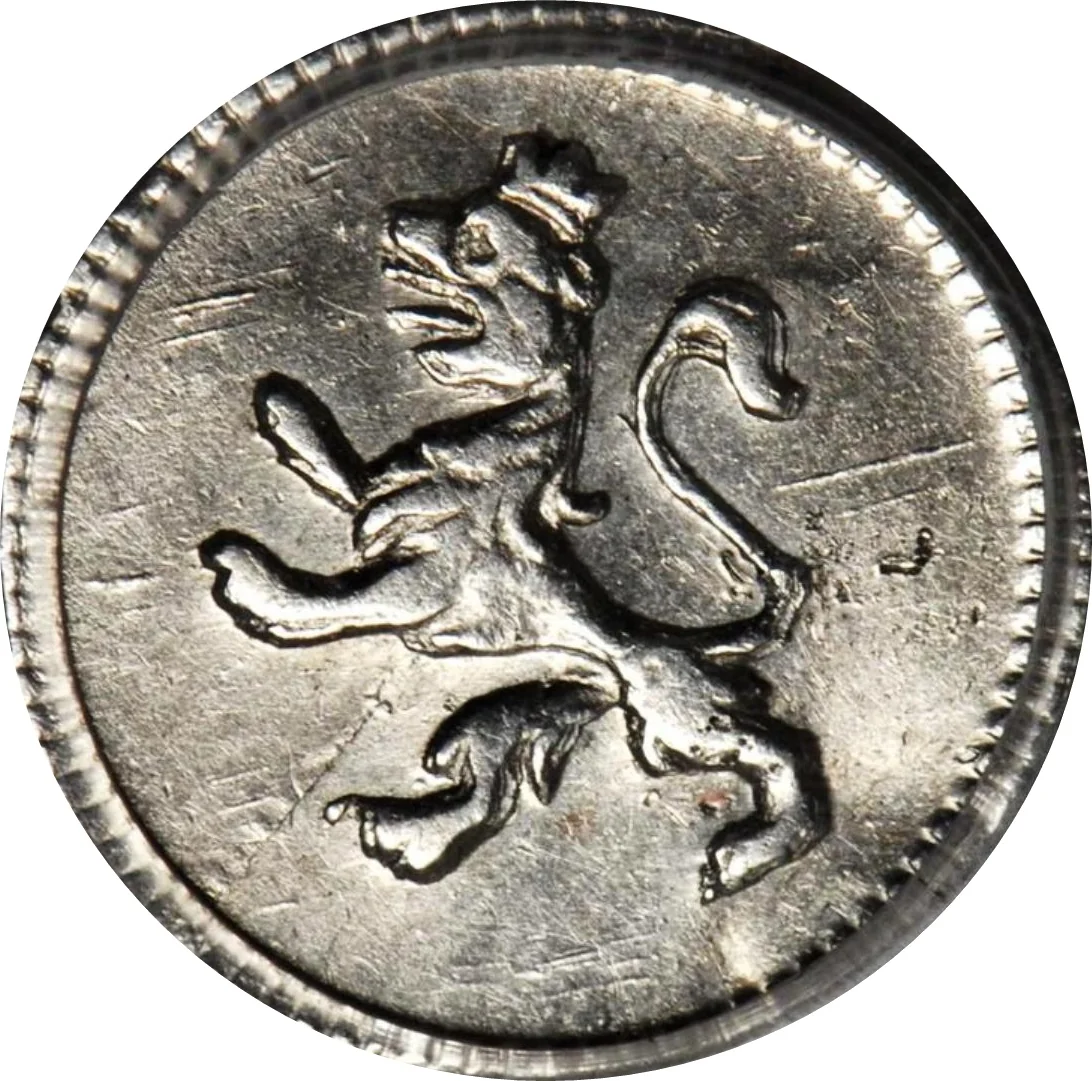
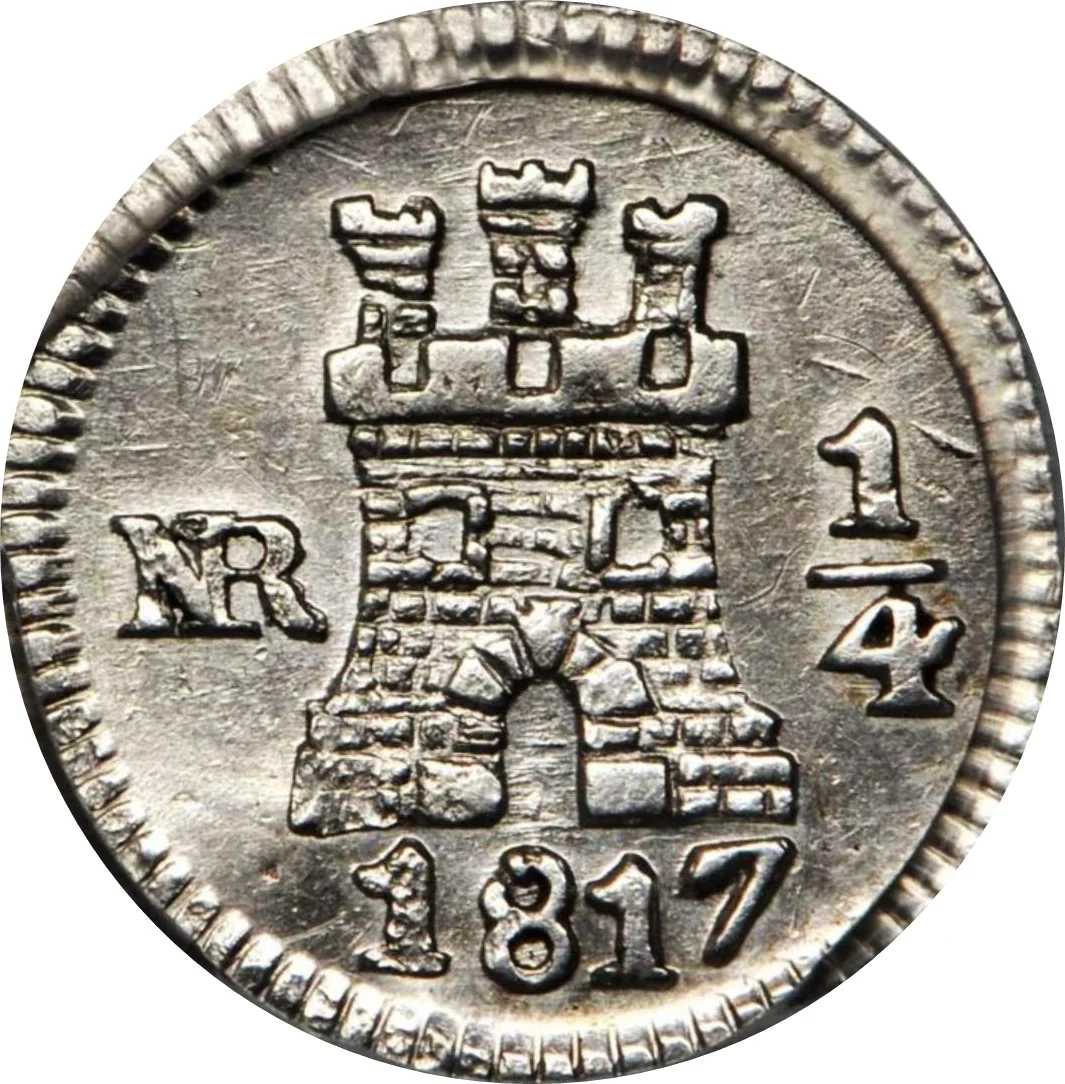
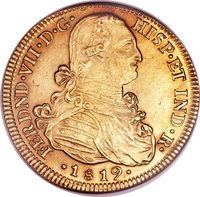
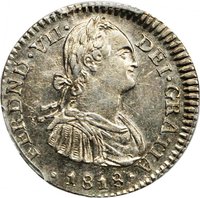
Obverse
Description:
Crowned lion left-facing.
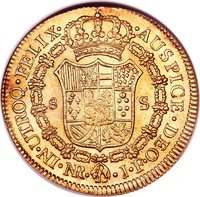
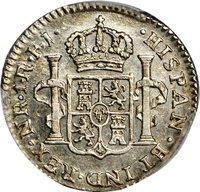
Reverse
Edge
Mints
| Name | Mark |
|---|---|
| Bogota Mint | NR |
| Casa de Moneda de Colombia | NR |
| Casa de Moneda de Colombia | PN |
Mintings
Historical background
In 1809, the currency situation in the Kingdom of New Granada (modern-day Colombia) was a complex and deteriorating system, deeply entangled with the political crisis of the Spanish Empire. The official currency was the Spanish colonial real, with coins minted primarily in precious metals—gold escudos and silver reales—from mints in Bogotá, Popayán, and, to a lesser extent, Santa Fe de Antioquia. However, the outbreak of the Peninsular War in 1808, following Napoleon's invasion of Spain, caused a severe rupture. Metropolitan Spain, now under French control and with a rival government in Cádiz, could no longer effectively supply or regulate the colony's coinage, leading to acute shortages of circulating specie.
This scarcity was exacerbated by longstanding local economic pressures, including counterfeiting and the clipping of coins, which reduced public trust. More critically, to facilitate everyday commerce in the absence of sufficient official coin, various forms of substitute money proliferated. These included señas (promissory notes or tokens) issued by merchants, hacienda owners, and even local civic bodies. The most significant and problematic of these were the moneda de necesidad (emergency money), often crudely cut and stamped pieces of silver or copper of irregular weight and purity, leading to a chaotic and inflationary environment where the intrinsic value of the metal in a coin often exceeded its face value.
Thus, by 1809, the monetary landscape was one of fragmentation and instability, mirroring the political uncertainty of the Patria Boba period that would soon follow. The vacuum of royal authority undermined the uniformity and credibility of the currency, creating a patchwork of local solutions that hampered regional trade and public finance. This monetary disarray was both a symptom and a cause of the deepening colonial crisis, setting the stage for the financial challenges the nascent republic would face after the declaration of independence in 1810.
This scarcity was exacerbated by longstanding local economic pressures, including counterfeiting and the clipping of coins, which reduced public trust. More critically, to facilitate everyday commerce in the absence of sufficient official coin, various forms of substitute money proliferated. These included señas (promissory notes or tokens) issued by merchants, hacienda owners, and even local civic bodies. The most significant and problematic of these were the moneda de necesidad (emergency money), often crudely cut and stamped pieces of silver or copper of irregular weight and purity, leading to a chaotic and inflationary environment where the intrinsic value of the metal in a coin often exceeded its face value.
Thus, by 1809, the monetary landscape was one of fragmentation and instability, mirroring the political uncertainty of the Patria Boba period that would soon follow. The vacuum of royal authority undermined the uniformity and credibility of the currency, creating a patchwork of local solutions that hampered regional trade and public finance. This monetary disarray was both a symptom and a cause of the deepening colonial crisis, setting the stage for the financial challenges the nascent republic would face after the declaration of independence in 1810.
💎 Extremely Rare