

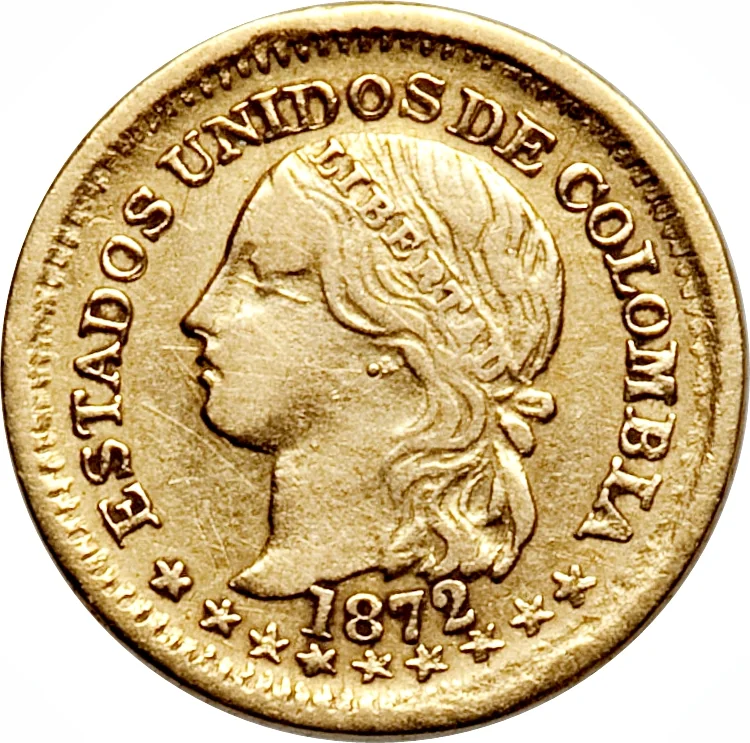
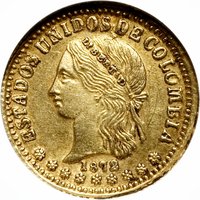
Obverse
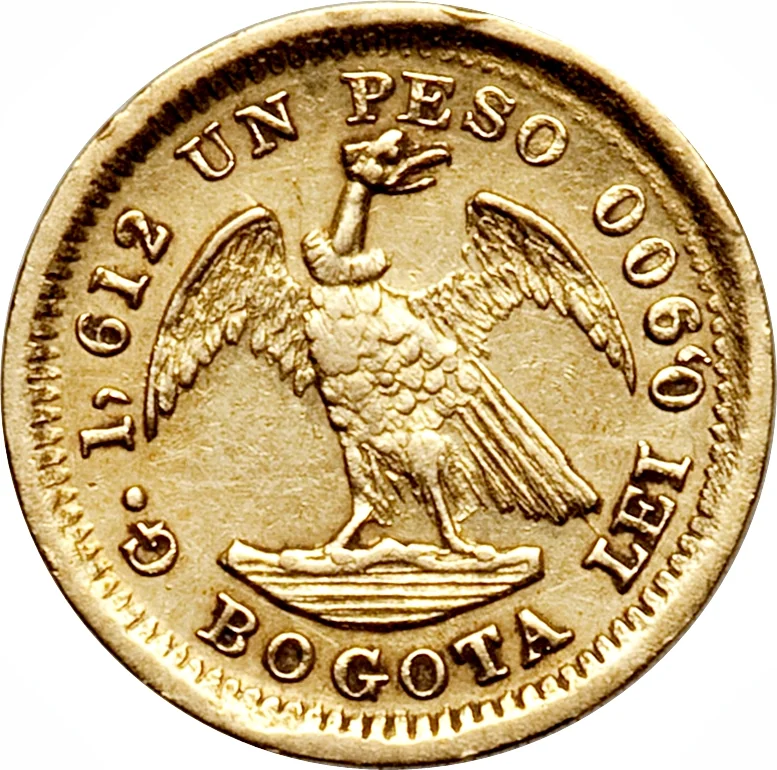
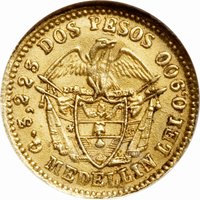
Reverse
Description:
Condor with spread wings, encircled by weight, denomination, mint, and fineness.
Inscription:
G. 1,612 UN PESO
BOGOTA LEI 0,900
BOGOTA LEI 0,900
Script: Latin
Edge
Milled
Mints
| Name | Mark |
|---|---|
| Bogota Mint | Bogota |
| Casa de Moneda de Colombia | MEDELLIN |
Mintings
| Year | Mint Mark | Mintage | Quality | Collection |
|---|---|---|---|---|
| 1871 | — | — | ||
| 1872 | — | — | ||
| 1873 | — | — | ||
| 1874 | — | 14,000 | ||
| 1875 | — | 7,002 | ||
| 1878 | — | — |
Historical background
In 1871, Colombia’s currency situation was characterized by profound instability and complexity, a direct legacy of the country's political fragmentation. Following the dissolution of Gran Colombia in 1831, the nation (known then as the United States of Colombia under the 1863 federal constitution) was a decentralized federation of sovereign states. This political structure led to a monetary free-for-all, where the federal government in Bogotá and nine individual estados soberanos (sovereign states) all exercised the right to issue their own paper money. Consequently, a bewildering array of banknotes and coins circulated with no uniform standard, leading to widespread confusion, counterfeiting, and wildly fluctuating values from one region to another.
The primary currency in practical use was based on the silver peso, but its value was severely undermined by the flood of inconvertible paper billetes. These paper issues, intended to finance budget deficits and regional projects, were not backed by gold or silver reserves, leading to rapid depreciation. The situation created a dual system where hard coin was hoarded for significant transactions and foreign trade, while devalued paper money was used for daily wages and local commerce, eroding public trust and hindering economic integration. International merchants often refused the local paper, insisting on payment in metallic currency or foreign coin.
This monetary chaos was widely recognized as a major obstacle to national economic development and a source of social discontent. By 1871, the federal government, under President Eustorgio Salgar, was attempting to assert greater central control, but its authority was limited. The period set the stage for the monetary reforms that would follow later in the 1880s, after the Regeneration movement under Rafael Núñez re-established a centralized republic and ultimately created the Banco Nacional in 1880, aiming to unify and stabilize the nation's currency.
The primary currency in practical use was based on the silver peso, but its value was severely undermined by the flood of inconvertible paper billetes. These paper issues, intended to finance budget deficits and regional projects, were not backed by gold or silver reserves, leading to rapid depreciation. The situation created a dual system where hard coin was hoarded for significant transactions and foreign trade, while devalued paper money was used for daily wages and local commerce, eroding public trust and hindering economic integration. International merchants often refused the local paper, insisting on payment in metallic currency or foreign coin.
This monetary chaos was widely recognized as a major obstacle to national economic development and a source of social discontent. By 1871, the federal government, under President Eustorgio Salgar, was attempting to assert greater central control, but its authority was limited. The period set the stage for the monetary reforms that would follow later in the 1880s, after the Regeneration movement under Rafael Núñez re-established a centralized republic and ultimately created the Banco Nacional in 1880, aiming to unify and stabilize the nation's currency.
💎 Extremely Rare