

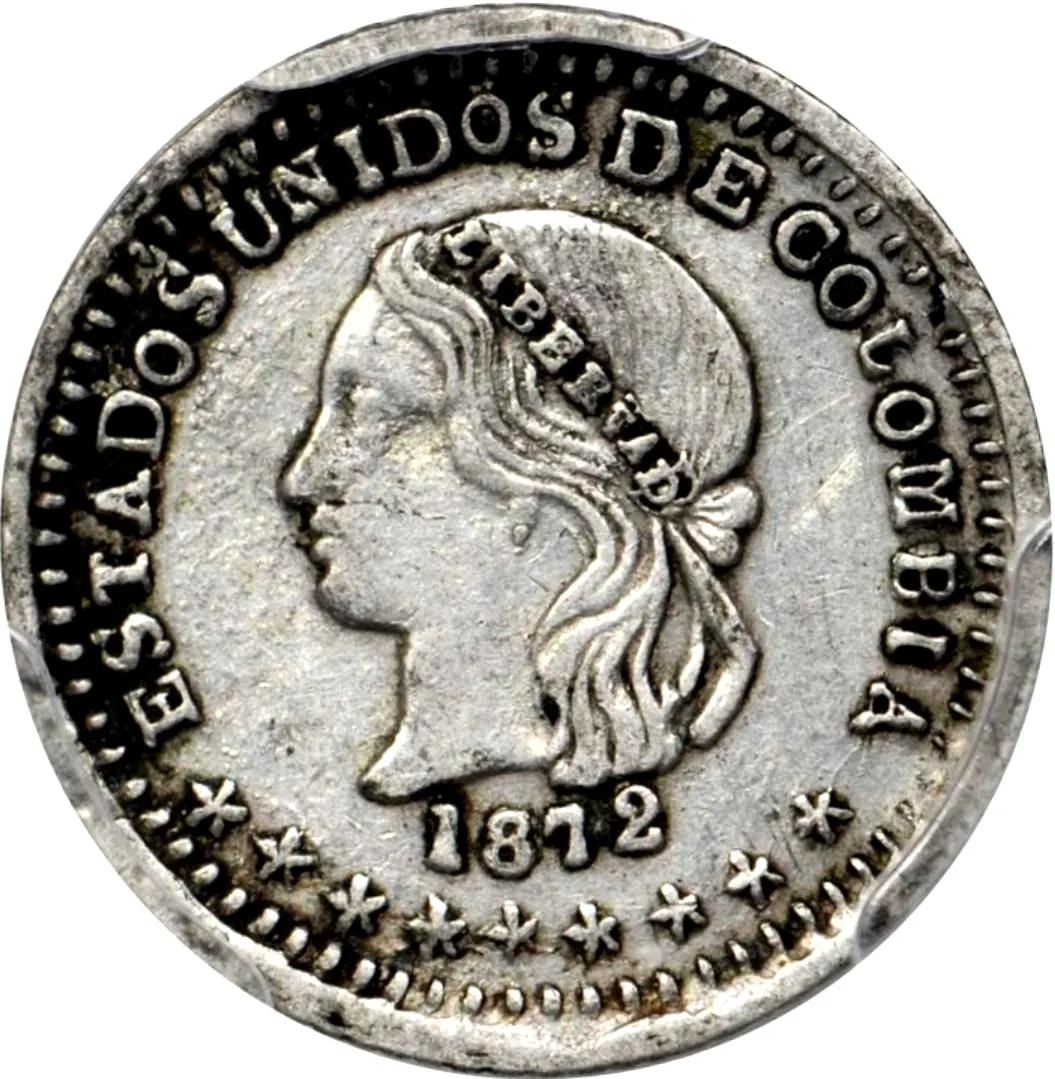
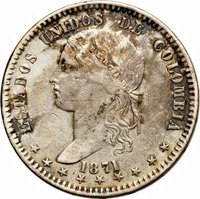
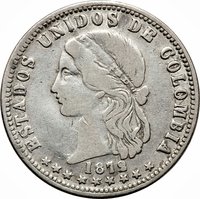
Obverse
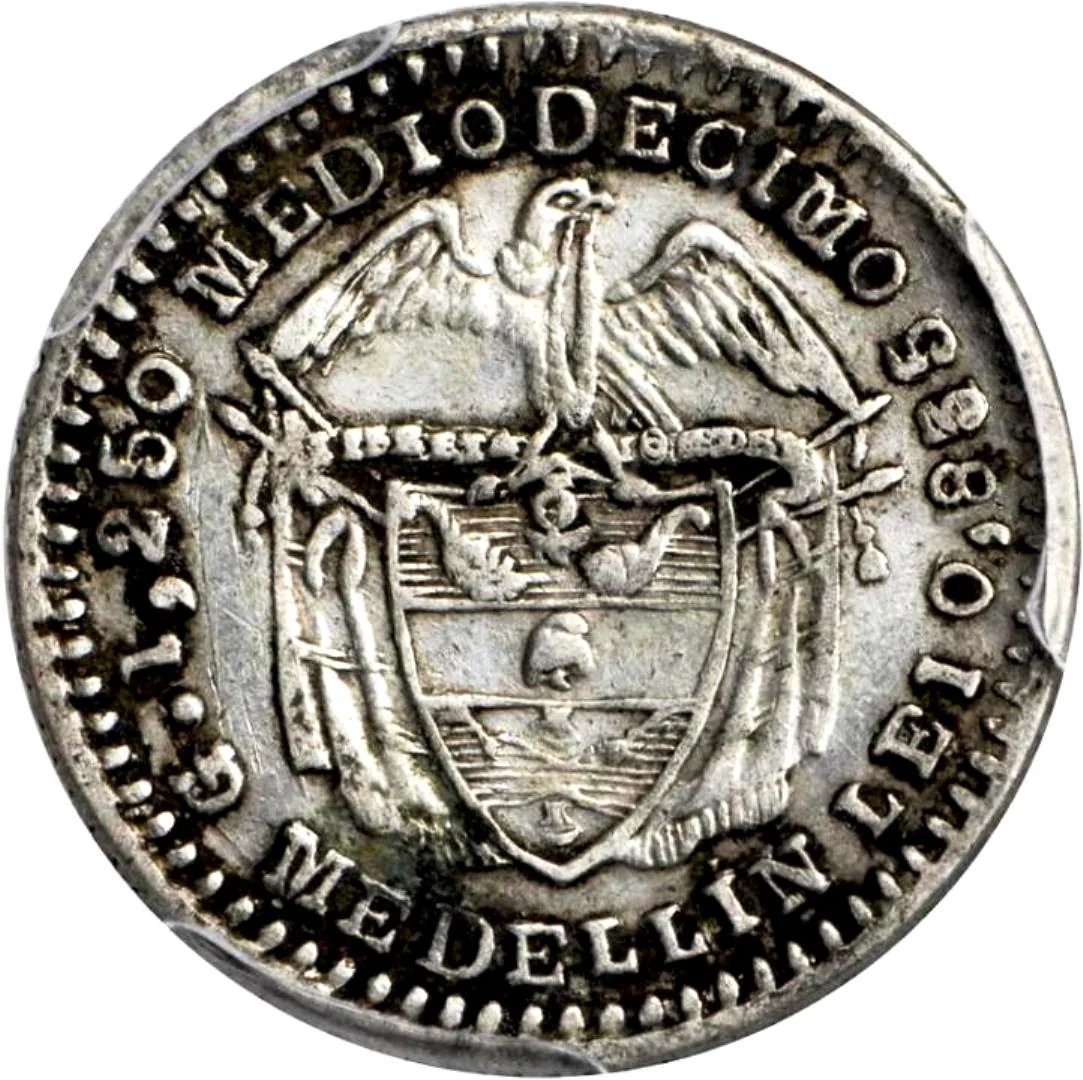
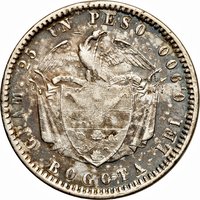
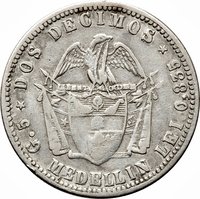
Reverse
Description:
Condor over heraldic flags.
Inscription:
G. 1,250 MEDIO DECIMO
MEDELLIN LEI 0,835
MEDELLIN LEI 0,835
Script: Latin
Edge
Plain
Categories
| Symbol> Allegory |
| Symbols> Coat of Arms |
Mints
| Name | Mark |
|---|---|
| Casa de Moneda de Colombia | — |
Mintings
| Year | Mint Mark | Mintage | Quality | Collection |
|---|---|---|---|---|
| 1870 | — | — | ||
| 1871 | — | 61,000 | ||
| 1872 | — | — | ||
| 1875 | — | — |
Historical background
In 1870, Colombia was navigating a complex and fragmented monetary landscape, a direct legacy of its post-independence political instability. Following the dissolution of Gran Colombia, the country had experienced decades of civil war and regionalism, which was reflected in its currency. There was no single, unified national currency; instead, a multitude of coins circulated simultaneously. These included old Spanish colonial coins, coins minted by the defunct Gran Colombia, and various issues from the independent Republic of New Granada and subsequent Grenadine Confederation. Furthermore, foreign coins, particularly from Peru, Bolivia, France, and Britain, were widely used in commerce, leading to a chaotic system of valuation based on weight and metallic content rather than a stable unit of account.
The official monetary system was bimetallic, theoretically based on both gold and silver, but it suffered from the global problem of fluctuating relative values between the two metals. The basic unit was the peso, divided into 10 reales. However, the most important and trusted coin in daily transactions was the silver peso fuerte (strong peso), often called the "columnario" or later the "Republican peso," which contained roughly 25 grams of pure silver. The government struggled to maintain a fixed legal ratio between gold and silver, which often caused one metal to disappear from circulation as it was hoarded or exported—a classic example of Gresham's Law. This instability hindered both domestic trade and foreign investment.
This chaotic situation set the stage for significant monetary reforms later in the 1870s. Recognizing that the lack of a uniform currency was an obstacle to economic modernization and national cohesion, the government of President Eustorgio Salgar would soon enact decisive changes. In 1871, Colombia adopted the gold standard and contracted with the Paris Mint to produce new national gold coins, the cóndor, and subsidiary silver coins. This move aimed to simplify the monetary system, instill confidence, and better integrate Colombia into the international financial order, marking a pivotal transition from the post-colonial monetary patchwork toward a modern, unified currency.
The official monetary system was bimetallic, theoretically based on both gold and silver, but it suffered from the global problem of fluctuating relative values between the two metals. The basic unit was the peso, divided into 10 reales. However, the most important and trusted coin in daily transactions was the silver peso fuerte (strong peso), often called the "columnario" or later the "Republican peso," which contained roughly 25 grams of pure silver. The government struggled to maintain a fixed legal ratio between gold and silver, which often caused one metal to disappear from circulation as it was hoarded or exported—a classic example of Gresham's Law. This instability hindered both domestic trade and foreign investment.
This chaotic situation set the stage for significant monetary reforms later in the 1870s. Recognizing that the lack of a uniform currency was an obstacle to economic modernization and national cohesion, the government of President Eustorgio Salgar would soon enact decisive changes. In 1871, Colombia adopted the gold standard and contracted with the Paris Mint to produce new national gold coins, the cóndor, and subsidiary silver coins. This move aimed to simplify the monetary system, instill confidence, and better integrate Colombia into the international financial order, marking a pivotal transition from the post-colonial monetary patchwork toward a modern, unified currency.
💎 Extremely Rare