

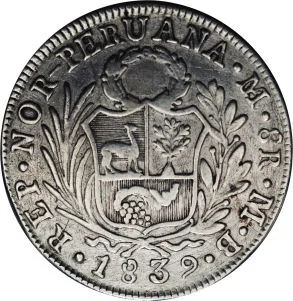
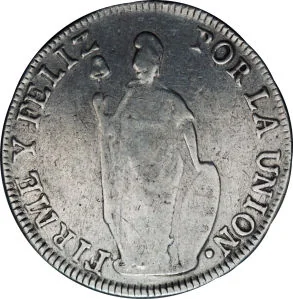
8 reales – Republic of North Peru
Add to wishlist
Peru
Obverse
Description:
Flagged coat of arms with wreath above.
Inscription:
REP · NOR-PERUANA · M · 8R · M
Script: Latin
Reverse
Edge
Mints
| Name | Mark |
|---|---|
| Lima | — |
Mintings
| Year | Mint Mark | Mintage | Quality | Collection |
|---|---|---|---|---|
| 1839 | MB | — |
Historical background
In 1839, the currency situation in the short-lived Republic of North Peru was one of profound instability and fragmentation, a direct legacy of the political and economic turmoil following the dissolution of the Peru-Bolivian Confederation. The Confederation's collapse after its defeat in the War of the Confederation (1836-1839) left its constituent states—including North Peru—with a shattered fiscal system. The region reverted to using a chaotic mix of monetary instruments, including worn Spanish colonial coins, Republican coinage from earlier Peruvian mints, and Bolivian currencies, all circulating at fluctuating and often arbitrary values. This lack of a unified, authoritative currency severely hampered internal trade and state revenue collection.
The economic foundation was further weakened by the devastation of the war, which had disrupted mining and agricultural production. With little specie (precious metal) entering the treasury, the government, led by President Agustín Gamarra (who moved to reincorporate North Peru into a unified Peruvian Republic), had limited capacity to issue credible new coinage. Consequently, the monetary landscape was defined by scarcity and distrust. Foreign merchants, particularly the British, often conducted business using their own hard currency, while local transactions relied heavily on barter or the physical condition of individual coins, leading to widespread discounting and fraud.
Ultimately, the currency chaos of 1839 was a symptom of a failed state project. The resolution came not through monetary reform within North Peru, but through its political reabsorption. By early 1839, Gamarra's forces were already working to dissolve the Republic of North Peru and restore a unified Peruvian state. This political reintegration, formally achieved later that year, paved the way for a gradual return to a centralized monetary system under the government in Lima, slowly phasing out the disparate currencies of the confederation period in favor of a national Peruvian currency.
The economic foundation was further weakened by the devastation of the war, which had disrupted mining and agricultural production. With little specie (precious metal) entering the treasury, the government, led by President Agustín Gamarra (who moved to reincorporate North Peru into a unified Peruvian Republic), had limited capacity to issue credible new coinage. Consequently, the monetary landscape was defined by scarcity and distrust. Foreign merchants, particularly the British, often conducted business using their own hard currency, while local transactions relied heavily on barter or the physical condition of individual coins, leading to widespread discounting and fraud.
Ultimately, the currency chaos of 1839 was a symptom of a failed state project. The resolution came not through monetary reform within North Peru, but through its political reabsorption. By early 1839, Gamarra's forces were already working to dissolve the Republic of North Peru and restore a unified Peruvian state. This political reintegration, formally achieved later that year, paved the way for a gradual return to a centralized monetary system under the government in Lima, slowly phasing out the disparate currencies of the confederation period in favor of a national Peruvian currency.
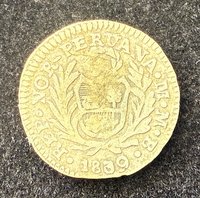
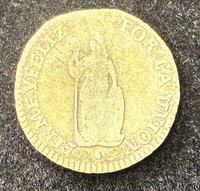
✨ Legendary