

2 Centavos – Chile
Chile

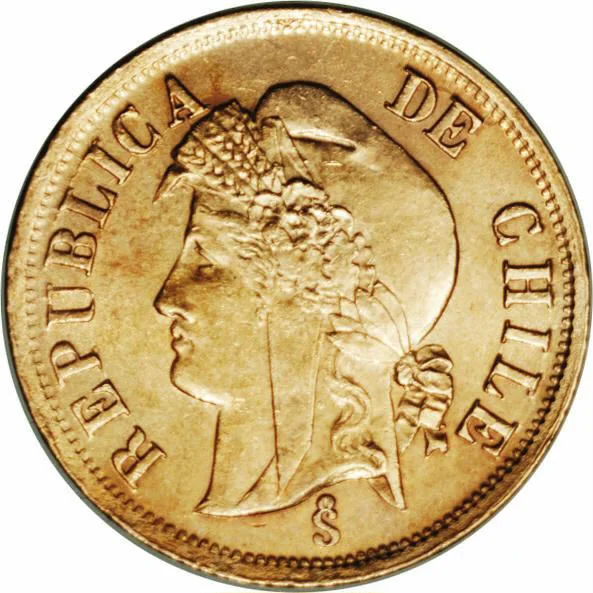
Obverse
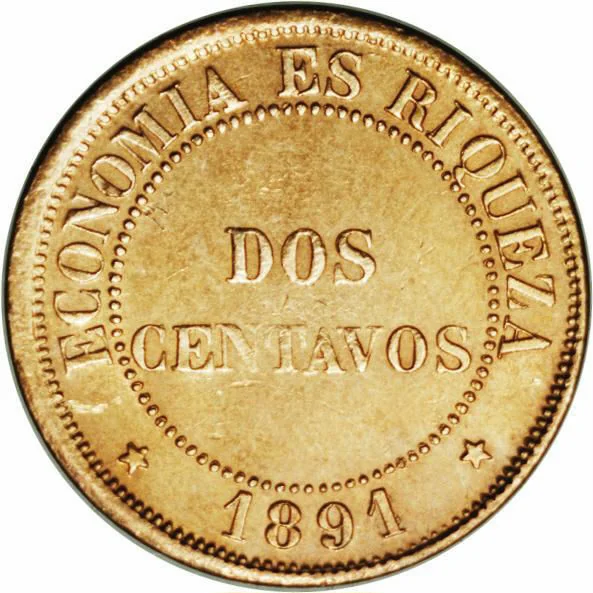
Reverse
Description:
Circle denomination, date beneath.
Inscription:
ECONOMIA ES RIQUEZA
DOS
CENTAVOS
1891
DOS
CENTAVOS
1891
Script: Latin
Edge
Plain
Categories
| Symbol> Allegory |
| Symbol> Phrygian cap |
Mints
| Name | Mark |
|---|---|
| Casa de Moneda de Chile | (So) |
Mintings
| Year | Mint Mark | Mintage | Quality | Collection |
|---|---|---|---|---|
| 1878 | So | 112,000 | ||
| 1879 | So | 479,000 | ||
| 1880 | So | 278,000 | ||
| 1881 | So | 172,000 | ||
| 1882 | So | 361,000 | ||
| 1883 | So | 405,000 | ||
| 1884 | So | 182,000 | ||
| 1885 | So | 146,000 | ||
| 1886 | So | 494,000 | ||
| 1887 | So | 106,000 | ||
| 1888 | So | 186,000 | ||
| 1890 | So | 155,000 | ||
| 1891 | So | 89,000 | ||
| 1893 | So | 141,000 | ||
| 1894 | So | 190,000 |
Historical background
In 1878, Chile's currency situation was characterized by a complex and unstable bimetallic system, heavily strained by pre-war fiscal pressures. The nation officially operated on a gold standard with the peso convertible to gold, but in practice, a large volume of inconvertible banknote emissions circulated alongside silver coinage. This created a dual system where the value of the paper peso began to diverge from the gold peso, sowing confusion in commerce. The root cause was significant government expenditure, particularly on extensive public works and railway development under President Aníbal Pinto, which was financed heavily by borrowing from emission banks, leading to inflationary pressures and a mounting external debt.
The specific trigger for the 1878 crisis was the dramatic fall in the international price of silver, which flooded the Chilean market with the metal as it was worth more as coin than as bullion. This led to the hoarding of gold and the effective disappearance of gold coinage from circulation, in adherence to Gresham's Law ("bad money drives out good"). Faced with the depletion of its gold reserves needed to back the currency and service foreign debt, the government took drastic action. In July 1878, it passed the "Ley de Inconvertibilidad," which suspended the gold convertibility of paper money for an indefinite period, effectively taking Chile off the gold standard.
This legislative move was a desperate attempt to conserve gold and prevent state bankruptcy, but it set the stage for severe economic consequences. The suspension of convertibility removed a key discipline on money printing, allowing for greater fiscal flexibility but also opening the door to future inflation. Crucially, this unstable financial backdrop formed the immediate economic context for the outbreak of the War of the Pacific in 1879. The conflict would then exert catastrophic pressure on the already fragile system, leading to massive further emissions of inconvertible paper money to fund the war effort, resulting in rampant inflation and a profound currency devaluation throughout the early 1880s.
The specific trigger for the 1878 crisis was the dramatic fall in the international price of silver, which flooded the Chilean market with the metal as it was worth more as coin than as bullion. This led to the hoarding of gold and the effective disappearance of gold coinage from circulation, in adherence to Gresham's Law ("bad money drives out good"). Faced with the depletion of its gold reserves needed to back the currency and service foreign debt, the government took drastic action. In July 1878, it passed the "Ley de Inconvertibilidad," which suspended the gold convertibility of paper money for an indefinite period, effectively taking Chile off the gold standard.
This legislative move was a desperate attempt to conserve gold and prevent state bankruptcy, but it set the stage for severe economic consequences. The suspension of convertibility removed a key discipline on money printing, allowing for greater fiscal flexibility but also opening the door to future inflation. Crucially, this unstable financial backdrop formed the immediate economic context for the outbreak of the War of the Pacific in 1879. The conflict would then exert catastrophic pressure on the already fragile system, leading to massive further emissions of inconvertible paper money to fund the war effort, resulting in rampant inflation and a profound currency devaluation throughout the early 1880s.
🌟 Uncommon