

25 piastres – Syria
Add to wishlist
Circulating commemorative coins
Commemoration: F.A.O.
Syria
Context
Year: 1976
Islamic (Hijri) Year:: 1396
Issuer: Syria
Period:
(since 1961)
Currency:
(since 1919)
Demonetized: Yes
Total mintage: 1,000,000
Material
References
KM: #
Numista: #14972
Value
Exchange value: 0.25 SYP
Obverse
Description:
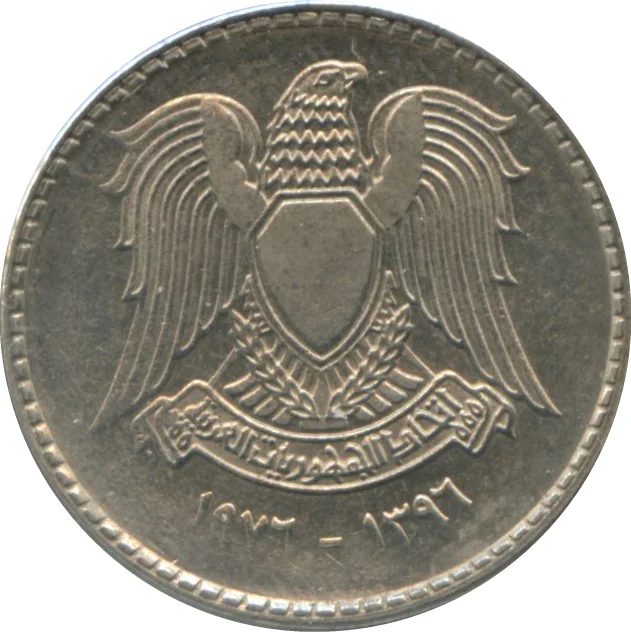
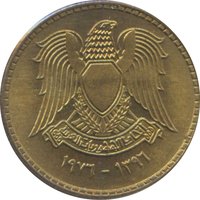
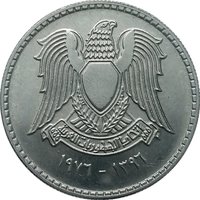
Syria's coat of arms: The Quraish hawk holding a shield (no star) and a scroll reading "Union of Arab Republics" in Arabic. Arabic numerals for the dates (AD and AH) are below.
Inscription:
اتحاد الجمهوريات العربية
١٣٩٦ - ١٩٧٦
١٣٩٦ - ١٩٧٦
Translation:
Union of Arab Republics
1396 - 1976
1396 - 1976
Script: Arabic
Language: Arabic
Reverse
Description:
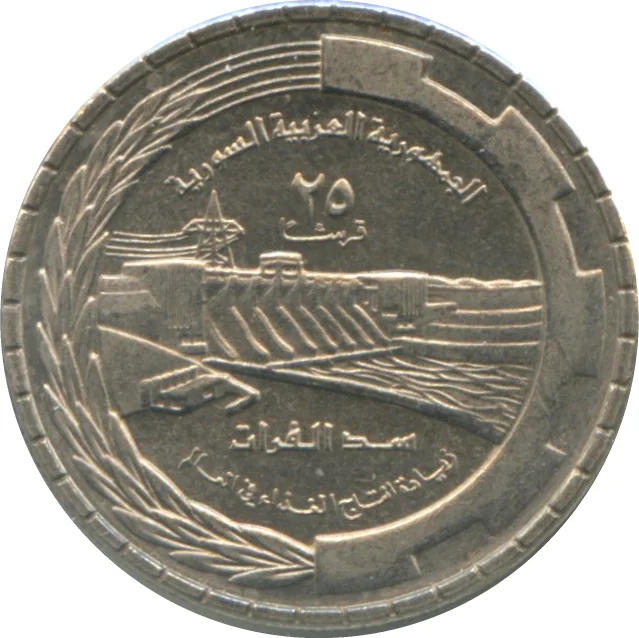
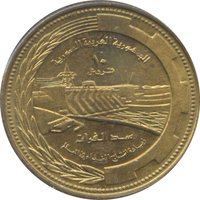
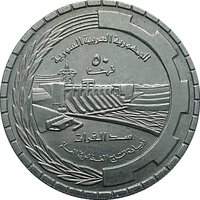
The Tabqa Dam, also called al-Thawra Dam, features a gear half and a wheat ear encircled on the Euphrates River.
Inscription:
الجمهورية العربية السورية
٢٥
قرشا
سد الفرات
زيادة انتاج الغذاء في العالم
٢٥
قرشا
سد الفرات
زيادة انتاج الغذاء في العالم
Translation:
The Syrian Arab Republic
25
Qirsh
The Euphrates Dam
Increasing food production in the world
25
Qirsh
The Euphrates Dam
Increasing food production in the world
Script: Arabic
Language: Arabic
Edge
Reeded
Categories
| Organization> FAO |
| Symbols> Coat of Arms |
| Animal> Bird |
| Building> Dam |
Mints
| Name | Mark |
|---|---|
| Staatliche Münze Baden-Württemberg | — |
Mintings
| Year | Mint Mark | Mintage | Quality | Collection |
|---|---|---|---|---|
| 1976 | — | 1,000,000 |
Historical background
By 1976, Syria's currency, the Syrian pound, was under significant strain due to a combination of regional conflict and ambitious domestic policies. The nation was deeply involved in the Lebanese Civil War, which began in 1975, committing substantial military and financial resources to this costly intervention. Concurrently, President Hafez al-Assad's government pursued a state-led economic development model, featuring large-scale public sector investment and subsidies on essential goods. This high level of expenditure, without commensurate increases in productive economic output, began to create fiscal pressures that weighed on the currency.
Internally, the economy showed signs of stress. While not yet in a state of hyperinflation, inflationary pressures were building as government spending increased the money supply. A growing budget deficit was financed primarily by borrowing from the state-owned Central Bank of Syria, a practice that eroded monetary stability. Furthermore, the regime maintained an official fixed exchange rate for the pound, but this rate was increasingly overvalued, leading to the emergence of a thriving black market for foreign currencies, particularly the US dollar and Lebanese pound, where the Syrian pound traded at a significant discount.
The currency situation in 1976 thus represented a critical juncture. The stability of the Syrian pound was becoming compromised by the twin burdens of regional military engagement and expansive domestic spending. While a full-blown crisis was still several years away, the foundational pressures—fiscal deficits, monetary financing, and a misaligned exchange rate—were firmly established. These factors set the stage for the more severe economic challenges and gradual currency depreciation that would characterize the Syrian economy in the decades to follow.
Internally, the economy showed signs of stress. While not yet in a state of hyperinflation, inflationary pressures were building as government spending increased the money supply. A growing budget deficit was financed primarily by borrowing from the state-owned Central Bank of Syria, a practice that eroded monetary stability. Furthermore, the regime maintained an official fixed exchange rate for the pound, but this rate was increasingly overvalued, leading to the emergence of a thriving black market for foreign currencies, particularly the US dollar and Lebanese pound, where the Syrian pound traded at a significant discount.
The currency situation in 1976 thus represented a critical juncture. The stability of the Syrian pound was becoming compromised by the twin burdens of regional military engagement and expansive domestic spending. While a full-blown crisis was still several years away, the foundational pressures—fiscal deficits, monetary financing, and a misaligned exchange rate—were firmly established. These factors set the stage for the more severe economic challenges and gradual currency depreciation that would characterize the Syrian economy in the decades to follow.
🌱 Fairly Common