

1 Sovereign – Australia
Australia
Context
Years: 1902–1910
Issuer: Australia 
Ruler: Edward VII
Currency:
(1788—1966)
Total mintage: 96,474,000
Material
References
KM: #Click to copy to clipboard15
Numista: #14963
Value
Bullion value: $1221.61
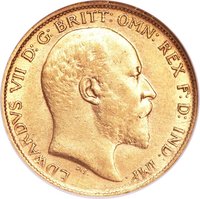
Obverse
Description:
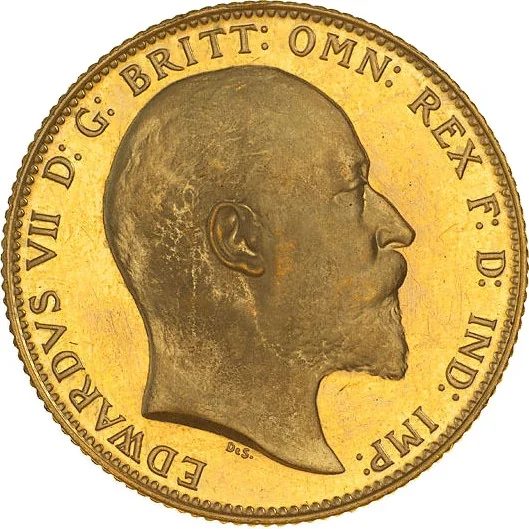
King Edward VII in right-facing profile.
Inscription:
EDWARDVS VII D: G: BRITT: OMN: REX F: D: IND: IMP:
DeS.
DeS.
Translation:
Edward VII, by the Grace of God, King of all the Britains, Defender of the Faith, Emperor of India.
Script: Latin
Language: Latin
Designer: George William de Saulles
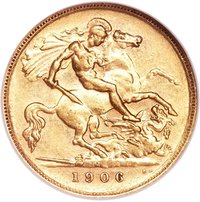
Reverse
Description:
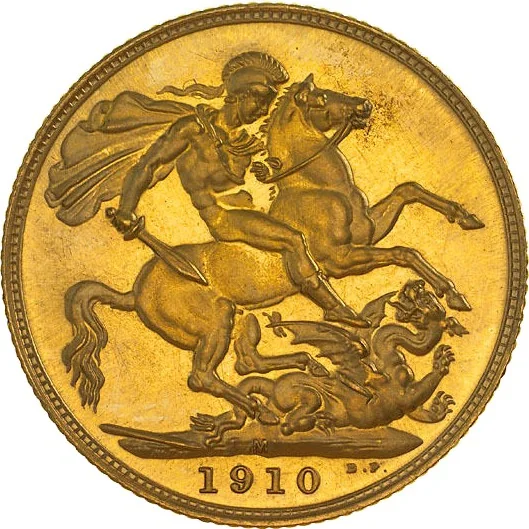
Saint George defeating the dragon.
Inscription:
M
S B.P.
1910
S B.P.
1910
Script: Latin
Designer: Benedetto Pistrucci
Edge
Milled
Categories
| Mythology> Fantastic animal |
| Animal> Horse |
Mints
| Name | Mark |
|---|---|
| Royal Mint | M |
| Perth Mint | P |
| Royal Mint | S |
Mintings
| Year | Mint Mark | Mintage | Quality | Collection |
|---|---|---|---|---|
| 1902 | M | 4,267,000 | ||
| 1902 | P | 4,289,000 | ||
| 1902 | S | 2,813,000 | ||
| 1902 | S | — | Proof | |
| 1903 | M | 3,521,000 | ||
| 1903 | P | 4,674,000 | ||
| 1903 | S | 2,806,000 | ||
| 1904 | P | 4,506,000 | ||
| 1904 | S | 2,986,000 | ||
| 1904 | M | 3,743,000 | ||
| 1904 | M | — | Proof | |
| 1905 | M | 3,633,000 | ||
| 1905 | P | 4,876,000 | ||
| 1905 | S | 2,778,000 | ||
| 1906 | P | 4,829,000 | ||
| 1906 | S | 2,792,000 | ||
| 1906 | M | 3,657,000 | ||
| 1907 | M | 3,332,000 | ||
| 1907 | P | 4,972,000 | ||
| 1907 | S | 2,539,000 | ||
| 1908 | M | 3,080,000 | ||
| 1908 | P | 4,875,000 | ||
| 1908 | S | 2,017,000 | ||
| 1909 | M | 3,029,000 | ||
| 1909 | P | 4,524,000 | ||
| 1909 | S | 2,057,000 | ||
| 1910 | P | 4,690,000 | ||
| 1910 | S | 2,135,000 | ||
| 1910 | M | 3,054,000 | ||
| 1910 | M | — | Proof |
Historical background
In 1902, Australia stood on the cusp of a monumental financial transformation as a newly federated nation. The currency situation was a complex patchwork inherited from its colonial past, with multiple private trading banks issuing their own banknotes, backed by British gold sovereigns and half-sovereigns which served as the primary circulating coinage. This system, while functional, was seen as inefficient and lacking a unifying national symbol. The British pound sterling remained the official standard, but the practical reality was a decentralised system where the credibility of a banknote depended entirely on the issuing bank's reputation.
The push for a singular Australian currency was a key early priority for the first federal parliament, driven by the need for economic integration and identity. The Coinage Act 1909 and the Australian Notes Act 1910 were still years away, but the foundational work began in this period. In 1902, the government was laying the groundwork by taking steps to assert federal control, including the establishment of a Commonwealth Treasury and early debates on assuming responsibility for note issue from the private banks. The goal was to replace the variety of private notes with uniform, government-issued currency.
Underpinning this entire system was the gold standard, which Australia adhered to faithfully. The value of all currency was legally defined by and convertible into a fixed quantity of gold, ensuring stability in international exchange, particularly with Britain. This era, therefore, was one of transition—a hybrid system of colonial legacy and nascent national ambition, all anchored by gold. The economic confidence of the post-federation period, fueled by agricultural and mineral exports, provided the stable conditions necessary to plan for a unified national currency that would eventually become the Australian pound in 1910.
The push for a singular Australian currency was a key early priority for the first federal parliament, driven by the need for economic integration and identity. The Coinage Act 1909 and the Australian Notes Act 1910 were still years away, but the foundational work began in this period. In 1902, the government was laying the groundwork by taking steps to assert federal control, including the establishment of a Commonwealth Treasury and early debates on assuming responsibility for note issue from the private banks. The goal was to replace the variety of private notes with uniform, government-issued currency.
Underpinning this entire system was the gold standard, which Australia adhered to faithfully. The value of all currency was legally defined by and convertible into a fixed quantity of gold, ensuring stability in international exchange, particularly with Britain. This era, therefore, was one of transition—a hybrid system of colonial legacy and nascent national ambition, all anchored by gold. The economic confidence of the post-federation period, fueled by agricultural and mineral exports, provided the stable conditions necessary to plan for a unified national currency that would eventually become the Australian pound in 1910.
🌱 Fairly Common