

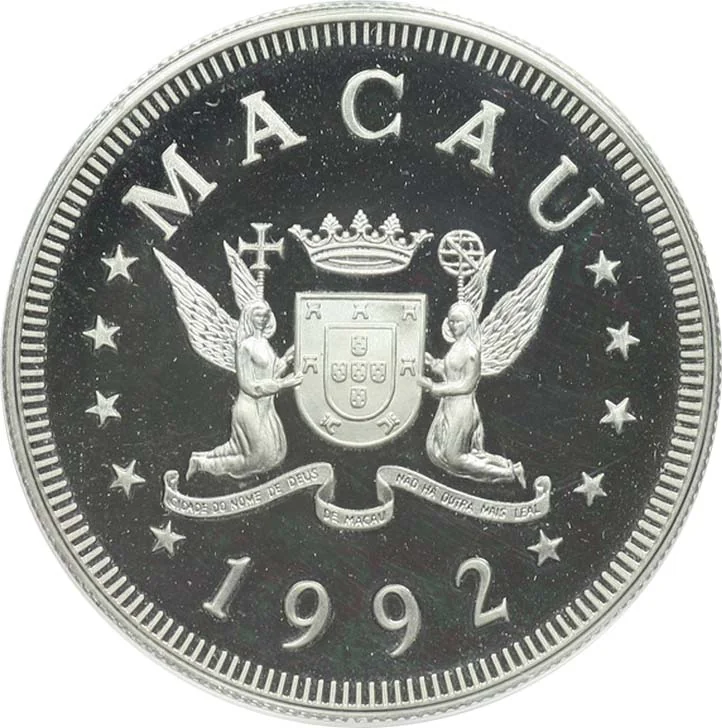
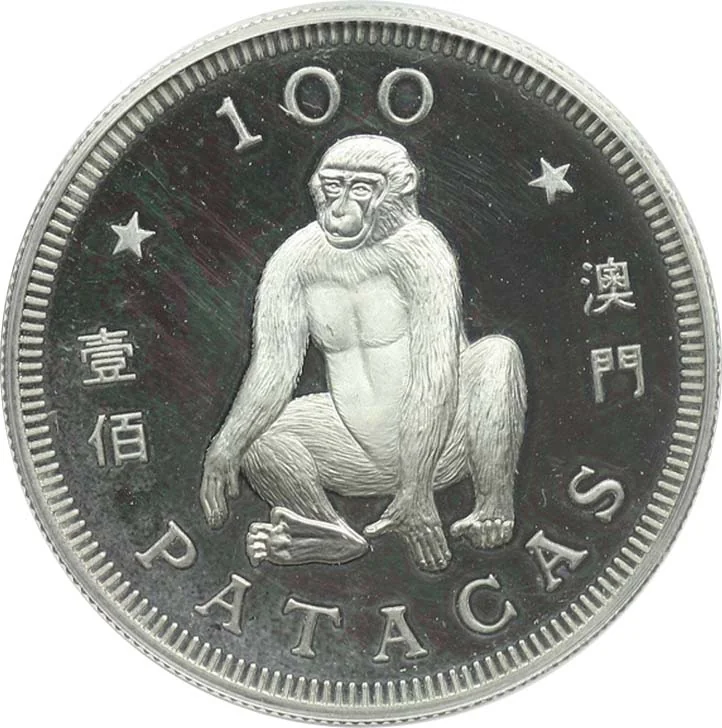
100 Patacas – Macau
Non-circulating coins
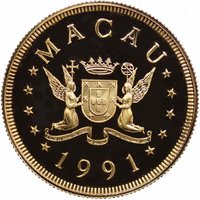
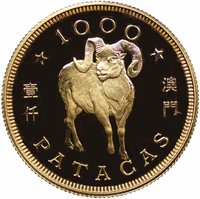
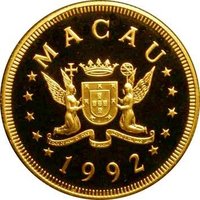
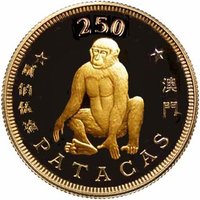
Commemoration: Year of the Monkey
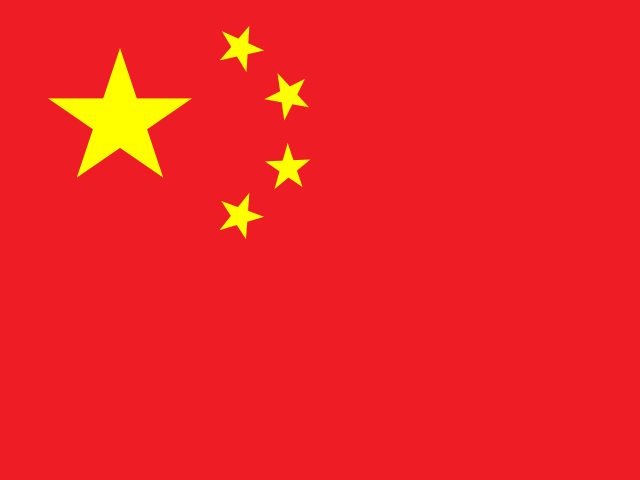
China
Obverse
Edge
Reeded
Categories
| Animal> Primate |
| Symbols> Coat of Arms |
| Astrology> Chinese calendar |
Mints
| Name | Mark |
|---|---|
| Singapore Mint | — |
Mintings
| Year | Mint Mark | Mintage | Quality | Collection |
|---|---|---|---|---|
| 1992 | — | 4,000 | Proof |
Historical background
In 1992, Macau was a Portuguese-administered territory operating under a unique and complex dual-currency system. The official currency was the Macanese pataca (MOP), which was pegged to the Hong Kong dollar (HKD) at a fixed rate of 1.03 patacas to 1 Hong Kong dollar. This peg, managed by the Banco Nacional Ultramarino and later the Monetary and Foreign Exchange Authority of Macau (AMCM), provided crucial stability. However, in daily economic life, the Hong Kong dollar was equally, if not more, prevalent, especially in large transactions, tourism, and the burgeoning casino industry. This created a de facto dual circulation where both currencies were widely accepted, with the Hong Kong dollar often perceived as stronger and more desirable.
The currency situation was deeply influenced by Macau's economic structure and its relationship with neighboring regions. The territory's economy was heavily reliant on tourism and gambling, with investments and high-roller play largely flowing in Hong Kong dollars. Furthermore, as a small, open economy, Macau's trade and financial links were overwhelmingly tied to Hong Kong and, by extension, the international markets. The pataca's peg to the HKD, which was itself pegged to the US dollar, effectively anchored Macau's currency to the global financial system. This arrangement facilitated business and investment but also meant Macau's monetary policy was largely imported, with its currency stability dependent on the health of the Hong Kong dollar peg.
Looking ahead, the currency environment of 1992 existed under the long shadow of the impending political transition. With the 1999 handover from Portugal to China already agreed upon, there were underlying questions about the future of the pataca. However, in the short term, the system was functioning effectively, providing the stability needed for economic growth. The dual circulation was a pragmatic reflection of Macau's economic realities, serving as a financial bridge between the territory's Portuguese administration, its capitalist hub neighbor Hong Kong, and its future sovereign, China. The priority for authorities was maintaining this stability during the final years of colonial rule.
The currency situation was deeply influenced by Macau's economic structure and its relationship with neighboring regions. The territory's economy was heavily reliant on tourism and gambling, with investments and high-roller play largely flowing in Hong Kong dollars. Furthermore, as a small, open economy, Macau's trade and financial links were overwhelmingly tied to Hong Kong and, by extension, the international markets. The pataca's peg to the HKD, which was itself pegged to the US dollar, effectively anchored Macau's currency to the global financial system. This arrangement facilitated business and investment but also meant Macau's monetary policy was largely imported, with its currency stability dependent on the health of the Hong Kong dollar peg.
Looking ahead, the currency environment of 1992 existed under the long shadow of the impending political transition. With the 1999 handover from Portugal to China already agreed upon, there were underlying questions about the future of the pataca. However, in the short term, the system was functioning effectively, providing the stability needed for economic growth. The dual circulation was a pragmatic reflection of Macau's economic realities, serving as a financial bridge between the territory's Portuguese administration, its capitalist hub neighbor Hong Kong, and its future sovereign, China. The priority for authorities was maintaining this stability during the final years of colonial rule.
💎 Extremely Rare