Logo Title
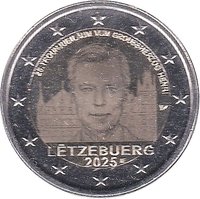
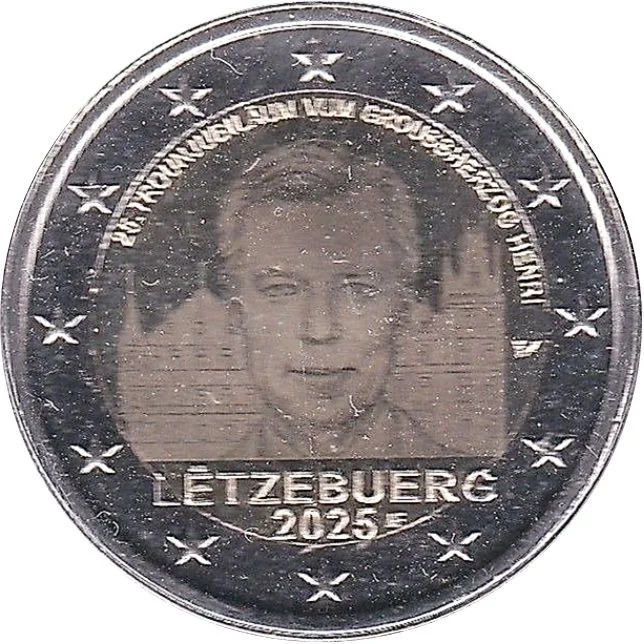
obverse
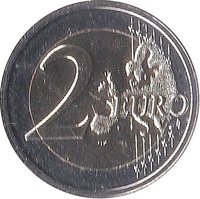
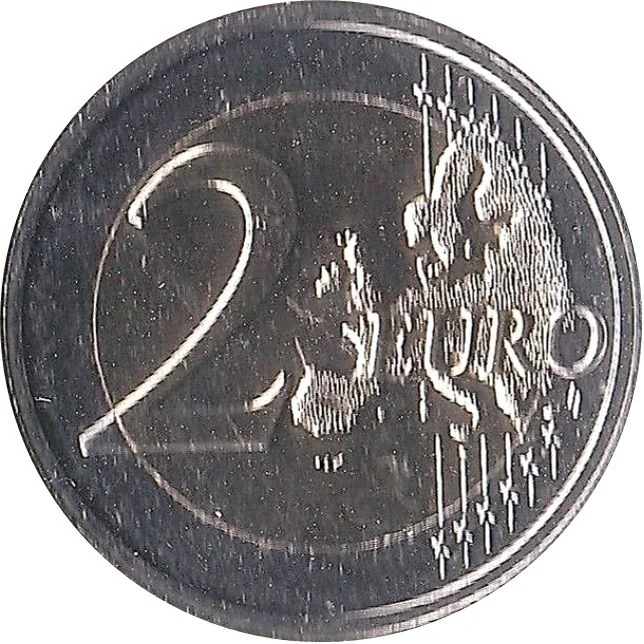
reverse
meerma

2 Euro (accession of Grand Duke Henri to the throne) – Grand Duchy of Luxembourg

Non-circulating coins
Commemoration: 25th anniversary of the accession of Grand Duke Henri to the throne
Luxembourg
Context
Year: 2025
Country: Luxembourg Country flag
Ruler: Henry
Currency:
(since 2002)
Total mintage: 2,500
Material
Diameter: 25.75 mm
Weight: 8.5 g
Thickness: 2.2 mm
Shape: Round
Composition: Bimetallic (Nickel brass center, Copper-nickel ring)
Technique: Milled
Alignment: Medal alignment
Obverse
OBVERSE ↑
flip
Reverse
REVERSE ↑
References
Numista: #477676
Value
Exchange value: 2 EUR = $2.36

Obverse

Description:
Portrait of Grand Duke Henri before the Grand Ducal Palace. Above, "25. TROUNJUBILÄUM VUM GROUSSHERZOG HENRI" arches at the top. Below are "LËTZEBUERG", the initials "MF", and "2025". The outer ring features the twelve stars of the European flag.
Inscription:
25. TROUNJUBILÄUM VUM GROUSSHERZOG HENRI

LËTZEBUERG

2025

MF
Translation:
25th Anniversary of Grand Duke Henri

Luxembourg

2025

MF
Script: Latin
Languages: German, Luxembourgish

Reverse

Description:
A Western Europe map spans the coin's right side, with "2 EURO" overlaid—the "2" in the Atlantic. Twelve stars flank the map, six above and six below, connected by six vertical stripes across the inner core.
Inscription:
2 EURO

LL
Script: Latin
Designer: Luc Luycx

Edge

The sequence "2 ★ ★" repeated six times alternately upright and inverted
Legend:
2★★2★★2★★2★★2★★2★★

Mints

NameMark
Royal Dutch Mint

Mintings

YearMint MarkMintageQualityCollection
20252,500BU

Historical background

In 2025, the Grand Duchy of Luxembourg remains a steadfast and integral member of the Eurozone, with the euro (EUR) serving as its sole legal tender. The currency situation is characterized by stability and deep integration into the broader European financial architecture. Luxembourg’s economy, heavily reliant on its prestigious financial sector, investment funds, and private banking, benefits immensely from the credibility and low transaction costs provided by the common currency. This stability is further reinforced by the European Central Bank's monetary policy, which continues to focus on price stability, a priority that aligns with Luxembourg’s own economic interests as a small, open, and export-oriented nation.

However, the monetary landscape is not without its challenges. The Luxembourgish government and financial regulators are actively navigating the dual pressures of the ECB’s post-pandemic policy normalization—managing interest rate adjustments to combat lingering inflationary pressures in the Eurozone—and the rapid digital transformation of finance. A key domestic focus in 2025 is the implementation of the EU’s Digital Euro project, with Luxembourg’s financial institutions playing a leading role in pilot programs and infrastructure development. Concurrently, the supervision of cryptocurrencies and other digital assets remains a top priority for the Commission de Surveillance du Secteur Financier (CSSF), as the country seeks to maintain its innovative edge while ensuring robust investor protection and anti-money laundering standards.

Looking forward, Luxembourg’s currency policy is inextricably linked to the future of European integration. National discourse centers on strengthening the Eurozone's banking and capital markets unions, seen as vital for the currency's long-term resilience and for securing Luxembourg’s position as a premier financial hub. While there is broad political and public consensus on euro membership, 2025 sees ongoing strategic efforts to mitigate any potential downsides, such as the lack of independent monetary levers, through exceptional fiscal discipline and aggressive diversification into high-value, knowledge-based industries like fintech, space tech, and sustainable finance.
💎 Extremely Rare