

1 lats – Latvia
Add to wishlist
Latvia
Context
Material
Diameter: 21.75 mm
Weight: 4.8 g
Thickness: 1.8 mm
Shape: Round
Composition: Copper-nickel
Technique: Milled
Alignment: Medal alignment
flip
References
KM: #
Numista: #10314
Value
Exchange value: 1 LVL
Inflation-adjusted value: 1.86 LVL
Obverse
Description:
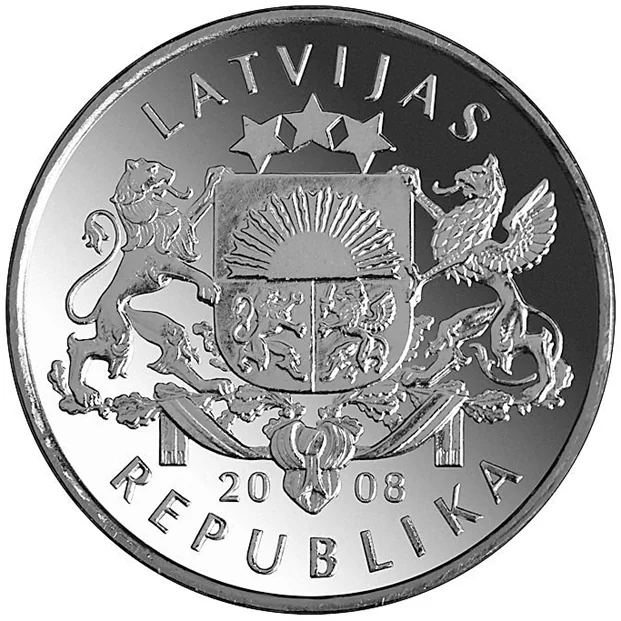
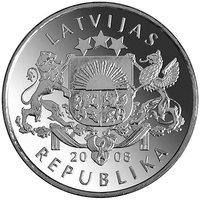
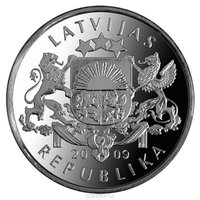
The Latvian coat of arms and the year 2008 are centered, with "LATVIJAS" arched above and "REPUBLIKA" arched below.
Inscription:
LATVIJAS
20 08
REPUBLIKA
20 08
REPUBLIKA
Translation:
LATVIA'S
20 08
REPUBLIC
20 08
REPUBLIC
Script: Latin
Language: Latvian
Engraver: Laura Medne
Designer: Aleksandrs Čhaidze
Reverse
Description:
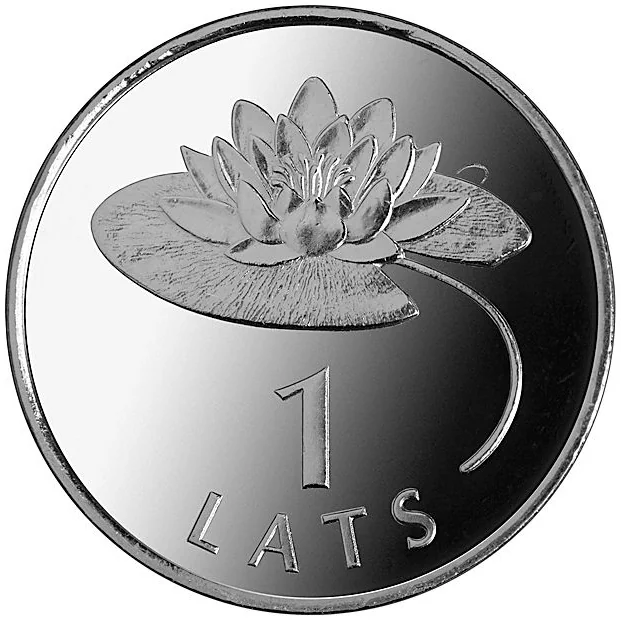
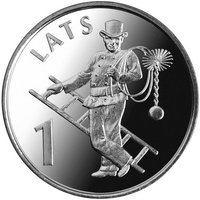
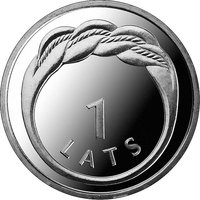
A waterlily is above the numeral 1, with "LATS" inscribed in a semicircle below.
Inscription:
1
LATS
LATS
Script: Latin
Engraver: Laura Medne
Designer: Aleksandrs Čhaidze
Edge
Two inscriptions LATVIJAS BANKA (Bank of Latvia), separated by rhombic dots.
Legend:
LATVIJAS BANKA ♦ LATVIJAS BANKA ♦
Translation:
LATVIJAS BANKA ♦ LATVIJAS BANKA ♦
Language: Latvian
Mints
| Name | Mark |
|---|---|
| Mint of Finland | — |
Mintings
| Year | Mint Mark | Mintage | Quality | Collection |
|---|---|---|---|---|
| 2008 | — | 1,000,000 |
Historical background
In 2008, Latvia found itself at the epicenter of a severe economic and currency crisis, stemming from an unsustainable pre-2008 boom. During the mid-2000s, fueled by easy credit primarily from Swedish banks, Latvia experienced a massive economic overheating. This led to a huge real estate bubble, rampant inflation, and a large current account deficit. The situation was made more precarious because Latvia maintained a fixed exchange rate, pegging the Latvian lats (LVL) first to the SDR and then to the euro, as part of its official path to Eurozone membership.
The global financial crisis of 2008 triggered a sudden stop in capital inflows, collapsing the credit-driven boom. This caused a deep recession, with GDP contracting by over 10% in 2009, one of the sharpest declines in the world. To defend the lats peg and avoid a devaluation, the Latvian government, with crucial support from the International Monetary Fund (IMF), the European Union, and other international lenders in a €7.5 billion bailout, implemented drastic austerity measures. These included severe cuts to public sector wages and pensions, and significant tax increases, which led to social unrest but were deemed necessary to maintain the currency peg.
The defense of the lats peg was ultimately successful, but at a tremendous social and economic cost. The austerity program stabilized the currency and allowed Latvia to eventually join the Eurozone in 2014, replacing the lats with the euro. However, the crisis of 2008-2010 left a lasting legacy, including high unemployment, significant emigration, and a debate on the merits of internal devaluation (austerity) versus external devaluation (currency devaluation) as a response to such profound economic imbalances.
The global financial crisis of 2008 triggered a sudden stop in capital inflows, collapsing the credit-driven boom. This caused a deep recession, with GDP contracting by over 10% in 2009, one of the sharpest declines in the world. To defend the lats peg and avoid a devaluation, the Latvian government, with crucial support from the International Monetary Fund (IMF), the European Union, and other international lenders in a €7.5 billion bailout, implemented drastic austerity measures. These included severe cuts to public sector wages and pensions, and significant tax increases, which led to social unrest but were deemed necessary to maintain the currency peg.
The defense of the lats peg was ultimately successful, but at a tremendous social and economic cost. The austerity program stabilized the currency and allowed Latvia to eventually join the Eurozone in 2014, replacing the lats with the euro. However, the crisis of 2008-2010 left a lasting legacy, including high unemployment, significant emigration, and a debate on the merits of internal devaluation (austerity) versus external devaluation (currency devaluation) as a response to such profound economic imbalances.
🌱 Common