

100 pesos (Central Bank of Chile) – Chile
Add to wishlist
Circulating commemorative coins
Commemoration: 100 Years of the Central Bank of Chile.
Chile
Context
Year: 2025
Issuer: Chile
Issuing organization: Central Bank of Chile
Period:
(since 1818)
Currency:
(since 1975)
Total mintage: 30,000,000
Material
References
Numista: #474034
Value
Exchange value: 100 CLP
Obverse
Description:
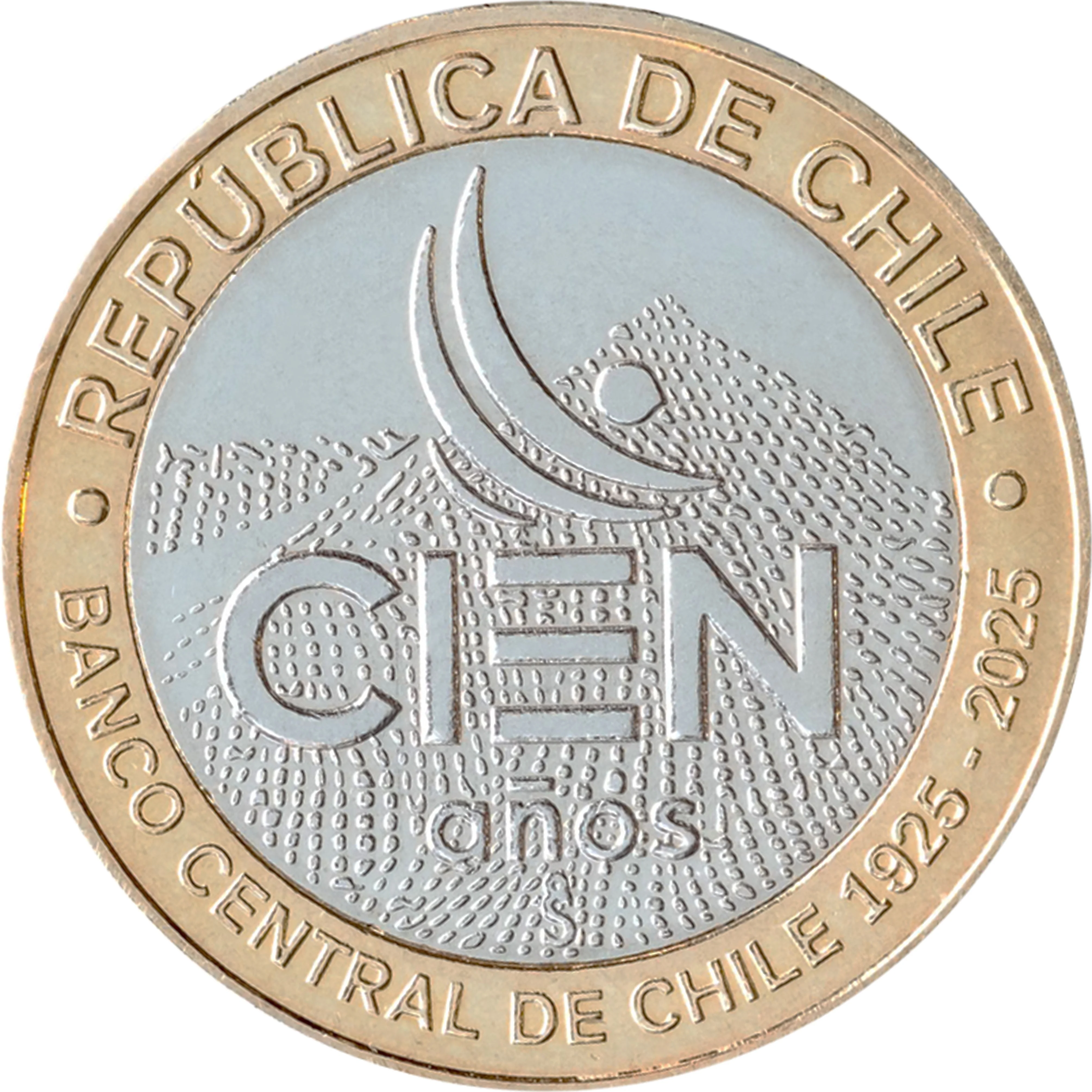
Centered on the coin's core are the Banco Central de Chile logo and "CIEN años," above a stylized Andes mountain. The outer ring reads "REPÚBLICA DE CHILE" at the top and "BANCO CENTRAL DE CHILE 1925 – 2025" at the bottom, alongside the mintmark.
Inscription:
REPUBLICA DE CHILE
CIEN
años
So
BANCO CENTRAL DE CHILE 1925 – 2025
CIEN
años
So
BANCO CENTRAL DE CHILE 1925 – 2025
Translation:
REPUBLIC OF CHILE
ONE HUNDRED
years
So
CENTRAL BANK OF CHILE 1925 – 2025
ONE HUNDRED
years
So
CENTRAL BANK OF CHILE 1925 – 2025
Script: Latin
Language: Spanish
Reverse
Description:
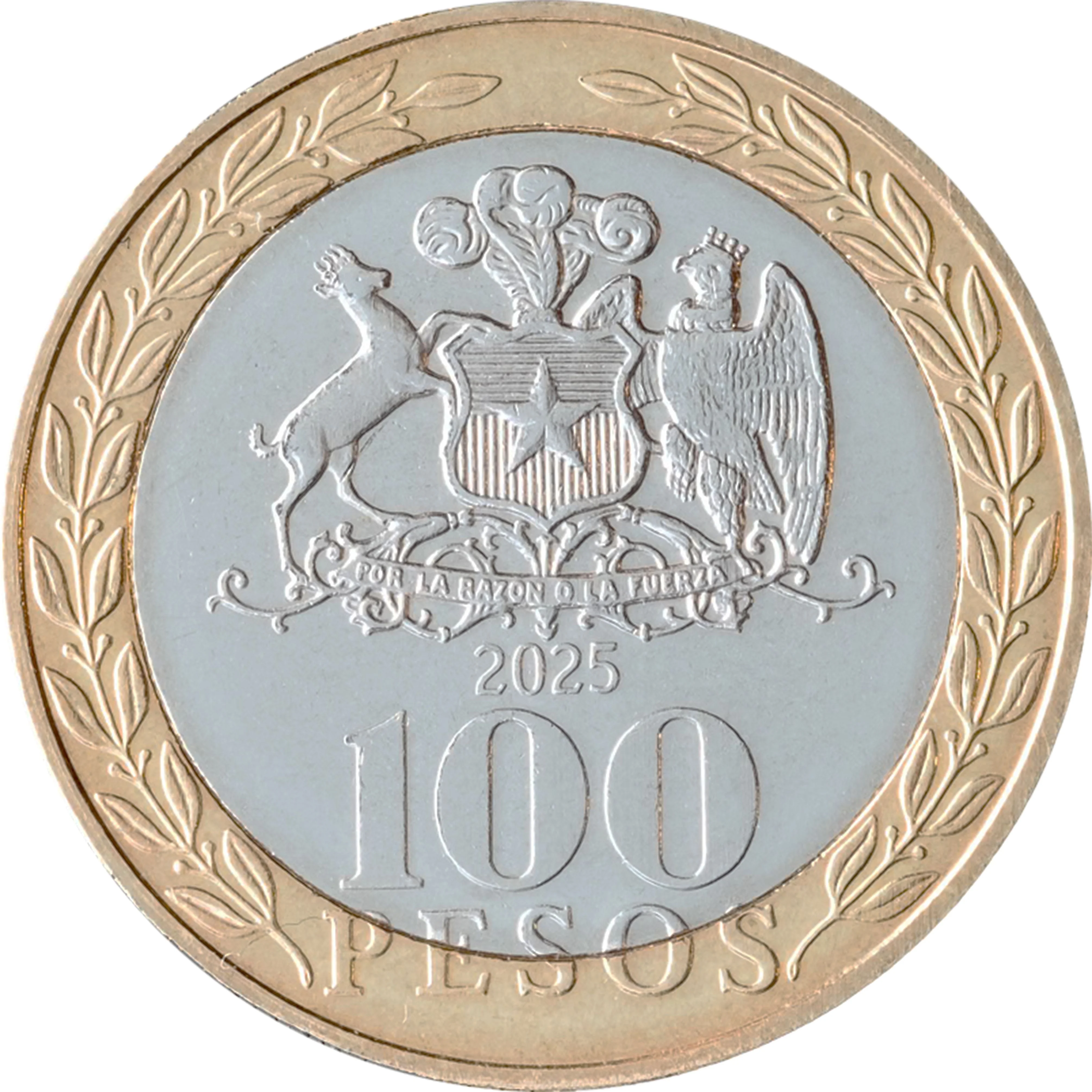
The core features the National Coat of Arms, with the year 2025, "100", and "PESOS" below it, extending onto the ring. Laurel branches surround the design on the ring.
Inscription:
POR LA RAZON O LA FUERZA
2025
100
PESOS
2025
100
PESOS
Translation:
By Reason or Force
2025
100
Pesos
2025
100
Pesos
Script: Latin
Language: Spanish
Edge
Categories
| Symbols> Coat of Arms |
Mints
| Name | Mark |
|---|---|
| Casa de Moneda de Chile | (So) |
Mintings
| Year | Mint Mark | Mintage | Quality | Collection |
|---|---|---|---|---|
| 2025 | So | 30,000,000 |
Historical background
As of 2025, Chile's currency situation is defined by a period of significant volatility and structural adjustment for the Chilean peso (CLP). The currency has faced sustained pressure from a combination of internal and external factors. Externally, a stronger US dollar driven by global monetary tightening and lower commodity prices—particularly for copper, which accounts for over half of Chile's exports—has reduced foreign exchange inflows. Internally, persistent domestic inflation, though moderating from its peak, has required the Central Bank of Chile (BCCh) to maintain a relatively high benchmark interest rate. This policy, while aimed at anchoring inflation expectations, has also contributed to economic slowing, creating a complex environment for the peso's valuation.
The primary domestic challenge has been navigating the aftermath of the post-pandemic economic overheating and the long-term fiscal uncertainty linked to the ongoing process of constitutional reform and debates over major social and pension system changes. These political-economy factors have periodically weighed on investor sentiment, leading to capital flow fluctuations. In response, the BCCh has utilized a flexible exchange rate as a primary shock absorber but has intermittently intervened in the foreign exchange market through a program of dollar sales from its substantial reserves to smooth out episodes of extreme volatility and provide liquidity, avoiding a disorderly depreciation.
Looking forward, the stability of the peso in 2025 hinges on several converging trends. Key factors include the trajectory of global copper prices, the pace at which the BCCh can safely lower interest rates as inflation converges to its 3% target, and the market's perception of Chile's long-term fiscal credibility as new social policies are legislated. Most analysts project a gradual stabilization of the CLP as these uncertainties clarify, with the currency expected to find a new, weaker equilibrium range compared to the pre-pandemic decade, reflecting both global financial conditions and Chile's evolving economic model.
The primary domestic challenge has been navigating the aftermath of the post-pandemic economic overheating and the long-term fiscal uncertainty linked to the ongoing process of constitutional reform and debates over major social and pension system changes. These political-economy factors have periodically weighed on investor sentiment, leading to capital flow fluctuations. In response, the BCCh has utilized a flexible exchange rate as a primary shock absorber but has intermittently intervened in the foreign exchange market through a program of dollar sales from its substantial reserves to smooth out episodes of extreme volatility and provide liquidity, avoiding a disorderly depreciation.
Looking forward, the stability of the peso in 2025 hinges on several converging trends. Key factors include the trajectory of global copper prices, the pace at which the BCCh can safely lower interest rates as inflation converges to its 3% target, and the market's perception of Chile's long-term fiscal credibility as new social policies are legislated. Most analysts project a gradual stabilization of the CLP as these uncertainties clarify, with the currency expected to find a new, weaker equilibrium range compared to the pre-pandemic decade, reflecting both global financial conditions and Chile's evolving economic model.
⭐ Somewhat Rare