

2 pengos – Hungary
Add to wishlist
Hungary
Context
Years: 1929–1939
Issuer: Hungary
Ruler: Nicolas Horthy
Currency:
(1927—1946)
Demonetization: 31 January 1942
Total mintage: 17,544,000
Material
References
KM: #
Numista: #4734
Value
Bullion value: $15.84
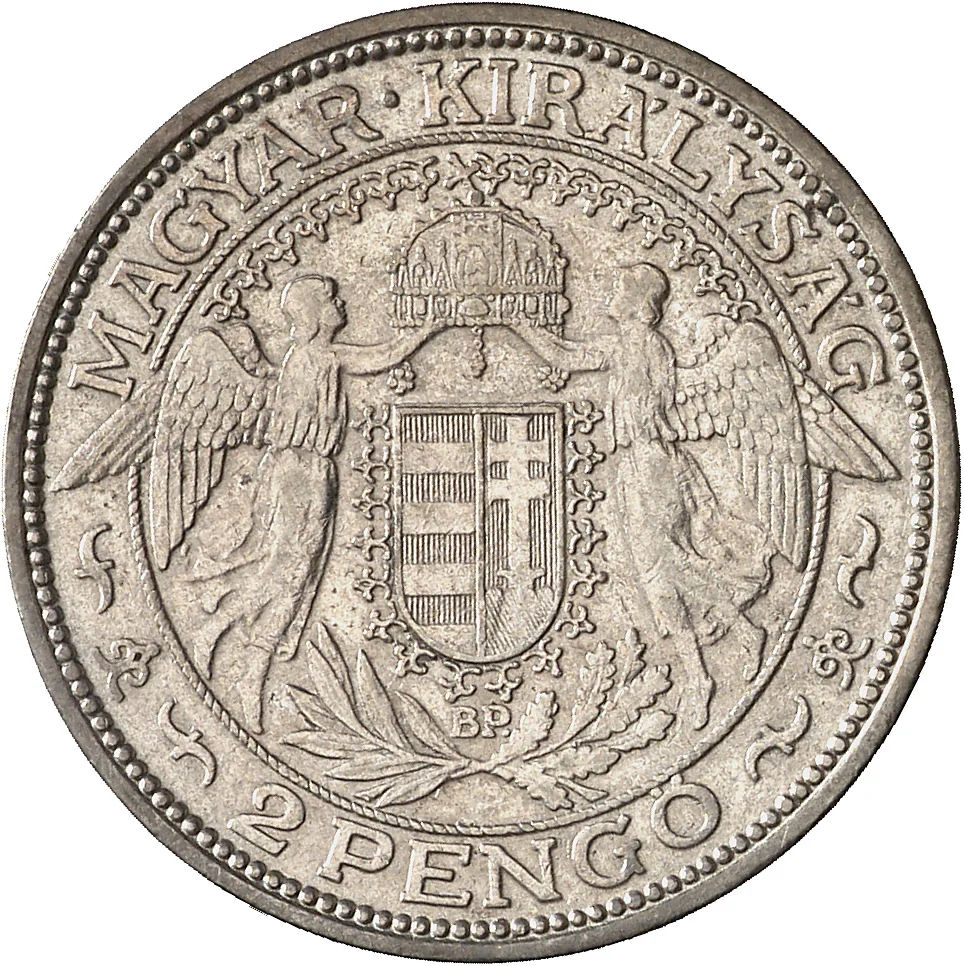
Obverse
Description:
Arms with angels, value, mintmark
Inscription:
MAGYAR.KIRÁLYSÁG
2 PENGŐ
2 PENGŐ
Translation:
HUNGARIAN KINGDOM
2 PENGO
2 PENGO
Script: Latin
Language: Hungarian
Engraver: István Szentgyörgyi
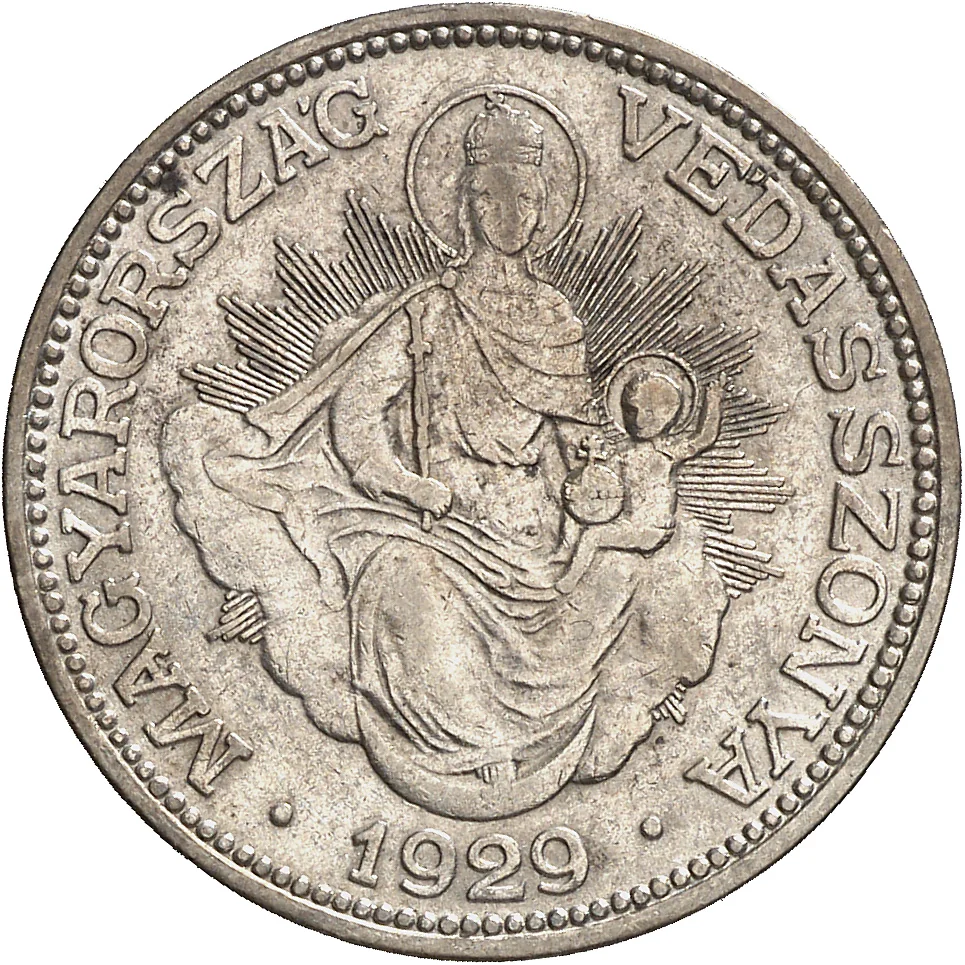
Reverse
Description:
Madonna and Child, mint year.
Inscription:
MAGYARORSZÁG VÉDASSZONYA
1937
1937
Translation:
Patroness of Hungary
Script: Latin
Language: Hungarian
Engraver: Vince Pittner
Edge
Repeated swirl
Mints
| Name | Mark |
|---|---|
| Hungarian mint | — |
Mintings
| Year | Mint Mark | Mintage | Quality | Collection |
|---|---|---|---|---|
| 1929 | BP | 5,000,000 | ||
| 1931 | BP | 110,000 | ||
| 1932 | BP | 602,000 | ||
| 1933 | BP | 1,051,000 | ||
| 1935 | BP | 50,000 | ||
| 1936 | BP | 711,000 | ||
| 1937 | BP | 1,500,000 | ||
| 1938 | BP | 6,417,000 | ||
| 1939 | BP | 2,103,000 |
Historical background
In 1929, Hungary’s currency situation was defined by the aftermath of World War I and the subsequent Treaty of Trianon (1920), which had dismantled the Austro-Hungarian Empire and left the new, much smaller Hungarian state with severe economic dislocation and a massive burden of reparations. To stabilize the economy, a comprehensive financial reconstruction was orchestrated by the League of Nations in 1924. This program included a large stabilization loan, which allowed Hungary to introduce a new, fully convertible currency in 1927: the pengő, replacing the utterly collapsed korona. The pengő was placed on a gold exchange standard, pegged to both gold and foreign currencies, and was initially successful in halting hyperinflation and restoring international confidence.
However, by 1929, the structural weaknesses of this stabilization were becoming apparent. The Hungarian economy remained fragile, heavily dependent on agricultural exports and foreign capital. The pengő’s stability was underpinned not by robust domestic production but by the continuous inflow of foreign loans, creating a vulnerable debt-dependent equilibrium. Furthermore, the country struggled with a persistent budget deficit and a large, inefficient state sector, pressures that the rigid gold-standard currency regime made difficult to address through monetary policy.
Consequently, when the Great Depression struck in late 1929, Hungary was exceptionally exposed. The global collapse in agricultural prices devastated its export earnings, while the simultaneous drying up of international credit flows removed the essential prop for the pengő. The year 1929 thus represents the precarious end of a brief period of artificial stability, setting the stage for the severe economic crisis of the early 1930s, which would eventually force Hungary to abandon the gold standard and see the pengő begin its long, troubled decline.
However, by 1929, the structural weaknesses of this stabilization were becoming apparent. The Hungarian economy remained fragile, heavily dependent on agricultural exports and foreign capital. The pengő’s stability was underpinned not by robust domestic production but by the continuous inflow of foreign loans, creating a vulnerable debt-dependent equilibrium. Furthermore, the country struggled with a persistent budget deficit and a large, inefficient state sector, pressures that the rigid gold-standard currency regime made difficult to address through monetary policy.
Consequently, when the Great Depression struck in late 1929, Hungary was exceptionally exposed. The global collapse in agricultural prices devastated its export earnings, while the simultaneous drying up of international credit flows removed the essential prop for the pengő. The year 1929 thus represents the precarious end of a brief period of artificial stability, setting the stage for the severe economic crisis of the early 1930s, which would eventually force Hungary to abandon the gold standard and see the pengő begin its long, troubled decline.
🌱 Common