

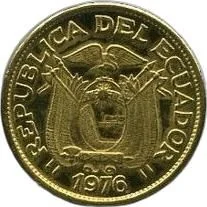
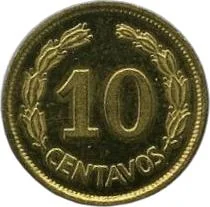
10 centavos – Ecuador
Add to wishlist
Ecuador
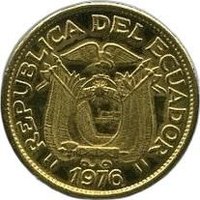
Obverse
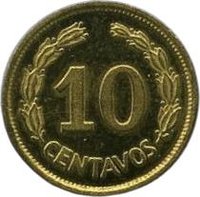
Reverse
Edge
Categories
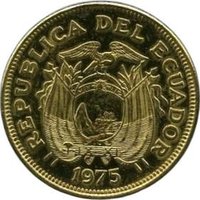
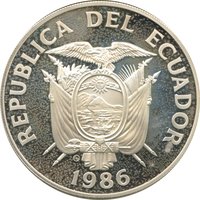
| Symbols> Coat of Arms |
| Symbol> Wreath |
Mints
| Name | Mark |
|---|---|
| Monnaie de Paris | — |
Mintings
| Year | Mint Mark | Mintage | Quality | Collection |
|---|---|---|---|---|
| 1976 | — | — |
Historical background
In 1976, Ecuador's currency situation was characterized by relative stability under the sucre, which had been the national currency since 1884. The country was in the midst of an oil boom, following the discovery and export of significant petroleum reserves in the Amazon region starting in 1972. This influx of petrodollars provided the military government, led by General Guillermo Rodríguez Lara (and later the Supreme Council from 1976), with substantial foreign reserves. This financial cushion allowed the government to maintain a fixed exchange rate, manage imports, and fund ambitious public works and industrialization projects without immediate pressure to devalue the currency.
However, this stability was superficial and masked underlying economic vulnerabilities. The oil wealth led to "Dutch disease," where a heavy reliance on a single export commodity caused the national currency to become overvalued. This overvaluation made non-oil exports, like bananas and coffee, less competitive on the global market and encouraged a surge in imports, which began to hurt domestic industries. Furthermore, the government's expansive spending policies fueled inflation, which began to erode purchasing power domestically despite the stable official exchange rate.
Consequently, by 1976, the first signs of future currency troubles were emerging. While a major devaluation of the sucre would not occur until the 1980s, the economic distortions of the oil boom were setting the stage for later crises. The fixed exchange rate regime was becoming increasingly difficult to sustain as internal inflation diverged from global prices. The year thus represents a pivotal point of apparent strength, but one that was built on unstable, mono-export foundations, presaging the severe debt and currency crises that would engulf Ecuador and much of Latin America in the following decade.
However, this stability was superficial and masked underlying economic vulnerabilities. The oil wealth led to "Dutch disease," where a heavy reliance on a single export commodity caused the national currency to become overvalued. This overvaluation made non-oil exports, like bananas and coffee, less competitive on the global market and encouraged a surge in imports, which began to hurt domestic industries. Furthermore, the government's expansive spending policies fueled inflation, which began to erode purchasing power domestically despite the stable official exchange rate.
Consequently, by 1976, the first signs of future currency troubles were emerging. While a major devaluation of the sucre would not occur until the 1980s, the economic distortions of the oil boom were setting the stage for later crises. The fixed exchange rate regime was becoming increasingly difficult to sustain as internal inflation diverged from global prices. The year thus represents a pivotal point of apparent strength, but one that was built on unstable, mono-export foundations, presaging the severe debt and currency crises that would engulf Ecuador and much of Latin America in the following decade.
✨ Legendary